Portuguese Prepper
How much emergency water do you actually need?
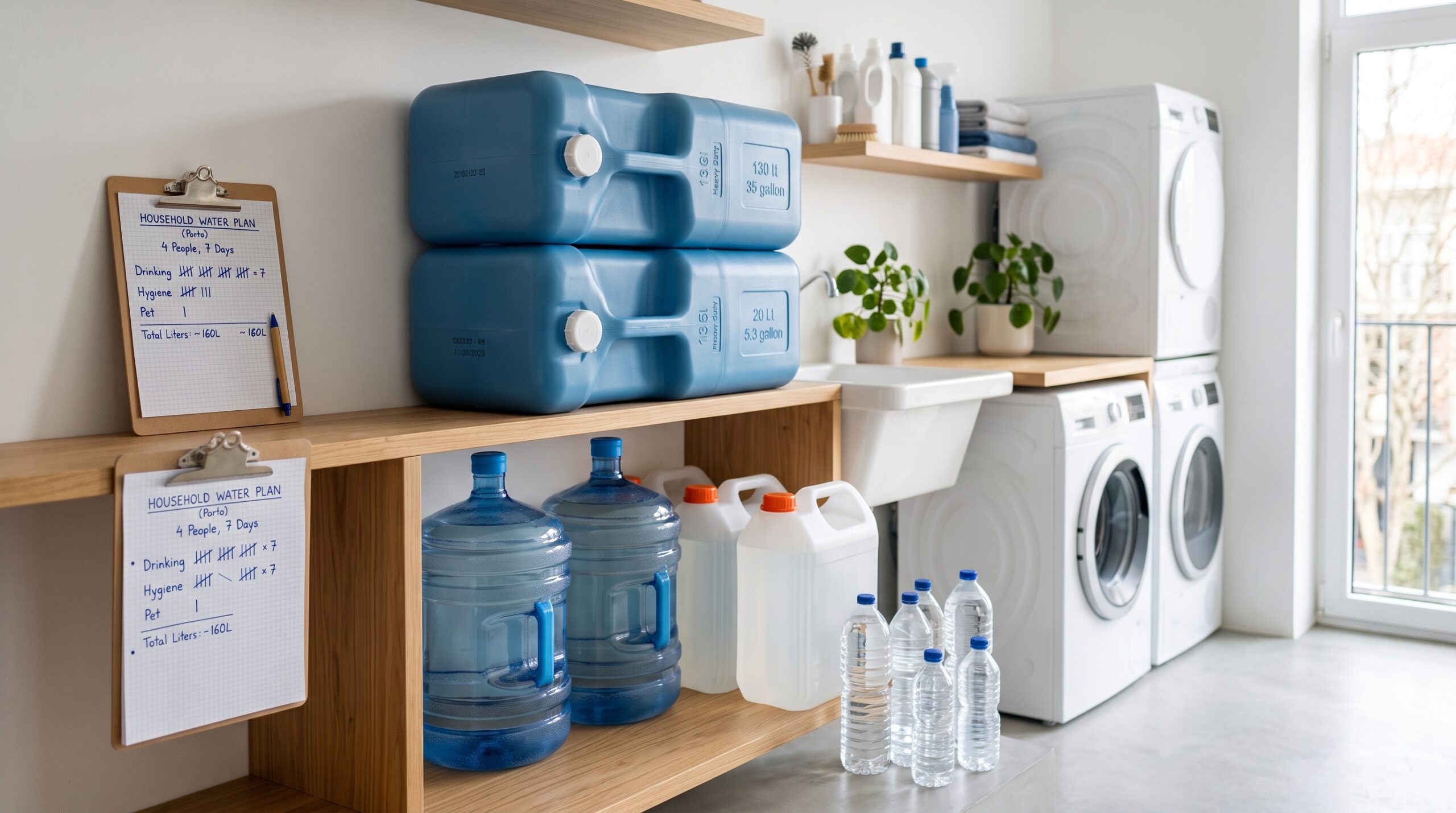
Short answer: if you are deciding how much water to store, start with at least 1 US gallon (about 3.8 litres) per person per day for at least three days. CDC recommends trying to store a two-week supply when possible. Store more for hot climates, pregnancy, illness, pets and higher activity.
That baseline includes water for drinking and basic sanitation. It is a planning minimum, not a guarantee that every household will use exactly the same amount.
Emergency water calculator
People × days × 3.785 L = baseline stored water.
| Household | 3 days | 7 days | 14 days |
|---|---|---|---|
| 1 person | 11.4 L | 26.5 L | 53.0 L |
| 2 people | 22.7 L | 53.0 L | 106 L |
| 4 people | 45.4 L | 106 L | 212 L |
| 6 people | 68.1 L | 159 L | 318 L |
Round upward when choosing containers. Water weighs approximately 1 kg per litre, so a 212-litre reserve contains roughly 212 kg of water before container weight is added.
Why the two-week target gets difficult quickly
For a four-person household, a two-week baseline is about 56 US gallons, or 212 litres. This is why emergency water planning is partly a storage and handling problem. One very large container may be space-efficient but impossible to move; several smaller food-grade containers distribute the reserve and make daily access easier.
For apartments, consider floor loading, leak consequences and whether every household member can lift the filled containers. A mixed system of smaller portable containers plus a larger static reserve is often more practical than using one size exclusively.
Who needs more than the baseline?
CDC specifically notes that needs vary according to age, health, physical condition, activity, diet and climate. Children, pregnant people, people who are ill and people living in hot climates may need more. Pets also need their own supply.
If your preparedness plan includes strenuous evacuation, high heat or substantial cooking and hygiene needs, build margin above the baseline instead of treating 3.8 L/day as a hard ceiling.
What containers should you use?
CDC recommends food-grade water-storage containers. Before filling, clean and sanitize them according to appropriate guidance, label them as drinking water and store them in a cool location away from direct sunlight and toxic substances.
Do not use containers that previously held toxic chemicals. Commercially bottled water is also an option; keep it in the original sealed container and follow the manufacturer’s date and storage information.
How often should stored water be replaced?
For water you fill yourself, CDC recommends replacing it every six months. This is different from claiming that stored water must simply be “treated” every six or twelve months. For commercially bottled water, follow the manufacturer’s date and storage instructions.
Inspect containers periodically for leaks, damaged seals or contamination and replace questionable water rather than relying only on the calendar.
Stored water first; treatment is the backup layer
A filter or disinfectant does not eliminate the need for stored safe water. Treatment equipment becomes valuable when your stored supply is depleted or you must use an uncertain source.
Different treatment methods address different hazards. Do not assume that every portable filter removes viruses, chemicals, salt or all other contaminants. Match the treatment method to the source and follow current manufacturer and public-health guidance.
Do not plan around swimming-pool water
A swimming pool should not be treated as an automatic source of drinking water. Pool water may contain disinfectants and other chemicals at concentrations or combinations that ordinary portable filters are not designed to remove. Keep a dedicated potable-water reserve and identify safer backup sources in advance.
A practical household strategy
- Calculate the three-day baseline using 3.785 L per person per day.
- Increase toward a 14-day reserve as space and budget permit.
- Add water for pets and extra margin for heat, health or activity.
- Split the reserve into containers household members can safely handle.
- Keep treatment equipment as a second layer rather than substituting it for stored water.
- Replace self-filled water every six months and inspect the storage system regularly.
Sources and methodology
Quantities on this page use the CDC baseline of at least one US gallon per person per day and convert US gallons at 3.785 litres per gallon. Rounded figures are intended for practical planning.
Reviewed: September 2026.
Related pages
Affiliate disclosure: If you buy through qualifying links on this site, we may earn a commission at no extra cost to you. Editorial recommendations are based on preparedness suitability and documented specifications rather than commission availability.