
Portuguese Prepper
How to Store Emergency Water in an Apartment or Small Home
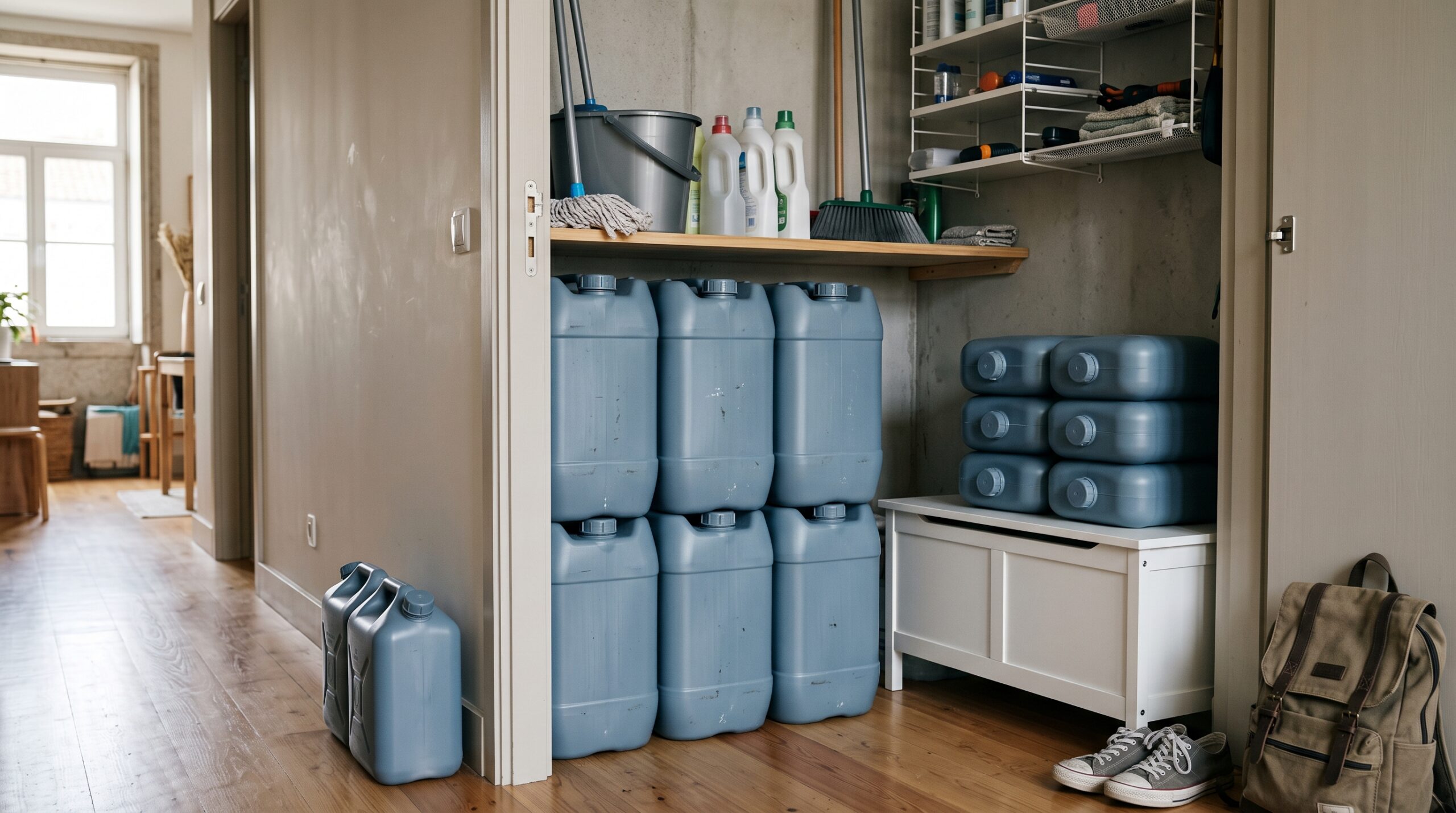
Short answer: emergency water storage for apartments does not require a garage, basement, or 55-gallon drum. In an apartment or small home, the most practical strategy is decentralized water storage: use several smaller food-grade containers distributed between closets, under-bed spaces, cabinets, and other suitable storage areas.
Affiliate disclosure: This page contains affiliate links. If you purchase through these links, we may earn a commission at no additional cost to you. As an Amazon Associate I earn from qualifying purchases.
Our Apartment Water Storage Picks
Start with manageable, food-grade containers that fit your available storage space. Spread the weight safely and check floor-load limits before choosing large-capacity storage.
BEST FOR SMALL SPACES
WaterBrick 3.5-Gallon Container
A compact, stackable option for dividing an apartment’s emergency water supply into smaller, easier-to-place containers.
Find it on Amazon →PORTABLE ALTERNATIVE
Reliance Aqua-Tainer 7-Gallon Container
A larger rigid container with a dispensing option; remember that seven gallons of water alone weighs about 58 pounds (26 kg).
Find it on Amazon →
For emergency planning, the CDC recommends storing at least 1 gallon of water per person per day for at least 3 days and, when possible, building toward a 2-week supply. That water is intended for drinking, cooking, brushing teeth, and other essential uses. Some people, pets, and hot climates require more.
How much water should you store in an apartment?
Start with the emergency minimum and expand from there. At 1 gallon per person per day, the basic quantities are:
| Household | 3 Days | 7 Days | 14 Days |
|---|---|---|---|
| 1 person | 3 gallons | 7 gallons | 14 gallons |
| 2 people | 6 gallons | 14 gallons | 28 gallons |
| 3 people | 9 gallons | 21 gallons | 42 gallons |
| 4 people | 12 gallons | 28 gallons | 56 gallons |
If space is extremely limited, establish the 3-day supply first. Then expand toward 7 days and eventually 14 days rather than abandoning water storage because you cannot immediately accommodate a large reserve.
The best strategy: decentralized water storage
A large tank concentrates your entire water reserve in one place. Smaller containers let apartment dwellers use otherwise wasted spaces and make the supply easier to move.
Instead of asking, “Where can I put 30 gallons?”, ask where you can safely place 3 to 7 gallons at a time. A bedroom closet, pantry, under-bed area, utility cabinet, or another cool indoor location may each hold part of the total supply.
This also gives you redundancy. If one container leaks or becomes contaminated, you have not necessarily lost your entire emergency water reserve.
Best emergency water containers for apartments
Best for Closets: WaterBrick 3.5 Gallon
WaterBrick containers are designed to interlock and stack, making them particularly useful where floor space is limited. Each standard WaterBrick holds approximately 3.5 gallons and remains small enough to move individually.
They can be distributed between closets and other small storage spaces instead of requiring room for a conventional water barrel.
View on AmazonHigh-Capacity Option: AquaTank Water Storage Bladder
A flexible water bladder can provide substantial capacity without the rigid footprint of a barrel. The AquaTank is better considered a specialized high-capacity option rather than the default solution for every apartment.
Before filling a large bladder indoors, choose its location carefully. Water becomes extremely heavy, and moving a large filled bladder may be impractical. Follow the manufacturer’s instructions for filling, placement, storage, and sanitation.
View on AmazonBest Portable Option: Reliance Aqua-Tainer 7 Gallon
A rigid 7-gallon container is a useful middle ground between small modular containers and bulk storage. It provides meaningful capacity while remaining portable enough for many households to handle.
This format works particularly well for a pantry, utility area, closet floor, or other location where stacking efficiency is less important than having one self-contained water reserve.
View on AmazonBackup Capacity: Collapsible Water Container
Collapsible containers take up very little space while empty, making them useful as supplemental capacity when you have advance warning of a storm, planned water shutdown, or other developing emergency.
But an empty container is not stored water. Do not count collapsible containers toward your minimum emergency supply unless they are already filled.
View on AmazonQuick comparison: which container works best?
| Option | Best Use | Main Advantage | Main Limitation |
|---|---|---|---|
| WaterBrick 3.5 Gallon | Closets and modular storage | Stackable and individually portable | Multiple containers needed for a large reserve |
| AquaTank Bladder | High-capacity storage | Large volume in a flexible format | Difficult to move once filled |
| Reliance Aqua-Tainer 7 Gallon | General home storage | Good balance of capacity and portability | Larger footprint than modular containers |
| Collapsible Container | Backup/last-minute capacity | Almost no storage space when empty | Provides no emergency water until filled |
Where should you store emergency water in an apartment?
Look for cool, indoor locations away from direct sunlight, chemicals, fuels, pesticides, and other contaminants. The objective is not to find one perfect storage area but to identify several usable spaces.
- Closet floors: particularly suitable for stackable containers.
- Under beds: useful for low-profile containers when the product is designed and positioned appropriately.
- Pantries: good for smaller rigid containers that you rotate regularly.
- Utility storage: potentially useful if temperatures remain appropriate and household chemicals are kept separate.
- Behind or beneath furniture: possible for suitable sealed containers where they remain accessible and protected from damage.
Keep enough water accessible that you can retrieve it without dismantling your apartment during an emergency.
Water is heavier than it looks
One U.S. gallon of water weighs roughly 8.3 pounds before including the container itself. That means approximately:
| Water Volume | Approximate Water Weight |
|---|---|
| 3 gallons | 25 lb |
| 5 gallons | 42 lb |
| 7 gallons | 58 lb |
| 14 gallons | 116 lb |
| 30 gallons | 249 lb |
| 50 gallons | 415 lb |
This is another reason modular storage makes sense in a small home. Smaller containers can be distributed and handled individually rather than concentrating the entire supply in one very heavy container.
Do not assume that a particular floor, shelf, bed frame, or piece of furniture can safely support a large water load. If you have concerns about structural capacity—particularly in an older building or when considering high-capacity storage—consult the property owner, building manager, or an appropriately qualified professional.
Stored water vs. emergency fill-up capacity
These are two different parts of a preparedness plan.
Stored water is already available when the tap stops working. This should cover at least your initial emergency requirement.
Fill-up capacity consists of empty collapsible containers, bathtub storage systems, and other vessels that can dramatically increase your reserve when you receive advance warning.
For example, a household could keep 14 gallons permanently stored in rigid containers and several empty collapsible containers nearby. If authorities announce a storm or planned interruption while the water supply remains safe, those additional containers can be filled before service is lost.
The second layer is useful, but it should not replace the first: earthquakes, infrastructure failures, contamination incidents, and other emergencies may provide no opportunity to fill containers beforehand.
How to store water safely
For water you fill yourself, the CDC recommends using food-grade water-storage containers when possible. Containers should be cleaned and sanitized before use, tightly closed after filling, labeled, and stored appropriately.
The CDC recommends replacing water that you fill yourself every 6 months. Commercially bottled water should be stored according to its labeling and expiration or best-by information.
Never use containers that previously held toxic chemicals. If stored water may have become contaminated, do not assume that appearance, smell, filtration, or boiling alone can make every type of contamination safe.
A practical apartment water-storage plan
For one person living in a small apartment, a sensible progression could look like this:
- Stage 1 — 3 gallons: establish the minimum 72-hour reserve.
- Stage 2 — 7 gallons: build toward one week of basic emergency water.
- Stage 3 — 14 gallons: reach a two-week baseline if space permits.
- Stage 4 — Extra capacity: add collapsible containers or another temporary storage method for emergencies with advance warning.
- Stage 5 — Treatment backup: maintain an appropriate method for treating additional water if the stored supply is exhausted.
For two people, double those water quantities. Larger households can use the same method while distributing containers across more storage locations.
Frequently asked questions
How much emergency water should I store in an apartment?
Store at least 1 gallon per person per day for at least 3 days. If space permits, work toward a 2-week supply. Store additional water for pets and where household needs, health conditions, or climate require it.
What is the best water container for a small apartment?
There is no single best container for every apartment. Stackable 3.5-gallon WaterBricks work well for modular closet storage, while a 7-gallon Aqua-Tainer provides more capacity per container. A combination of container types is often more space-efficient than relying on one large tank.
Can I store emergency water under my bed?
Yes, if the container is suitable for water storage, physically fits the space, remains protected from damage, and the supporting structure can safely accommodate the weight. WaterBrick specifically identifies under-bed storage as one possible use for its containers.
Are collapsible water containers good for emergencies?
They are useful as supplemental capacity because they require little storage space when empty. However, they should not be counted as part of your ready-to-use emergency water reserve unless they are already filled.
How often should stored tap water be replaced?
The CDC recommends replacing water stored in containers you fill yourself every 6 months.
Is a 55-gallon water barrel practical in an apartment?
Usually not. A 55-gallon volume of water alone weighs roughly 457 pounds, before adding the container. Large stationary storage also reduces portability and concentrates the supply in one location. Smaller modular containers are generally more practical for apartment preparedness.
Sources and methodology
Emergency-water recommendations on this page are based primarily on current CDC and Ready.gov guidance. Product-specific claims are separated from general preparedness recommendations, and container choice should always account for the manufacturer’s current instructions.
- CDC — How to Create and Store an Emergency Water Supply
- CDC — Safe Water Storage
- Ready.gov — Build an Emergency Supply Kit
- WaterBrick — Product Specifications
- WaterBrick — Owner’s Manual
Reviewed: September 2026. Product specifications, availability, and official preparedness guidance can change; verify current information before purchase or long-term storage.