
Portuguese Prepper
Best Water Containers for Emergency Storage: Scepter vs. WaterBrick
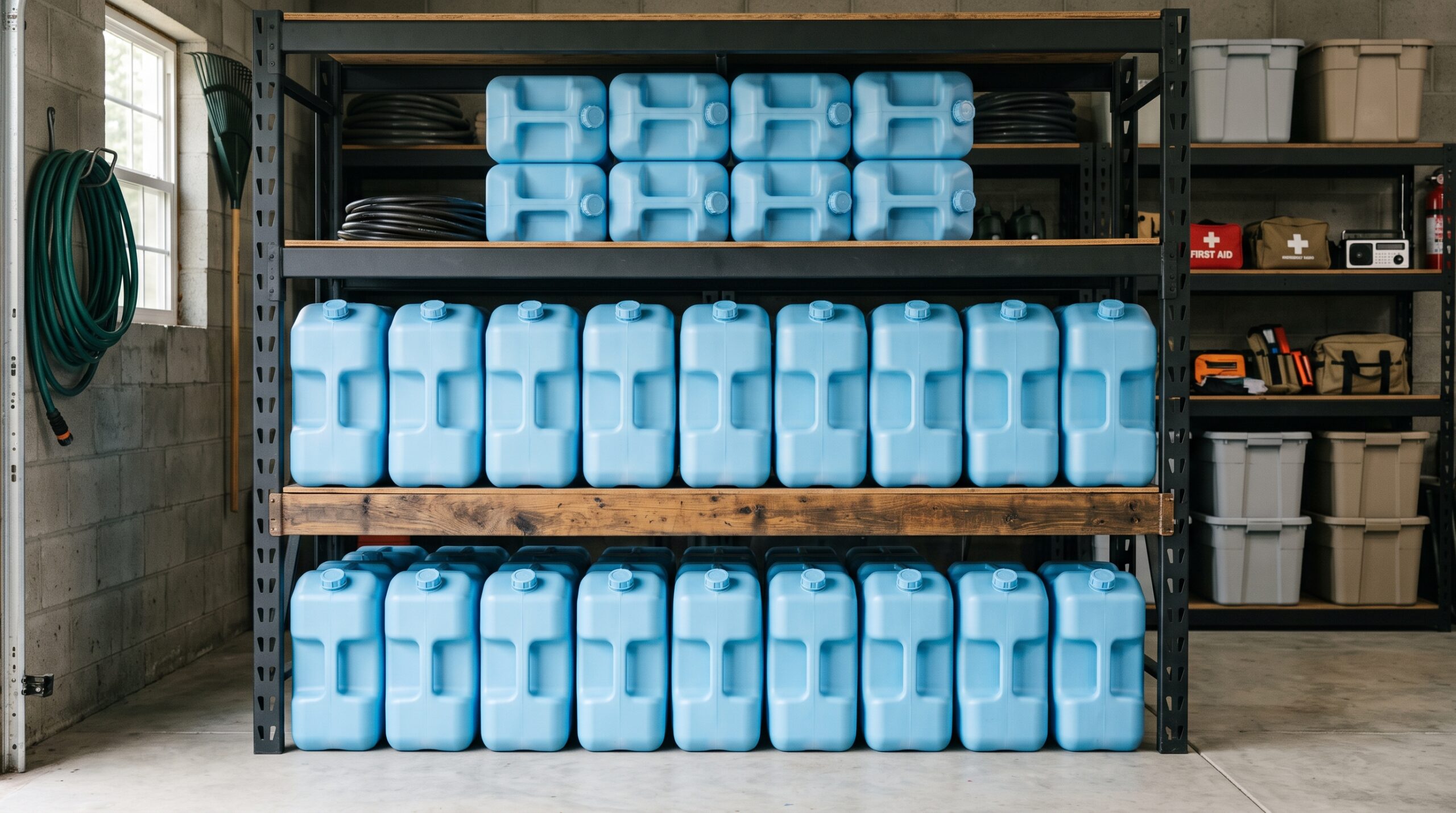
Short answer: choose the container around how you will store and move the water. WaterBrick’s interlocking 3.5-gallon format is particularly useful where floor space and modular stacking matter. A Scepter 5-gallon water can is better suited to carrying and vehicle transport. Reliance Aqua-Tainer is a larger-capacity budget alternative for mostly static storage.
Affiliate disclosure: This page contains affiliate links. If you purchase through these links, we may earn a commission at no additional cost to you. As an Amazon Associate I earn from qualifying purchases.
Our Emergency Water Storage Picks
Choose modular stacking for compact storage or a carrying-oriented water can for transport. Account for the weight of a full container.
MODULAR HOME STORAGE
WaterBrick 3.5-Gallon Container
Interlocking containers for modular storage where floor space and manageable individual capacity matter.
Find it on Amazon →CARRYING AND VEHICLE USE
Scepter 5-Gallon Water Can
A carrying-oriented format for emergency water transport. Check the exact model and filled weight before choosing it.
Find it on Amazon →
The overlooked specification is weight. Water weighs about 1 kg per litre (8.34 lb per US gallon), before the container itself is added. A 3.5-gallon WaterBrick therefore holds about 13.2 L / 13.2 kg of water; a 5-gallon can holds about 18.9 L / 18.9 kg; and a 7-gallon container holds about 26.5 L / 26.5 kg. Bigger is not automatically better if household members cannot safely move it.
Comparison at a glance
| Format | Nominal capacity | Water weight alone | Best use | Main tradeoff |
|---|---|---|---|---|
| WaterBrick | 3.5 US gal / ~13.2 L | ~13.2 kg / 29.2 lb | Modular indoor storage | More containers needed for the same total reserve |
| Scepter water can | 5 US gal / ~18.9 L | ~18.9 kg / 41.7 lb | Carrying and vehicle transport | Heavier when full |
| Reliance Aqua-Tainer | 7 US gal / ~26.5 L | ~26.5 kg / 58.4 lb | High-capacity static storage | Very heavy when full; should not be stacked when filled |
Weights above are calculated from water volume and exclude the empty container.
WaterBrick: best when modular storage matters
WaterBrick’s defining feature is its interlocking rectangular design. The manufacturer specifies a 3.5-gallon water capacity and markets the containers for stacking and emergency storage. That geometry can be useful in apartments, cupboards and other spaces where several smaller modules fit better than one large tank.
The smaller unit also keeps the water itself near 13 kg, which can be easier to handle than a full 5- or 7-gallon container. Do not interpret “stackable” as permission to build an arbitrarily tall tower: follow the manufacturer’s current stacking guidance and account for floor loading, stability, earthquakes or impact, and access.
Scepter: best when the water has to move
Scepter manufactures portable potable-water containers in the familiar jerry-can format. A 5-gallon / roughly 20-litre class container concentrates more water into one carryable unit and can be practical for vehicle transport, camping, evacuation planning, and situations where stored water may need to be moved.
The tradeoff is filled weight: approximately 19 kg / 42 lb of water before the can itself is included. Test whether the people in your household can actually lift, carry and pour from a full container before making it the basis of the entire water plan.
Reliance Aqua-Tainer: capacity at the expense of portability
A 7-gallon Aqua-Tainer stores about 26.5 litres in one container. That can reduce the number of containers required, but the water alone weighs roughly 26.5 kg / 58 lb. We therefore regard this size primarily as static or short-distance storage rather than the default choice for everyone.
There is also an important storage limitation: Reliance states that a filled Aqua-Tainer should not be stacked. The containers can be stacked when empty, but do not plan a filled-water storage system around vertical stacking.
How many containers does a household need?
CDC recommends storing at least 1 US gallon (about 3.8 L) per person per day for three days, and trying to store a two-week supply when possible. For a four-person household, the baseline is therefore 12 gallons for three days and 56 gallons for two weeks.
| Example reserve | WaterBrick 3.5 gal | 5-gal cans | 7-gal containers |
|---|---|---|---|
| ~14 gal | 4 | 3 (15 gal) | 2 |
| ~28 gal | 8 | 6 (30 gal) | 4 |
| 56 gal | 16 | 12 (60 gal) | 8 |
This is why a mixed system can work better than choosing one container exclusively: smaller units for daily access and carrying, larger units for bulk reserve.
What makes a good emergency water container?
For water stored at home, CDC recommends using food-grade water-storage containers. A suitable container should be made from durable material, have a top that can be closed tightly, and allow water to be dispensed without unnecessarily contaminating the stored supply.
Never use a container that previously held toxic chemicals. A container that looks clean is not automatically suitable for drinking-water storage if its previous contents could have contaminated the material.
Capacity also matters. Large containers reduce the number of individual vessels required, but they become increasingly difficult to move when full. For many households, several manageable containers are more useful than putting the entire emergency reserve into the largest containers available.
Cleaning and storing emergency water
CDC recommends using food-grade water-storage containers, cleaning and sanitizing containers before filling them, labeling them, storing them in a cool place away from direct sunlight and toxic substances, and replacing water that you fill yourself every six months. Commercially bottled water should be stored according to its original labeling and manufacturer guidance.
For containers without specific manufacturer sanitizing instructions, CDC recommends first washing the container with soap and rinsing it completely. A sanitizing solution can then be made using 1 teaspoon of unscented household liquid chlorine bleach containing 5%–9% sodium hypochlorite mixed with 1 quart (about 1 litre) of water. Close the container and shake it so the solution contacts all interior surfaces, wait at least 30 seconds, then pour the solution out and allow the empty container to air-dry before use.
Do not use containers that previously held toxic chemicals. Where the container manufacturer provides its own cleaning or sanitizing procedure, follow the instructions for that specific product.
Where should emergency water be stored?
Store emergency water in a cool location away from direct sunlight. Keep the containers away from gasoline, pesticides and other toxic substances that could contaminate the water or container.
Also consider the physical load created by stored water. A 56-gallon two-week reserve for four people represents roughly 467 lb / 212 kg of water before the containers and shelving are included. Distribute that weight appropriately and use shelving or storage locations capable of supporting the load.
Keep at least some of the reserve accessible. A large supply is less useful if every container is buried behind other emergency equipment or is too heavy for household members to move safely.
Can emergency water containers be stacked?
Do not assume that every rectangular water container is designed to be stacked while full. Stackability is a product-specific feature and the manufacturer’s current instructions should control how the container is stored.
WaterBrick is specifically designed around an interlocking, stackable format, but users should still follow the manufacturer’s current stacking guidance and consider stability and total load.
Reliance, by contrast, states that its Aqua-Tainer should not be stacked when filled. This distinction is important when planning a large reserve in a limited storage area.
Our recommendation by scenario
- Apartment or cupboard: WaterBrick when its modular footprint fits the available space.
- Vehicle evacuation: Scepter potable-water cans when carrying, vehicle transport and secure storage are priorities.
- Basement or garage reserve: larger containers such as Aqua-Tainer can be efficient if they rarely need to move, but filled Aqua-Tainers should not be stacked.
- Older adults, injuries or limited lifting capacity: favor smaller containers even if the cost per litre is higher.
- Best overall system: combine sizes rather than putting the entire reserve into containers that one person cannot move.
The Bottom Line
There is no single best emergency water container for every household. WaterBrick makes sense when modular storage and smaller individual containers are priorities. Scepter is a strong format when water needs to be carried or transported. Reliance Aqua-Tainer provides more capacity per container when portability is less important.
Before buying, calculate the total amount of water your household needs and then work backward to a combination of containers that you can safely store, access, carry and rotate.
The best emergency water system is not necessarily the one with the largest containers. It is the one your household can realistically store, maintain and use when normal water service is unavailable.
Sources and methodology
- CDC — How to Create and Store an Emergency Water Supply
- WaterBrick — manufacturer information
- Scepter — 5 Gallon / 20 Litre Water Can
- Reliance Outdoors — Product FAQs
Capacity conversions and filled-water weights on this page are calculated from nominal US-gallon capacity using 3.785 L per US gallon and approximately 1 kg per litre of water. They do not include container weight.
Reviewed: September 2026. Product specifications and availability can change, particularly between North American and European markets.