
Portuguese Prepper
Water purification tablets vs. bleach and calcium hypochlorite
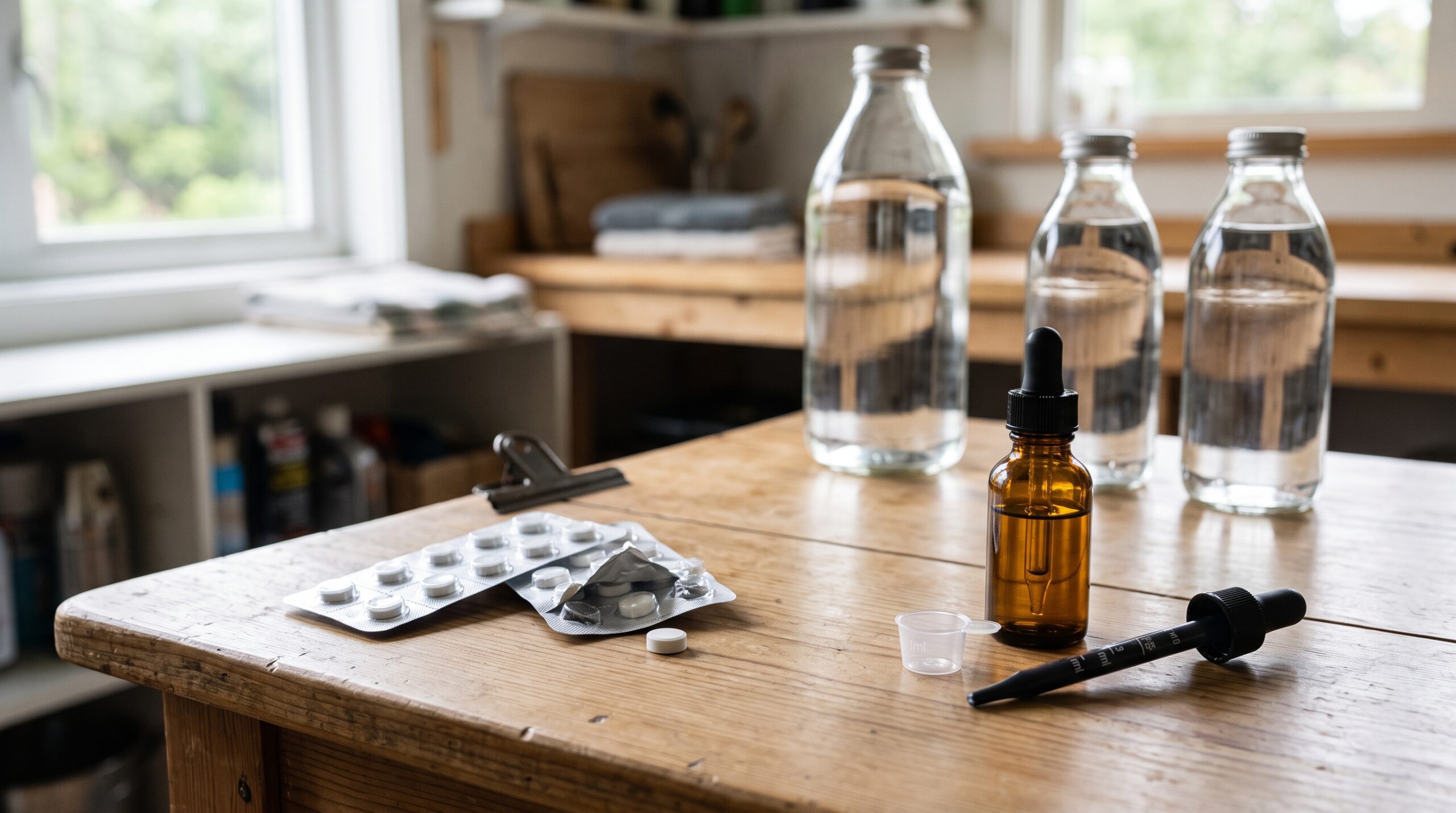
Short answer: for most emergency kits, commercially packaged water-disinfection tablets—such as Katadyn Micropur tablets or Potable Aqua germicidal tablets—are the simplest chemical backup because the dose is specified on the label. For household emergencies, fresh unscented chlorine bleach can disinfect water when used at the correct concentration. Granular calcium hypochlorite is an option recognized by the U.S. EPA, but it is a powerful oxidizer and requires a two-step preparation process, accurate measurement and careful storage.
Affiliate disclosure: This page contains affiliate links. If you purchase through these links, we may earn a commission at no additional cost to you. As an Amazon Associate I earn from qualifying purchases.
Our Emergency Water Disinfection Tablet Picks
Commercially packaged tablets are the simpler chemical backup for most emergency kits. Follow the exact product label for water volume, contact time and limitations. Boiling remains preferable when practical; chemical treatment does not make chemically contaminated water safe.
PORTABLE TABLET OPTION
Aquatabs Water Purification Tablets
Packaged disinfection tablets for use according to the specific product directions and water-treatment limitations.
Find it on Amazon →ALTERNATIVE TABLET OPTION
Katadyn Micropur Tablets
An alternative packaged tablet treatment. Check the exact formulation, required contact time and organisms covered on its label.
View Katadyn Micropur →
Boiling is preferred when practical. CDC says boiling is the best method for killing germs in emergency water. Chemical disinfection kills many bacteria and viruses but has important limitations, particularly with some parasites. None of these methods makes water contaminated with fuel, toxic chemicals, heavy metals or salts safe to drink.
Which method should you use?
| Method | Best use | Main advantage | Main limitation |
|---|---|---|---|
| Boiling | Home/basecamp when heat is available | CDC’s preferred emergency method for killing germs | Needs fuel/energy; does not remove chemicals, salts or heavy metals |
| Commercial tablets/drops | Bug-out bag, travel, vehicle kit | Compact and pre-dosed for a specified water volume | Performance and waiting time depend on active ingredient/product |
| Unscented household bleach | Household emergency backup | Widely available | Concentration varies and liquid bleach loses strength with storage |
| Granular calcium hypochlorite | Advanced preparedness where it can be safely stored and measured | Concentrated dry chlorine source | Powerful oxidizer; requires stock-solution preparation and careful handling |
Commercial purification tablets: the simplest portable option
CDC advises following the package directions for chlorine dioxide, chlorine or iodine tablets/drops because products have different strengths and treatment times. Do not assume that every tablet is “one tablet per liter” or that every product works in 30 minutes.
The active ingredient matters. CDC notes that iodine and ordinary chlorine tablets kill many germs but do not kill Cryptosporidium. Chlorine dioxide tablets can kill Cryptosporidium when the product instructions are followed correctly. People who are pregnant, have thyroid problems or are hypersensitive to iodine should avoid iodine-disinfected water, and CDC advises against drinking iodine-treated water for more than a few weeks.
Portable option: Aquatabs
A compact chemical-disinfection option. Verify the exact tablet strength, water volume and contact time on the package you purchase rather than using a generic dose.
Find it on AmazonHousehold bleach: useful, but concentration matters
CDC and EPA both permit regular, unscented household chlorine bleach for emergency disinfection when boiling is not possible. Use only bleach suitable for disinfection/sanitization and check the sodium-hypochlorite concentration on the label. Do not use scented, color-safe bleach or products with added cleaners.
For example, EPA’s current guidance lists 8 drops of 6% bleach per gallon of clear water or 6 drops of 8.25% bleach per gallon, followed by mixing and at least 30 minutes of contact time. If water is cloudy, colored or very cold, EPA instructs users to double the amount. Because bleach products vary, use the official concentration table rather than memorizing one universal number.
EPA recommends fresh liquid chlorine bleach, or bleach stored at room temperature for less than one year, for this purpose. That is a more defensible planning rule than claiming every bottle becomes useless at a fixed 6- or 12-month date.
Calcium hypochlorite: an advanced option, not a casual “pool shock hack”
EPA also describes emergency disinfection using high-test granular calcium hypochlorite (HTH). Its method first creates an approximately 500 mg/L chlorine stock solution and then dilutes that stock solution into the water being treated. EPA specifically warns that HTH is a very powerful oxidant and says to follow label instructions for safe handling and storage.
For that reason, we do not recommend buying an arbitrary bag of “pool shock” based only on a percentage printed on the front. Pool products can have different formulations and additives. If you choose calcium hypochlorite for emergency planning, use a suitable product whose composition you can verify, keep its safety documentation, store it according to its label and keep EPA’s current preparation instructions with it.
Advanced stockpile option: calcium hypochlorite
Potentially useful for experienced users who can verify the formulation, measure accurately and store a strong oxidizer safely. Not our first recommendation for a basic household kit.
Cloudy water must be clarified first
Disinfection is less effective in cloudy or colored water. CDC and EPA advise allowing cloudy water to settle and filtering it through a clean cloth, paper towel or coffee filter before chemical disinfection. This clarification step removes visible material; it does not by itself make the water microbiologically safe.
What chemical disinfection cannot fix
Do not use these instructions for water contaminated by fuel, toxic chemicals or other hazardous substances. EPA states that boiling and disinfection do not destroy contaminants such as heavy metals, salts and most other chemicals. CDC similarly warns that water containing fuel or toxic chemicals cannot be made safe simply by treating it.
During an official boil-water, do-not-drink or do-not-use advisory, follow the instructions from local authorities. Their advice takes priority over a generic preparedness method because the actual contaminant determines what treatment is appropriate.
Our preparedness recommendation
Store safe drinking water first. Keep a boiling method as the primary treatment backup when practical. Add a correctly labeled commercial disinfectant product to mobile kits. Fresh unscented household bleach can provide a household backup if you know its concentration and retain the correct dosing table. Reserve granular calcium hypochlorite for people prepared to manage the additional measurement, handling and storage requirements.
Sources and methodology
Because incorrect water-treatment instructions can cause illness, this page prioritizes public-health guidance over product marketing. Dosages can change with concentration and formulation, so verify the current label and official guidance before treatment.
- CDC — How to Make Water Safe in an Emergency
- U.S. EPA — Emergency Disinfection of Drinking Water
- CDC — Drinking Water Advisories
Reviewed: September 2026. This is emergency-preparedness information, not a substitute for instructions from your local water or public-health authority.