
Portuguese Prepper
Faraday Protection for Emergency Electronics: What It Can and Cannot Do
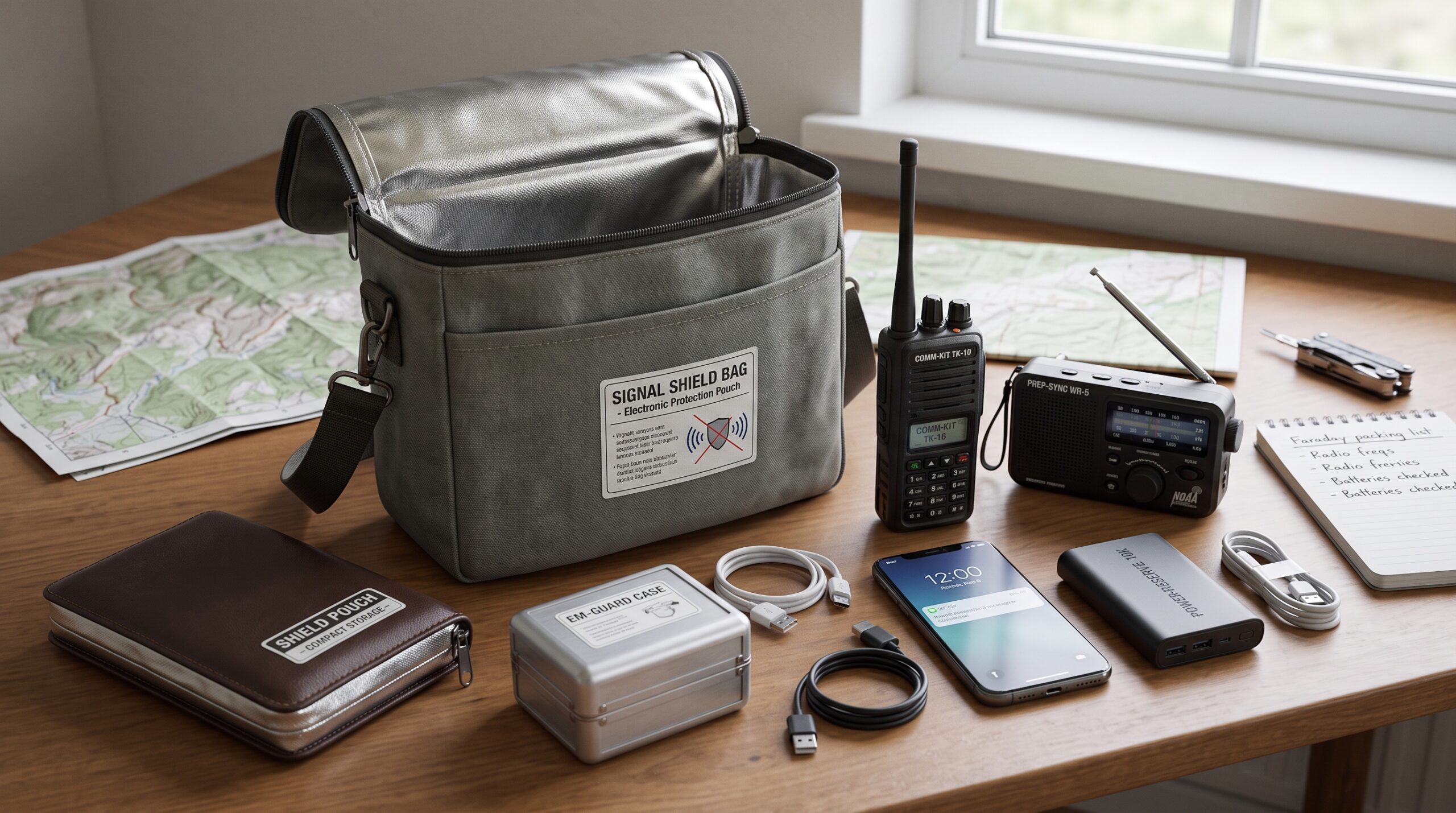
Short answer: a Faraday enclosure can reduce electromagnetic energy reaching electronics, but consumer bags and improvised metal containers do not provide a universal guarantee against every electromagnetic threat. Protection depends on shielding effectiveness across relevant frequencies, conductive continuity, seams, closures, penetrations and how the equipment is stored.
It is also important to separate different hazards. A high-altitude electromagnetic pulse, ordinary electrostatic discharge and a geomagnetic storm are not the same event. NOAA explains that geomagnetic storms are especially important to long conductive systems such as electric power grids and pipelines, while space weather can also disrupt satellites, GPS and radio communications.
What a Faraday enclosure actually does
A conductive enclosure can attenuate external electromagnetic fields by providing a path for induced currents around the protected space. The practical result depends on the quality of the enclosure. Gaps, poorly conducting seams, cables that pass through the shield and imperfect closures can reduce attenuation.
That is why the phrase “Faraday bag” describes a concept and product category, not a guaranteed performance level. Two products that look similar can provide very different shielding at different frequencies.
What should you protect?
If electromagnetic resilience is part of your plan, prioritize small backup electronics that have a clear emergency role and can remain disconnected while stored: a spare radio, an offline storage device, a compact navigation receiver, selected charging electronics or other redundant equipment. Protecting every electronic device in the house is neither necessary nor practical.
Store the protected item with the accessories needed to make it useful, such as charging cables, compatible batteries or written operating instructions. A shielded radio without a usable power source is not a complete backup.
Professional bags vs. improvised containers
Commercial shielding bags can be convenient because they are designed around repeated opening and closing. Their value depends on documented shielding performance and correct closure. Improvised metal containers may also reduce electromagnetic coupling, but effectiveness varies with construction and should not be assumed from appearance alone.
If you choose a consumer shielding product, look for test data that specifies attenuation across frequency ranges rather than vague “military grade” language. Inspect the closure and conductive layers for damage, and avoid routing powered cables through the enclosure unless the system was specifically designed for that purpose.
Faraday storage is only one layer
The more broadly useful preparedness strategy is redundancy. Keep spare electronics disconnected when not needed, maintain independent power options, store critical information offline and preserve non-electronic alternatives where practical. A paper map, printed contact list or manual procedure cannot be disabled by a dead battery.
For space-weather events, monitor official alerts. NOAA’s Space Weather Prediction Center tracks conditions that can affect power systems, satellites, radio communication and navigation.
The bottom line
Faraday-style storage can be a reasonable protective layer for selected backup electronics, but it should not be marketed as certainty. Focus on documented shielding, proper storage technique and system redundancy rather than the idea that putting a device in any metal bag makes it “EMP proof.”
Sources reviewed: NOAA Space Weather Prediction Center and U.S. infrastructure EMP-resilience guidance. Reviewed: September 2026.