Portuguese Prepper
The PACE Plan: Your Family’s Emergency Communication Protocol
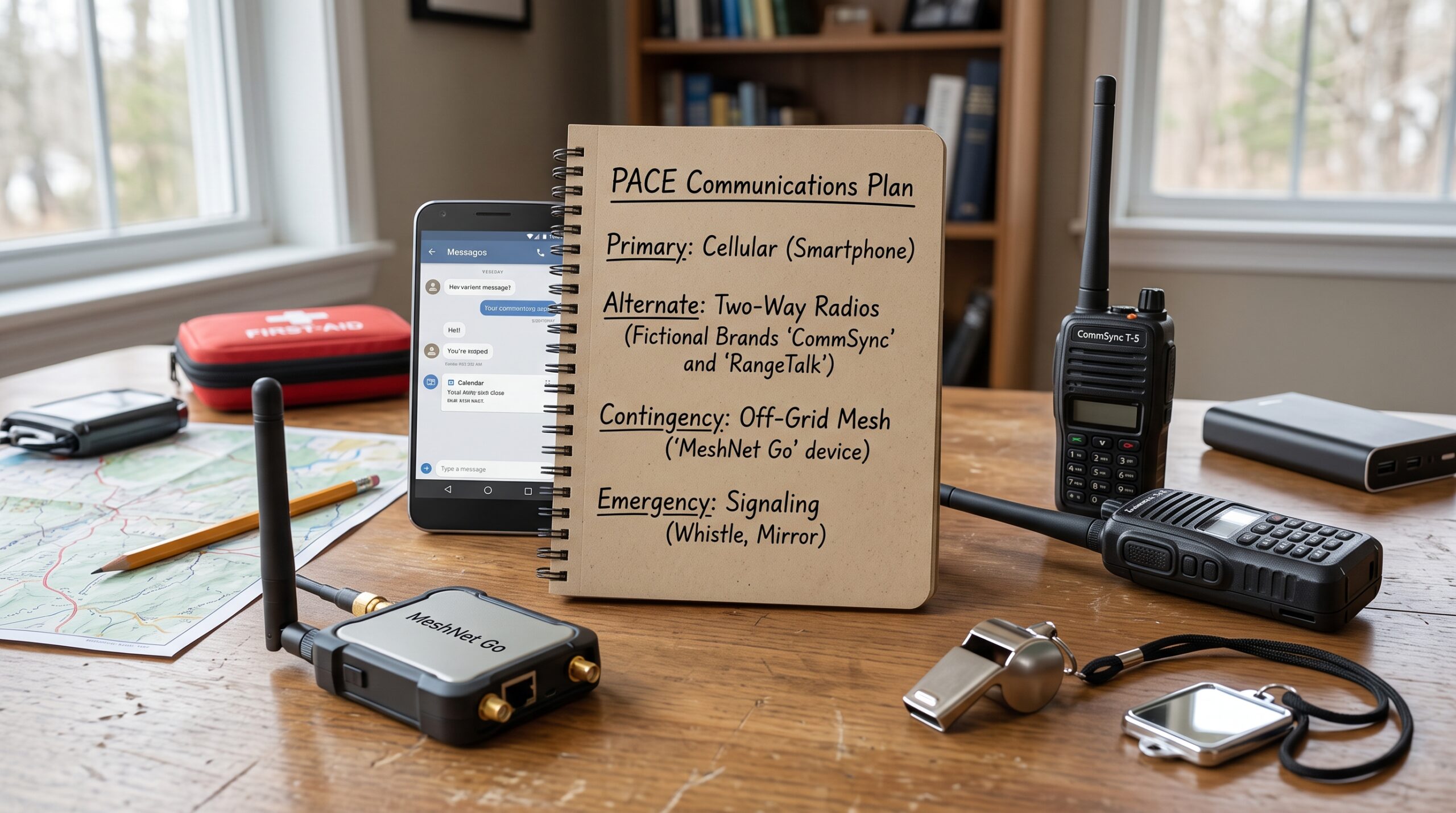
Having a radio in a drawer is not a communication plan. In an acute emergency, equipment is useless if your family does not know which channel to monitor, when to turn it on, or where to meet if electronic devices fail. A PACE Plan is the recognized military-grade methodology for establishing fail-safe communication redundancy across four structured tiers: Primary, Alternate, Contingency, and Emergency.
The Core Philosophy of PACE
Originating in military operational planning and adopted by disaster management agencies, PACE is fundamentally an order of operation, not a checklist of survival gadgets. You only transition to the next letter when the preceding method becomes physically impossible or dangerous to operate:
- Primary (P): Your standard, fastest, everyday communication method.
- Alternate (A): A reliable, secondary method with different infrastructure dependencies.
- Contingency (C): An independent, tactical off-grid capability that functions when local utilities and internet collapse.
- Emergency (E): The low-tech last resort when all electrical systems and transmitters are exhausted.
Why Communications Fail in Disasters
Modern communication networks create a dangerous illusion of permanence. During a severe crisis, civilian networks degrade rapidly across three distinct failure modes:
- Cellular Network Congestion: Within minutes of a major shock (earthquake, storm, civil disturbance), call volumes spike by 500% to 1,000%. Cell towers remain powered but reject connection requests due to circuit exhaustion.
- Backhaul & Internet Outages: Cell towers require fiber-optic backhaul and internet routing. Physical line cuts or server failures disable VoIP services, WhatsApp, Signal, and mobile data even if towers broadcast signal bars.
- Grid Power Depletion: Cellular base stations rely on commercial power with backup batteries designed to last only 4 to 24 hours. In an extended blackout, localized coverage collapses progressively tower by tower. Sizing a reliable backup battery system using our emergency power sizing calculator ensures your essential handheld devices remain chargeable.
The Four Tiers of a Family PACE Plan
1. Primary (The Everyday Channel)
This is how your family communicates 99% of the time under normal conditions.
Typical Equipment: Smartphones, voice calls, SMS text, and encrypted messaging apps (Signal, WhatsApp).
Strengths: Instant, high-bandwidth, global reach, zero training required.
When It Fails: Mobile tower congestion, carrier billing disruptions, or local ISP infrastructure cuts.
Operational Rule: During congestion, switch from voice calls to SMS. Text messages require minimal bandwidth and queue automatically in cellular buffers.
2. Alternate (The Off-Grid Digital Backup)
The moment terrestrial cell networks fail or congest, you transition to an independent digital layer.
Typical Equipment: Off-grid LoRa mesh networking such as Meshtastic nodes or dedicated satellite two-way messengers (Garmin InReach vs. Zoleo).
Strengths: Operates completely off-grid without mobile towers or internet backhaul; provides encrypted text delivery and GPS location sharing.
When It Fails: Severe overhead canopy, deep indoor/underground locations, or moving beyond line-of-sight LoRa node hops.
Affiliate disclosure: This page contains affiliate links. If you purchase through these links, we may earn a commission at no additional cost to you.
Heltec V3
An affordable compact Meshtastic-compatible node for building an independent LoRa messaging layer.
Find it on AmazonLILYGO T-Beam Supreme
A Meshtastic-oriented option with integrated GPS hardware for portable off-grid messaging and location sharing.
Find it on AmazonGarmin inReach
A dedicated satellite communicator for maintaining an Alternate communication path beyond terrestrial cellular coverage.
Find it on AmazonZOLEO Satellite Communicator
An alternative satellite communication device for extending messaging capability beyond cellular infrastructure.
Find it on Amazon3. Contingency (The Tactical Two-Way Radio)
In a true regional grid-down scenario where satellite services or mesh hops are unavailable, you shift to point-to-point radio frequency (RF) communications.
Typical Equipment: Handheld GMRS radios for localized family talk, dual-band Baofeng handheld radios, or amateur Ham Radio setups for long-range regional monitoring.
Strengths: Zero reliance on external infrastructure; direct radio-to-radio simplex communication works anywhere within line of sight.
When It Fails: Terrain blockages (hills, dense urban concrete), dead radio battery packs, or severe RF noise.
Midland GXT1000
A practical handheld radio option for localized family and group communications.
Find it on AmazonBaofeng UV-5R
A programmable dual-band handheld commonly used as an inexpensive entry point into amateur-radio preparedness.
Find it on Amazon4. Emergency (The Low-Tech Last Resort)
The final fail-safe when all electronic hardware is damaged, out of battery, or unsafe to operate.
Typical Equipment: Visual and acoustic signals using emergency whistles, signal mirrors, and high-lumen flashlights, combined with physical family dead-drops and pre-established rally points.
Strengths: 100% immune to EMP, power cuts, equipment malfunction, or electronic jamming.
When It Fails: Requires physical proximity, line-of-sight visibility, or pre-arranged geographic convergence.
LuxoGear Emergency Whistle
A compact acoustic signaling tool for the Emergency tier when electronic communication is unavailable.
Find it on AmazonJetec Signal Mirror
A simple visual signaling backup requiring no network, subscription, radio license, or battery.
Find it on AmazonStreamlight Emergency Flashlight
A dedicated light source that can also provide a visible signaling capability during the Emergency tier.
Find it on AmazonFamily PACE Plan Matrix
Use this reference matrix to structure your family’s hardware and escalation protocols:
| Tier | Primary Tool | Effective Range | Infrastructure Reliance | Failure Trigger & Escalation |
|---|---|---|---|---|
| Primary (P) | Smartphone (SMS / Signal) | Global / Cellular | Cell towers & Internet | Call drops / “No Service” → Move to Alternate |
| Alternate (A) | Meshtastic (LoRa) or Satellite | 1–10 miles / Global | Minimal (Direct LoRa / Satellite) | Node out of range / Sky obstructed → Move to Contingency |
| Contingency (C) | GMRS / Ham Radio Handhelds | 1–5 miles direct simplex | None (Direct radio-to-radio) | No response on schedule → Move to Emergency |
| Emergency (E) | Whistles / Meeting Points / Dead Drops | Local line-of-sight / Physical | None (Zero electronic hardware) | Execute pre-arranged physical rally protocol |
How to Build and Implement Your Plan
Follow these concrete steps to turn theoretical equipment into an operational family protocol:
- Step 1: Designate Contact Windows: Handheld radios and mesh nodes consume battery quickly if left transmitting constantly. Implement the Top-of-the-Hour Rule: turn radios on and monitor designated frequencies for exactly 5 minutes every hour (e.g., 12:00–12:05, 13:00–13:05).
- Step 2: Assign Specific Radio Channels: Do not say “use the walkie-talkie.” Specify exact parameters: “Channel 15 (462.550 MHz), Privacy Code CTCSS 10 (94.8 Hz). If interference occurs, fallback to Channel 7.”
- Step 3: Establish Out-of-Area Relays: In regional disasters, local phone circuits collapse while long-distance lines remain operational. Designate an out-of-state relative as your family clearinghouse contact. Everyone texts or calls that single contact to report status and location.
- Step 4: Designate Fixed Physical Meeting Points: If all radio and electronic comms fail, where does your family go? Choose Primary (Home), Secondary (Neighbor’s residence or designated street corner), and Tertiary (Regional park or church outside the hazard zone).
- Step 5: Write Down and Laminate the Card: In a crisis, stress causes memory lapse. Every family member must carry a waterproof, printed card in their wallet and backpack.
Actionable Family PACE Card Template
Copy and customize this template for every member of your household:
Family Emergency Communication Protocol
- Primary Channel: SMS / Signal to Family Group. Out-of-Area Contact: [Name & Phone Number].
- Alternate Channel: Meshtastic Mesh Channel [Channel Name / Key] or Garmin InReach [Address].
- Contingency Channel: GMRS Radio Channel 15 (CTCSS 10). Backup Channel: GMRS 7.
- Check-in Schedule: Top of every hour for 5 minutes (:00 to :05). If no contact, repeat at next hour.
- Emergency Rally Point 1 (Local): [Home Address].
- Emergency Rally Point 2 (Neighborhood): [Specific Landmark, School, or Church].
- Emergency Rally Point 3 (Regional): [Relative’s Home or Location Outside Town].
Common PACE Mistakes to Avoid
- Four Tiers with One Single Point of Failure: Relying on phone calls (P), WhatsApp (A), Signal (C), and email (E) is not a PACE plan. All four depend on the exact same cellular and internet infrastructure. When the network dies, all four die simultaneously.
- Gear No One Knows How to Use: A sophisticated programmable Ham radio is useless if your spouse or child does not know how to bypass menu locks or set the repeater offset under stress. Keep contingency gear simple (like GMRS) or thoroughly pre-program channels.
- Neglecting Regular Battery Maintenance: Rechargeable Li-ion batteries lose charge over time in storage. Schedule a quarterly battery inspection drill to ensure all handheld nodes and radios remain at 100% capacity.
- Forgetting Broadcast Intelligence: A PACE plan governs two-way communication, but in a blackout you also need incoming situational awareness. Pair your two-way gear with a reliable emergency weather radio to receive NOAA bulletins and civil defense instructions.
Raynic Emergency Weather Radio
A dedicated emergency weather radio for receiving NOAA alerts and broadcast information when normal communications are disrupted.
Find it on AmazonPACE Plan Maintenance Checklist
- Quarterly Radio Check: Perform a live radio check from your commute distance to verify line-of-sight range and repeater functionality.
- Pre-Programmed Channels: Lock all frequencies, CTCSS tones, and emergency channels into radio memory so users only need to turn the dial to channel numbers.
- Physical Contact Cards: Verify that children and spouses still have their laminated emergency contact cards in their daily carry bags.
- Battery Rotation: Top off handheld radio batteries, power banks, and spare AA/AAA cells every 90 days.
Frequently Asked Questions
Do I need an FCC license to use two-way radios in a PACE plan?
Yes, depending on the radio service. FRS (Family Radio Service) requires no license. GMRS requires a single $35 FCC license that covers your entire immediate family with no exam. Amateur (Ham) radio requires an individual exam for each operator. In a life-threatening emergency where no other communication exists, FCC regulations permit the use of any means of communication to call for help, but pre-crisis drills require appropriate licensing.
How do I preserve radio batteries during an extended blackout?
Never leave handheld radios powered on continuously to scan channels. Establish strict scheduled listening windows (e.g., 5 minutes at the top of the hour). Keep transmission power on low (1W to 2W) for local contacts, and only use high power (5W+) when necessary to break through obstacles or reach a distant repeater.
What is the difference between Contingency and Emergency in PACE?
Contingency relies on dedicated, independent backup hardware (such as battery-powered two-way radios or satellite messengers) when public utility networks fail. Emergency is your non-electronic, low-tech last resort (whistles, signal mirrors, flashlights, or predetermined physical rally locations) when all transmitters, power sources, or radios are lost, damaged, or unsafe.
Sources and Methodology
The communication frameworks on this page are grounded in emergency management best practices and technical radio standards established by disaster response organizations:
- FEMA: Comprehensive Preparedness Guide (CPG 101) — Developing and Maintaining Emergency Operations Plans.
- DHS Cybersecurity and Infrastructure Security Agency (CISA): National Emergency Communications Plan (NECP) & Public Safety Communications Interoperability.
- ARRL (The National Association for Amateur Radio): Emergency Communications and ARES Operating Guidelines.
Reviewed: September 2026.