
Portuguese Prepper
Power & Lighting Preparedness
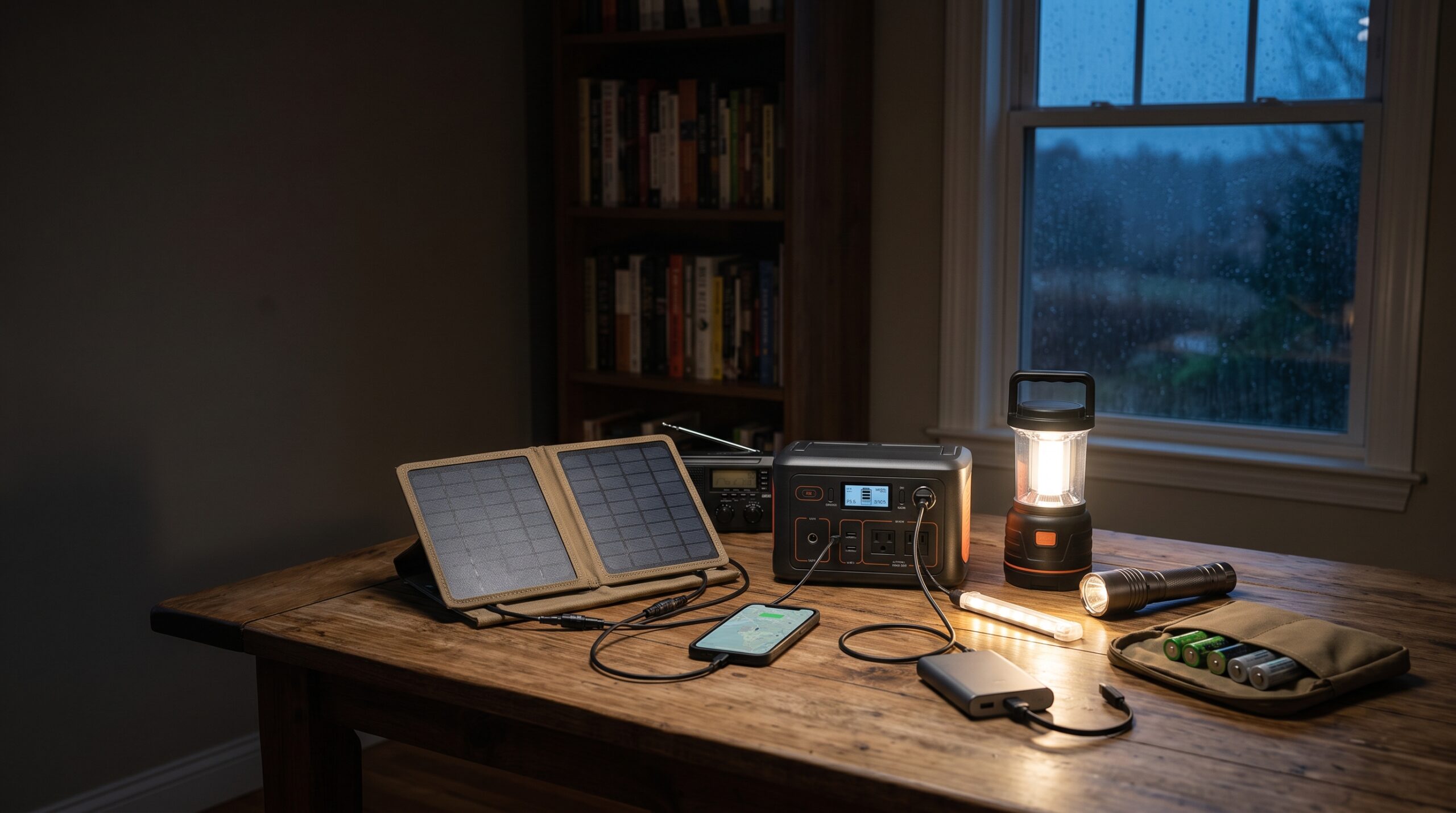
When the grid goes down, emergency power becomes a system rather than a single piece of gear. You need enough light to move and work safely, enough stored energy to keep phones and communications running, and enough capacity to support critical appliances such as refrigerators or essential medical equipment.
A resilient setup combines several layers: headlamps and flashlights for immediate lighting, replaceable or rechargeable batteries for small devices, power banks for communications, portable power stations or generators for larger loads, and a reliable way to replenish the energy you use.
The goal is not to power your entire home exactly as you would during normal grid service. It is to identify your critical loads, understand how much energy they require, and build enough redundancy to keep the essentials operating through an outage.
What Do You Need for Emergency Power?
Short answer: a basic emergency power system should cover three priorities: lighting, communications, and critical loads. Start with headlamps or flashlights and spare batteries, add power banks for phones and other small electronics, then size a portable power station or generator around essential equipment such as refrigeration or medical devices.
For longer outages, you also need a way to replace the energy you consume. Depending on your situation, that may mean solar panels, a fuel-powered generator, vehicle charging, grid power when service is intermittent, or a combination of several sources.
Solar panels can extend the usefulness of a battery-based system, but they do not eliminate the need for adequate storage capacity. Likewise, a large power station is only useful for a limited time if you have no practical way to recharge it.
Build Your Emergency Power System in Layers
Layer 1: Emergency Lighting
Start with the simplest requirement: being able to see. Keep headlamps for hands-free work, handheld flashlights for directed illumination, and lanterns for lighting rooms or shared spaces.
Do not rely on a single light. Store compatible spare batteries or maintain a tested charging method so one dead battery does not leave you in darkness.
Layer 2: Communications
Phones and other small electronics consume relatively little energy compared with major appliances, making them easier to support during an outage. A suitable power bank can provide multiple recharges without requiring a large backup-power system.
Keep the correct charging cables with your emergency equipment and consider how the power bank itself will eventually be recharged during a prolonged outage.
Layer 3: Critical Loads
The next step is identifying equipment that genuinely needs backup power. Refrigeration is a common priority because losing power can mean losing stored food. Some households may also have medical equipment, communications equipment, pumps, or other critical loads.
Do not choose a power station or generator based only on marketing claims. Calculate the running power, startup requirements where applicable, and the amount of energy each device will consume over the period you expect to operate it.
Layer 4: Recharging and Generation
Stored energy eventually runs out. A longer-duration system therefore needs a practical way to replenish it.
Portable solar panels can recharge compatible battery systems when sufficient sunlight is available. Fuel-powered generators can provide substantial power independent of sunlight but require fuel, maintenance, safe outdoor operation, and appropriate storage planning.
The strongest solution may combine technologies rather than depending entirely on one source.
Understand Watts vs. Watt-Hours
Two specifications matter when planning backup power: watts (W) and watt-hours (Wh).
Watts measure power. They tell you how much power a device requires at a particular moment. Your power station or generator must be capable of supplying the required load, including startup surges where applicable.
Watt-hours measure energy. They help describe how much energy a battery can store and therefore how long it may be able to support a particular load.
A power station can have enough wattage to run an appliance but still have too little battery capacity to run it for very long. Start by calculating your actual loads before choosing backup-power equipment.
Plan Your Emergency Power
Portable Power & Solar
Emergency Lighting
Emergency Batteries
What Is a “Solar Generator”?
The term solar generator is commonly used for a portable power station combined with one or more solar panels. The terminology can be misleading because the battery system does not itself generate solar energy.
The portable power station stores electrical energy in a rechargeable battery and provides outputs for your equipment. The solar panels convert sunlight into electricity that can be used to recharge the power station through a compatible solar input.
This distinction matters when planning for extended outages. A large battery gives you more stored energy, while adequate solar capacity can help replace some of the energy you consume. Both sides of the system need to be sized around your actual loads.
Do You Need a Generator or a Portable Power Station?
A portable power station is useful when you need quiet, indoor-safe stored electrical power for electronics and compatible appliances. It does not require fuel while operating, but its battery capacity is finite and it eventually needs to be recharged.
A fuel-powered generator can provide substantial power for as long as you can safely operate it and maintain an adequate fuel supply. However, combustion generators produce carbon monoxide and must never be operated inside a home, garage, or other enclosed space.
For many preparedness plans, these systems are complementary rather than mutually exclusive. A power station can handle quiet overnight loads and electronics, while a generator can provide additional energy and recharge batteries during longer outages.
Where Should You Start?
If you are building an emergency power system from zero, do not start by buying the largest generator or power station you can afford.
Start with your essential loads. Identify what must continue working, determine how much power each device requires, estimate how many hours per day it needs to operate, and calculate the resulting energy requirement.
Then build outward: reliable emergency lighting, communications power, enough stored energy for critical loads, and finally a practical method of replenishing that energy during a longer outage.
This approach produces a system based on your actual requirements rather than equipment specifications chosen in isolation.