
Portuguese Prepper
Baofeng UV-5R Review: Is It a Good Emergency Radio?
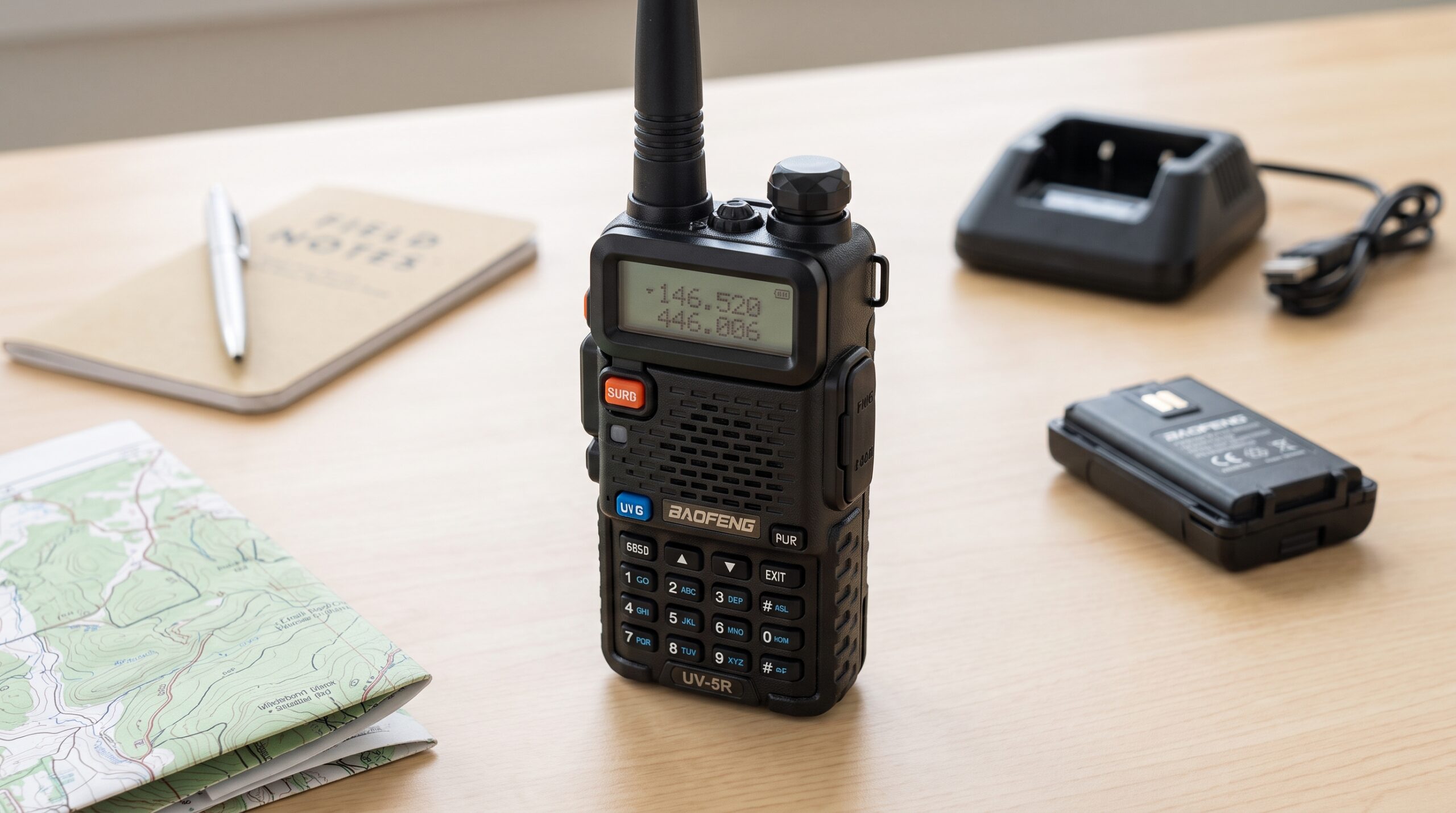
Short answer: the Baofeng UV-5R can be a useful low-cost entry point into amateur radio and a practical backup receiver/transceiver for a communications kit. But buying the radio does not create an emergency communications system. You still need legal operating privileges where required, correct programming, compatible stations or repeaters, a power plan and practice before an emergency.
For US preparedness, we view the UV-5R primarily as an inexpensive way to learn VHF/UHF amateur radio and add redundancy to a broader communications plan—not as a universal radio that can legally communicate with every service it can receive.
Affiliate disclosure: This page may contain affiliate links. If you purchase through these links, we may earn a commission at no additional cost to you.
Baofeng UV-5R at a Glance
| Feature | Baofeng UV-5R |
|---|---|
| Radio type | Handheld VHF/UHF FM transceiver |
| Memory channels | 128 |
| Power settings | High / Low; specifications vary by exact UV-5R version |
| Programming | Keypad or compatible programming software/cable depending on configuration |
| Best preparedness role | Low-cost amateur-radio learning, local communications and backup capability |
| Main limitation | Effective use requires correct programming, compatible stations/infrastructure and legal operating privileges |
Our verdict: the UV-5R makes the most sense as a low-cost learning and backup radio. Its value comes from what you learn to do with it before an emergency—not simply from keeping an unprogrammed radio in a drawer.
What the UV-5R Actually Is
The Baofeng UV-5R is a compact handheld transceiver designed around VHF and UHF operation. Current Baofeng documentation lists dual-band operation, 128 memory channels, selectable high/low transmit power, CTCSS/DCS support, dual-frequency display, FM broadcast reception and other basic handheld-radio functions.
The exact specifications can vary between UV-5R versions and generations. Baofeng currently sells multiple products carrying the UV-5R name or closely related designations, so verify the documentation and regulatory markings of the exact unit you purchase.
Do You Need a License?
In the United States, you do not need an amateur-radio license simply to purchase a UV-5R or to listen to amateur-radio frequencies.
Transmitting is different. Normal transmission on US amateur-radio frequencies requires the appropriate FCC amateur-radio authorization and operation within the privileges granted to the control operator.
The FCC’s amateur-radio rules contain provisions for genuine distress and immediate safety-of-life situations, but these are narrow emergency provisions. They should not be interpreted as general permission to transmit on arbitrary frequencies or services whenever normal communications become inconvenient.
Rules also differ by country. If you are outside the United States, check the regulations of your national telecommunications authority before transmitting.
Receiving Is Not the Same as Transmitting
A programmable handheld may be technically capable of receiving frequencies outside the amateur bands, depending on the exact model and local system.
That does not mean you are authorized to transmit on those frequencies.
Public-safety, business and other radio services operate under their own licensing and equipment rules. Some public-safety systems are also digital, trunked or encrypted and therefore cannot be usefully monitored by a basic analog UV-5R.
For preparedness, program only frequencies you have a legitimate reason to monitor and configure the radio carefully so that you do not accidentally transmit on frequencies where you have no authorization.
How Far Can a Baofeng UV-5R Communicate?
There is no reliable universal answer such as “five miles” or “ten miles.”
VHF/UHF handheld-radio range depends heavily on:
- terrain;
- buildings and other obstructions;
- antenna height;
- antenna performance;
- the location and antenna of the other station;
- radio-frequency interference;
- whether you are communicating directly or through a repeater.
Two handheld radios at street level in a dense urban environment may have much less useful range than two stations with clear line of sight. A properly located repeater can extend practical communications far beyond handheld-to-handheld simplex range.
For emergency planning, test the actual routes and locations that matter to your household instead of planning around an advertised mileage figure.
More Watts Do Not Automatically Mean More Range
One of the most persistent handheld-radio myths is that buying the version with the largest advertised wattage automatically produces dramatically greater range.
For VHF/UHF handheld communications, antenna position, terrain, line of sight and the receiving station can matter more than a modest increase in transmitter power.
The standard UV-5R family is fundamentally a low-power handheld platform. We would choose the exact model based on documented specifications, regulatory suitability, battery options and compatibility rather than chasing an “8W” label.
Should You Replace the Stock Antenna?
An aftermarket antenna can be a useful accessory, but it is not a guaranteed range multiplier.
A longer antenna designed for the frequencies you actually use may improve performance in some circumstances. Results depend on the antenna, frequency, radio, environment and how the radio is being carried.
We therefore would not treat an antenna replacement as mandatory, and we would not assume that a specific antenna will double communication range.
Start by learning the radio and testing the stock configuration. Upgrade only when you understand what limitation you are trying to solve.
Programming Matters More Than Accessories
A radio that has not been correctly programmed before an emergency is considerably less useful.
Your communications plan should identify the channels or frequencies you are legally permitted to use, local amateur repeaters where appropriate, agreed household calling procedures and backup options.
Baofeng provides programming software for the UV-5R family, and compatible versions can also be programmed using supported third-party software and the correct programming cable.
After programming, test every important channel and confirm that household members know how to select it without navigating complex menus.
Where the UV-5R Fits in a PACE Plan
A PACE communications plan assigns Primary, Alternate, Contingency and Emergency methods rather than assuming one communications technology will always work.
The UV-5R can occupy one layer of that plan where amateur VHF/UHF communication is appropriate, but it should not automatically be your only communications method.
For example, a household might use normal cellular communications while networks are functioning, an internet-based alternative where available, properly planned local radio communications as another layer, and an additional method for circumstances where those systems fail.
The exact order should be based on your household, geography, licensing, equipment and realistic emergency scenarios.
Power Is Part of the Communications Plan
A handheld radio stops being useful when its battery is empty.
For preparedness, consider the complete power system:
- the radio’s normal battery;
- a compatible spare battery where appropriate;
- the charging equipment required by that battery;
- a vehicle or USB charging option if supported by the exact battery or accessory;
- a larger backup power source for extended outages.
Some newer UV-5R packages and compatible replacement batteries provide USB-C charging, while older configurations commonly rely on a charging cradle. Verify the exact battery and charging method supplied with your radio rather than assuming all UV-5Rs charge the same way.
The Biggest Weakness: It Requires Practice
The UV-5R is inexpensive, but that does not make amateur radio simple.
Before depending on one, you should be able to:
- select the correct programmed memory channel;
- adjust volume and squelch;
- switch between appropriate power settings;
- understand the difference between simplex and repeater operation;
- recognize when you are authorized to transmit;
- monitor battery condition;
- use your household’s agreed calling procedure.
These skills should be practiced during normal conditions. An emergency is a poor time to learn the radio’s menu system for the first time.
Who Should Buy a UV-5R?
The UV-5R makes sense if you want an inexpensive entry point into VHF/UHF amateur radio, are willing to learn how to program and operate it correctly, and want to incorporate radio into a broader emergency communications plan.
It makes less sense if you want a device that family members can remove from a box years later and immediately use without training, programming or knowledge of radio regulations.
For some households, simpler radio services or purpose-built consumer radios may be easier to standardize. The best communications equipment is the equipment your group can legally and competently operate.
The Bottom Line
The Baofeng UV-5R remains attractive because it provides a large amount of radio functionality at a very low purchase price.
But its preparedness value is frequently misunderstood. The real advantage is not extreme range, high transmitter power or the ability to access every frequency. It is that an inexpensive handheld can provide a practical platform for learning local VHF/UHF amateur communications and building another layer into a properly designed communications plan.
Buy the radio if you intend to learn it, program it, test it and operate it legally. Do not buy one merely to place it unopened in an emergency kit.
Our Recommendation
Treat the UV-5R as an inexpensive training and backup radio rather than a complete emergency communications solution. Build the communications plan first, then configure the radio to support it.
Build Your PACE PlanSources and Methodology
We evaluate the UV-5R by its practical role in an emergency communications system rather than by advertised range or maximum-power claims. Technical specifications should be verified against the documentation for the exact radio version, while transmission privileges depend on the applicable radio service and jurisdiction.
- Baofeng — UV-5R Specifications
- Baofeng — UV-5R Manuals, Software and Certification Downloads
- ARRL — FCC Part 97 Amateur Radio Rules
- ARRL — Amateur Radio Licensing and Education
Radio regulations, firmware, hardware revisions and manufacturer specifications can change. Verify the rules applicable to your jurisdiction and the specifications of the exact radio before transmitting.
Reviewed: September 2026.