Portuguese Prepper
Preparedness Books, Survival Manuals & Training Resources
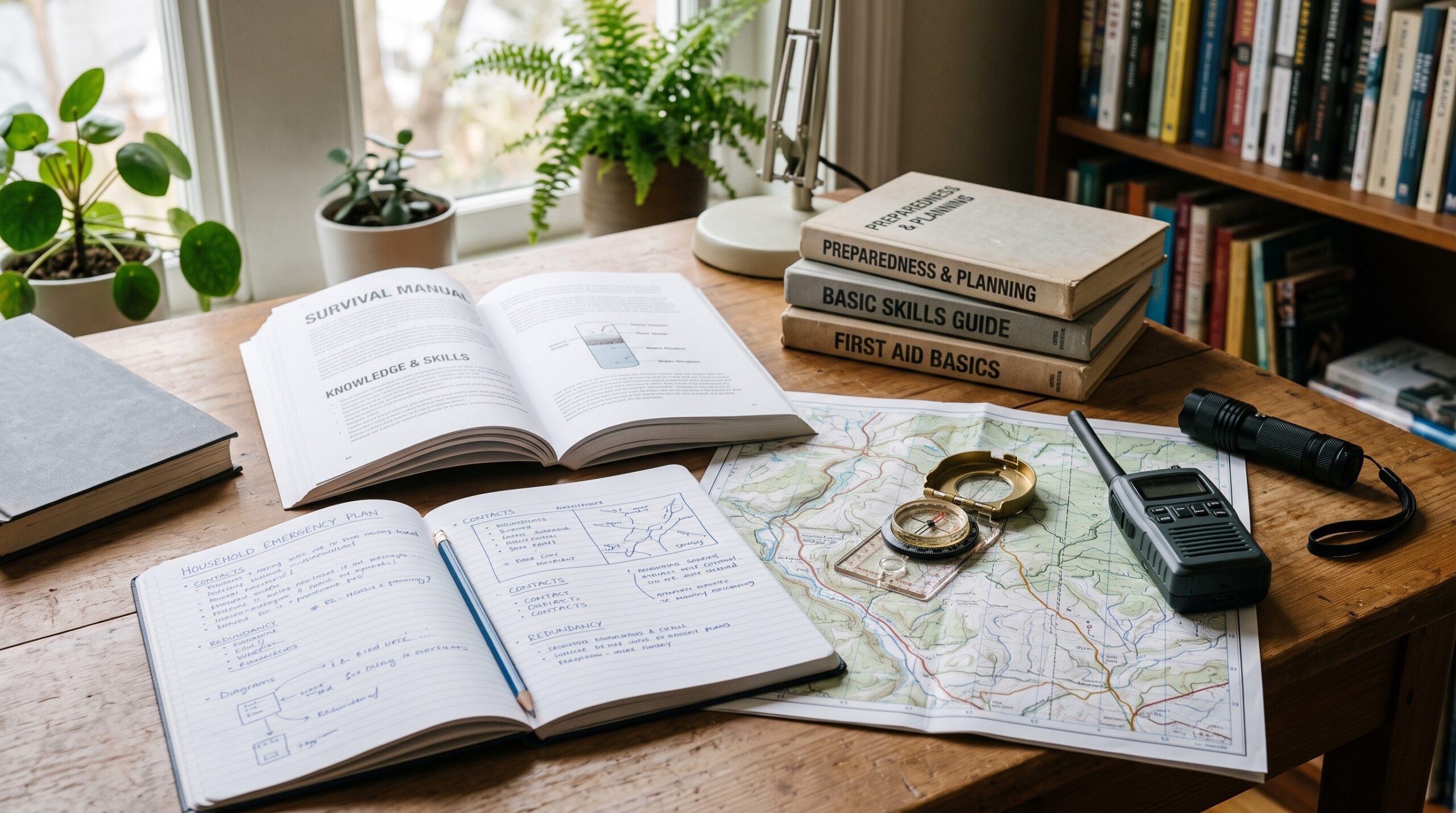
A useful preparedness library should cover the skills that become difficult to improvise during an emergency: first aid and health, water and sanitation, food production and preservation, shelter, navigation, communications, repair, and long-term self-reliance.
Equipment matters, but equipment becomes far more useful when you understand how and when to use it. Printed reference books add another layer of resilience because they remain accessible without electricity, internet access, subscriptions, or functioning electronic devices.
The objective is not to collect survival books. It is to build a practical reference system around the problems your household may actually need to solve.
What Should Be in a Preparedness Library?
Build your emergency library around capabilities rather than book titles. Start by identifying the problems your household could face and the subjects where you would struggle without outside help or internet access.
A balanced preparedness library should provide reliable reference material for:
- First aid and health: basic emergency response, prevention, hygiene, and recognizing when professional medical care is required.
- Water and sanitation: collection, treatment, storage, hygiene, and waste management.
- Food: storage, preservation, cooking, gardening, and longer-term production.
- Shelter and fieldcraft: exposure management, fire, tools, and fundamental outdoor skills.
- Navigation: maps, compass use, coordinates, route planning, and terrain awareness.
- Communications: emergency communication procedures, radio fundamentals, and communications planning.
- Repair and maintenance: keeping essential tools, equipment, and household systems functional.
- Long-term self-reliance: maintaining essential household capabilities during extended disruption.
You do not need the largest survival library. You need reliable information that covers important gaps in your existing knowledge, skills, and preparedness plan.
Core Preparedness & Survival References
Which Preparedness Books Should You Buy First?
If you are starting from zero, avoid buying several books that cover essentially the same general survival material. Start with complementary references that solve different problems.
| Need | Starting Reference | Role in the Library |
|---|---|---|
| General survival | SAS Survival Handbook | Broad reference across multiple survival disciplines |
| Health | Where There Is No Doctor | Community-health reference for situations where normal medical access is limited |
| Long-term self-reliance | The Encyclopedia of Country Living | Food production, preservation, and practical household skills |
| Nuclear preparedness | Nuclear War Survival Skills | Specialist historical and technical reference for fallout and nuclear-emergency preparedness |
| Wilderness skills | Bushcraft 101 | Introduction to fieldcraft and practical outdoor skills |
After establishing those foundations, add specialist references based on your location, household, likely hazards, existing skills, and preparedness priorities.
Navigation Skills & Offline Reference
Electronic navigation belongs in a modern preparedness plan, but paper maps and a magnetic compass provide an independent backup when phones, navigation devices, connectivity, or electrical power are unavailable.
Owning a compass is not the same as knowing how to navigate. Practice route planning, bearings, terrain association, and map reading before those skills are needed.
Communications Knowledge & Training
Radio capability combines equipment, technical knowledge, procedures, and regulatory requirements. Licensing and operating rules vary by country, so always follow the regulations that apply where you operate.
Security Knowledge & Planning
Security preparedness should begin with risk assessment, access control, lighting, doors, windows, communications, and household procedures rather than relying on any single product, defensive tool, or training course.
Practical Skills Matter More Than Reading
Books are reference tools. Many preparedness capabilities only become reliable through practice. Reading about navigation, first aid, radio operation, tool maintenance, food preservation, or fire building does not create the same capability as performing those tasks under normal conditions.
Physical Books vs. Digital Preparedness Libraries
| Format | Advantages | Limitations |
|---|---|---|
| Printed books | No electricity required; durable reference; easy to annotate | Heavy, bulky, and difficult to duplicate |
| Offline digital library | Large collections can fit on a small device; searchable and easy to duplicate | Requires compatible hardware and electrical power |
| Cloud library | Convenient access, backup, and synchronization during normal conditions | Depends on internet access and external infrastructure |
The strongest approach is redundancy. Keep the most important manuals in print, maintain an organized offline digital collection for breadth, and use cloud storage as an additional copy rather than the only copy.
How to Build an Offline Knowledge Vault
- Identify the emergencies most relevant to your household and location.
- List the skills you would need if normal services were unavailable.
- Identify subjects where nobody in the household has sufficient knowledge.
- Obtain or print the most important reference material for those gaps.
- Create a searchable offline digital library for secondary material.
- Organize files by subject so critical instructions can be found quickly.
- Keep important information accessible rather than buried among hundreds of files.
- Back up the digital library on more than one storage device where practical.
- Practice important procedures before an emergency.
- Periodically review medical, technical, and regulatory material for obsolescence.
A library is a reference system, not a substitute for competence. First aid, navigation, radio operation, food preservation, equipment maintenance, and other practical skills become substantially more useful when they are practiced before they are needed.
Frequently Asked Questions
What is a good survival book for beginners?
There is no single book that covers every preparedness need. For a broad introductory survival reference, the SAS Survival Handbook is a reasonable starting point. A useful preparedness library should then add specialist references for subjects such as health, food, navigation, communications, and self-reliance.
Should preppers keep physical books?
For critical information, physical books provide valuable redundancy because they do not depend on batteries, functioning electronics, or internet access. Digital copies remain useful because they allow a much larger searchable reference collection to occupy very little physical space.
What subjects should an emergency preparedness library cover?
Prioritize first aid and health, water and sanitation, food storage and production, shelter and fieldcraft, navigation, communications, repair, and longer-term self-reliance. The exact selection should reflect your household, location, likely hazards, and existing skills.
Are survival books enough to learn preparedness skills?
No. Books can explain procedures and provide valuable reference information, but practical skills such as first aid, land navigation, radio operation, food preservation, and equipment maintenance should be practiced under normal conditions.
Should I keep manuals for my equipment?
Yes. Keep important operating instructions, maintenance information, model numbers, specifications, and other useful documentation for equipment you may depend on during an emergency. Digital copies can also be stored in your offline library.
The Portuguese Prepper Approach
Preparedness works best when knowledge, practical skills, equipment, and planning reinforce one another. Buying equipment without knowing how to use it creates dependency. Learning skills without keeping appropriate tools and references available creates a different vulnerability.
Build your library gradually. Start with subjects that protect life and basic needs, practice the important skills, and expand into specialist references as your preparedness system develops.