
Portuguese Prepper
Essential Tools for Emergency Preparedness & Self-Reliance
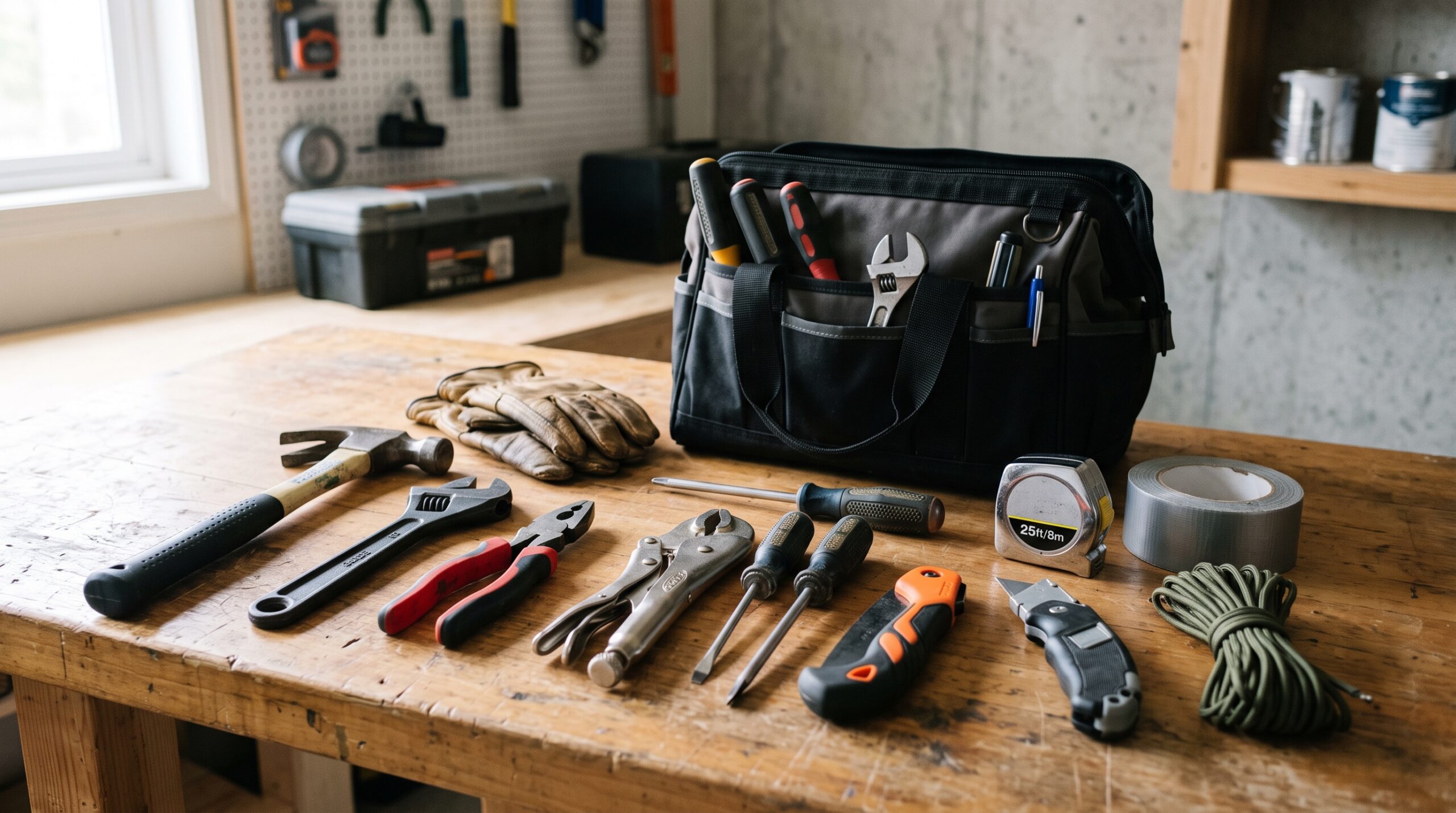
Preparedness tools extend what you can repair, build, cut, move, and maintain without outside help. The goal is not to collect as much gear as possible. It is to maintain a small, dependable set of capabilities that still work when normal services, electricity, or replacement equipment may not be available.
A practical preparedness tool system should cover cutting, repair, wood processing, digging, hands-free lighting, and basic home maintenance. Start with durable manual tools for essential tasks, then add specialized equipment based on your home, environment, skills, and likely emergencies.
What Tools Do You Actually Need?
Short answer: a basic preparedness tool kit should give you the ability to cut, repair, process wood, dig, illuminate a work area, and maintain your home. You do not need a specialized survival tool for every possible scenario.
Start with general-purpose tools that solve multiple common problems. A fixed-blade knife handles controlled cutting tasks. A multitool provides portable repair capability. A folding saw processes branches and small wood efficiently. A basic home tool kit handles the larger repair jobs that pocket tools cannot.
Axes, shovels, sharpening equipment, cordage, repair materials, and specialized tools can then be added according to your environment and actual preparedness plan.
Build Your Tool Kit by Capability
Cutting
A dependable cutting tool is one of the most versatile pieces of equipment you can own. A fixed-blade knife can handle controlled cutting, food preparation, cordage, carving, and many general camp or repair tasks.
Repair
A multitool gives you immediate access to pliers, drivers, cutting tools, and other compact functions. For sustained repairs, however, it should complement rather than replace a proper home tool kit.
Wood Processing
If your preparedness plan involves firewood, fallen branches, shelter materials, or rural property maintenance, saws and axes provide capabilities that a knife cannot efficiently replace.
Digging
A shovel can be useful for sanitation, drainage, clearing, vehicle recovery, fire management, and general property work. The appropriate size depends on whether it will remain at home, travel in a vehicle, or be carried on foot.
Hands-Free Lighting
Repairs become substantially harder when one hand has to hold a flashlight. A headlamp keeps both hands available for mechanical work, first aid, navigation, cooking, and other tasks in darkness.
Home Maintenance
Preparedness includes ordinary failures as well as major disasters. Basic plumbing, fastening, cutting, measuring, electrical isolation, and mechanical repair capabilities can prevent a small problem from becoming a larger one when professional help is unavailable.
Core Cutting & Repair Tools
Knife vs. Saw vs. Axe: Different Jobs
A knife, saw, and axe overlap slightly, but they are not interchangeable.
A knife is primarily a controlled cutting tool. It excels at cordage, carving, food preparation, fine wood work, and general utility.
A saw is designed to cut across wood efficiently. For branches and small logs, a good folding saw can remove material with considerably less effort than attempting the same task with a knife.
An axe or hatchet is useful for chopping and splitting. Its weight and geometry allow it to perform wood-processing tasks that would be inefficient or inappropriate for a knife.
Choose these tools according to what you actually expect to do. Someone preparing an urban apartment needs a different tool system from someone heating a rural property with wood.
Wood Processing & Field Tools
Digging & Home Maintenance
Tool Skills & Maintenance
Buying durable tools is only part of preparedness. Cutting edges become dull, moving parts require maintenance, handles can loosen, and corrosion can damage equipment that spends years in storage.
Learn the basic maintenance requirements of your critical tools before an emergency. Keep appropriate sharpening, lubrication, cleaning, and repair supplies with the equipment rather than assuming they will be available later.
Hands-Free Work Lighting
Lighting should be treated as part of the tool system rather than as an afterthought. A repair kit is considerably less useful during a blackout if you cannot clearly see the equipment you are trying to fix.
For a broader strategy covering flashlights, lanterns, batteries, power banks, generators, and off-grid charging, use our Power & Lighting Preparedness hub.
Manual Tools Are Your Baseline
Power tools dramatically increase productivity, and there is no reason to avoid them when electricity is available. A cordless drill, reciprocating saw, chainsaw, or other powered equipment can complete some jobs much faster than its manual equivalent.
The preparedness problem appears when a critical capability exists only in powered form. Batteries discharge, chargers require electricity, fuel can run out, and mechanical systems can fail.
For essential tasks, maintain a practical manual fallback. A handsaw does not replace a chainsaw for high-volume work, but it can still cut wood after the chainsaw becomes unavailable. A screwdriver is slower than a drill-driver, but it continues working without a charged battery.
Think in terms of capability redundancy: the powered tool provides speed and efficiency, while the manual tool preserves the underlying capability.
Multitool vs. Home Tool Kit
A multitool and a home tool kit solve different problems.
A multitool provides compact, immediately available repair capability. It is useful when carrying a complete set of tools is impractical or when a quick adjustment, cut, or repair needs to be made away from home.
A home tool kit provides dedicated tools with better leverage, reach, ergonomics, and task-specific performance. Full-size pliers, screwdrivers, wrenches, hammers, saws, and measuring tools are substantially better for sustained repair work than miniature equivalents.
Do not build an entire home preparedness plan around a pocket multitool. Carry the multitool for immediate capability and maintain proper tools for serious work.
Where Should You Start?
If you are building a preparedness tool system from zero, start with the tools needed to maintain your home and handle common failures rather than buying specialized survival equipment first.
Build a basic manual home tool kit, add a dependable cutting tool and portable multitool, ensure you have hands-free lighting, and then expand according to your circumstances.
If you live in a wooded rural environment, saws and axes may become priorities. If you live in an apartment, compact repair tools, lighting, utility shutoff capability, and equipment appropriate to your building may matter more.
The objective is not to own every possible tool. It is to preserve the practical capabilities you are most likely to need when normal assistance is delayed or unavailable.