
Portuguese Prepper
Survival Radio Antennas: Improving Range Without Unrealistic Claims
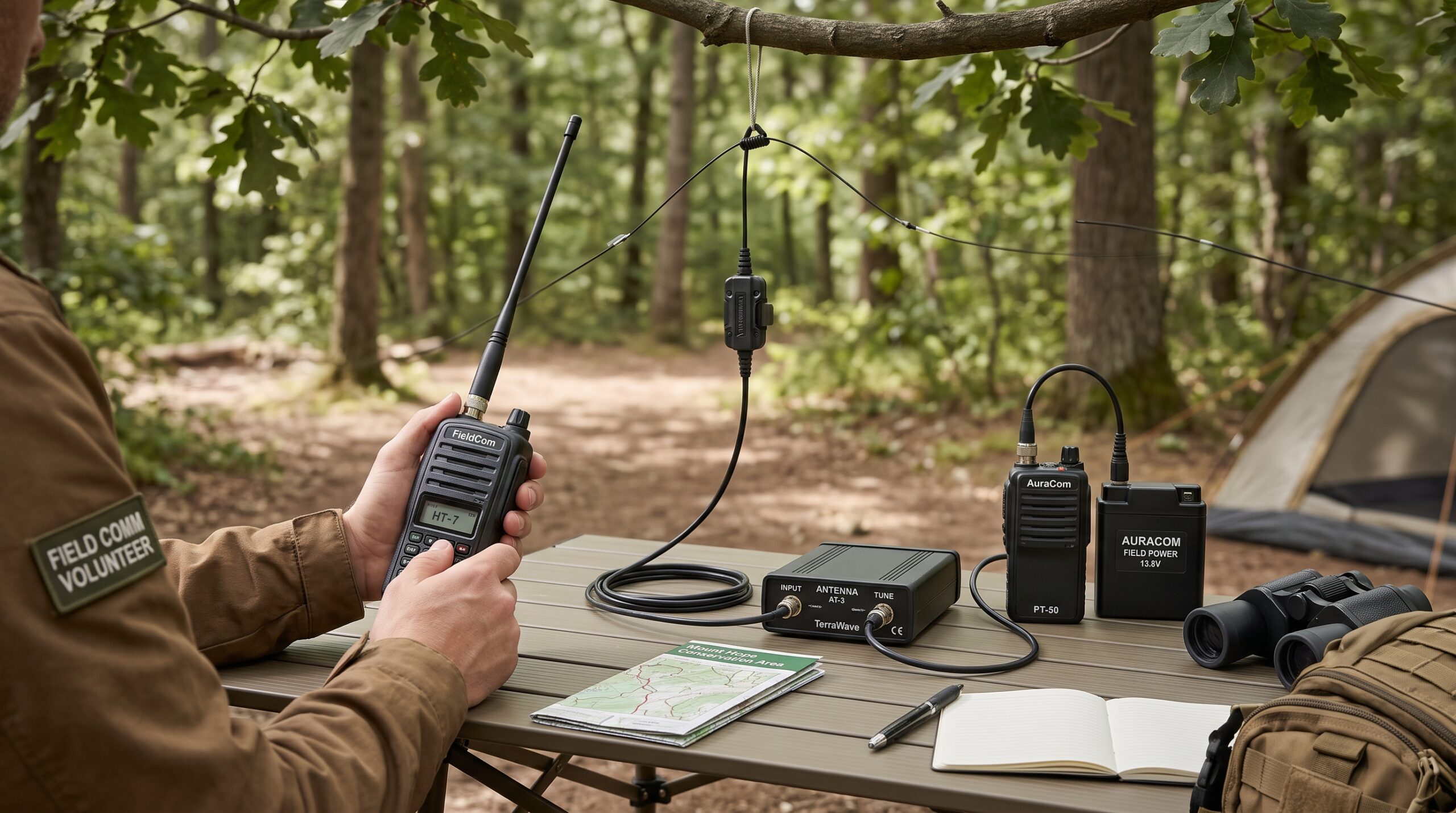
Short answer: changing an antenna can improve a handheld radio, but there is no universal promise that a longer whip will double your range. Practical performance depends on frequency, antenna design and matching, height, terrain, buildings, feed-line loss, radio power and the location of the other station.
Why antenna placement matters
Handheld radios used on VHF and UHF are strongly affected by obstructions. Your body, vehicles, buildings, hills and vegetation can absorb or block part of the signal path. Raising the antenna can improve the radio horizon and reduce some of those obstructions, which is why an elevated temporary antenna can outperform a handheld antenna at ground level even when transmitter power is unchanged.
That does not mean height always solves the problem. Terrain between stations, local electrical noise, receiver quality and the other station’s antenna can still limit communication.
Handheld whip upgrades
A replacement whip such as the commonly used Nagoya NA-771 format can be more efficient than a very short stock antenna on compatible radios and frequencies. Before buying one, confirm the connector, the frequency range and the authenticity of the product. A physically longer antenna that is poorly matched can perform worse than the original.
Roll-up J-poles and temporary elevated antennas
A roll-up J-pole or similar portable antenna can be useful when you stop at a campsite, shelter or temporary communications point. Hanging the antenna in a tree or other safe elevated position can improve line of sight while keeping the radio and operator at ground level.
The tradeoff is setup complexity. You now need suitable feed line, strain relief, a safe support, weather awareness and a way to keep the connector from damaging the radio. Coaxial cable also introduces loss, particularly at higher frequencies, so excessive or poor-quality feed line can reduce the benefit of extra height.
Do not confuse gain with guaranteed range
Antenna gain describes how an antenna redistributes energy in particular directions; it is not a multiplier that guarantees a fixed number of extra miles. Real-world range cannot be predicted from gain alone. For preparedness, field testing between the actual locations you care about is more useful than any headline distance claim.
A practical upgrade order
- Confirm the frequencies and legal radio service you are using.
- Learn the stock antenna’s real performance in your area.
- Improve operator position and line of sight before buying more power.
- Choose a correctly matched, mechanically compatible antenna.
- For fixed or temporary positions, consider an elevated external antenna and suitable feed line.
- Test the complete system with the people and locations in your communications plan.
Radio regulations vary by country and service. The fact that a radio or antenna can operate on a frequency does not itself authorize transmission there.
Reviewed: September 2026. This guide focuses on practical antenna principles rather than guaranteed range claims.