
Portuguese Prepper
Midland GXT1000 GMRS Review: Range, Features & Preparedness Use
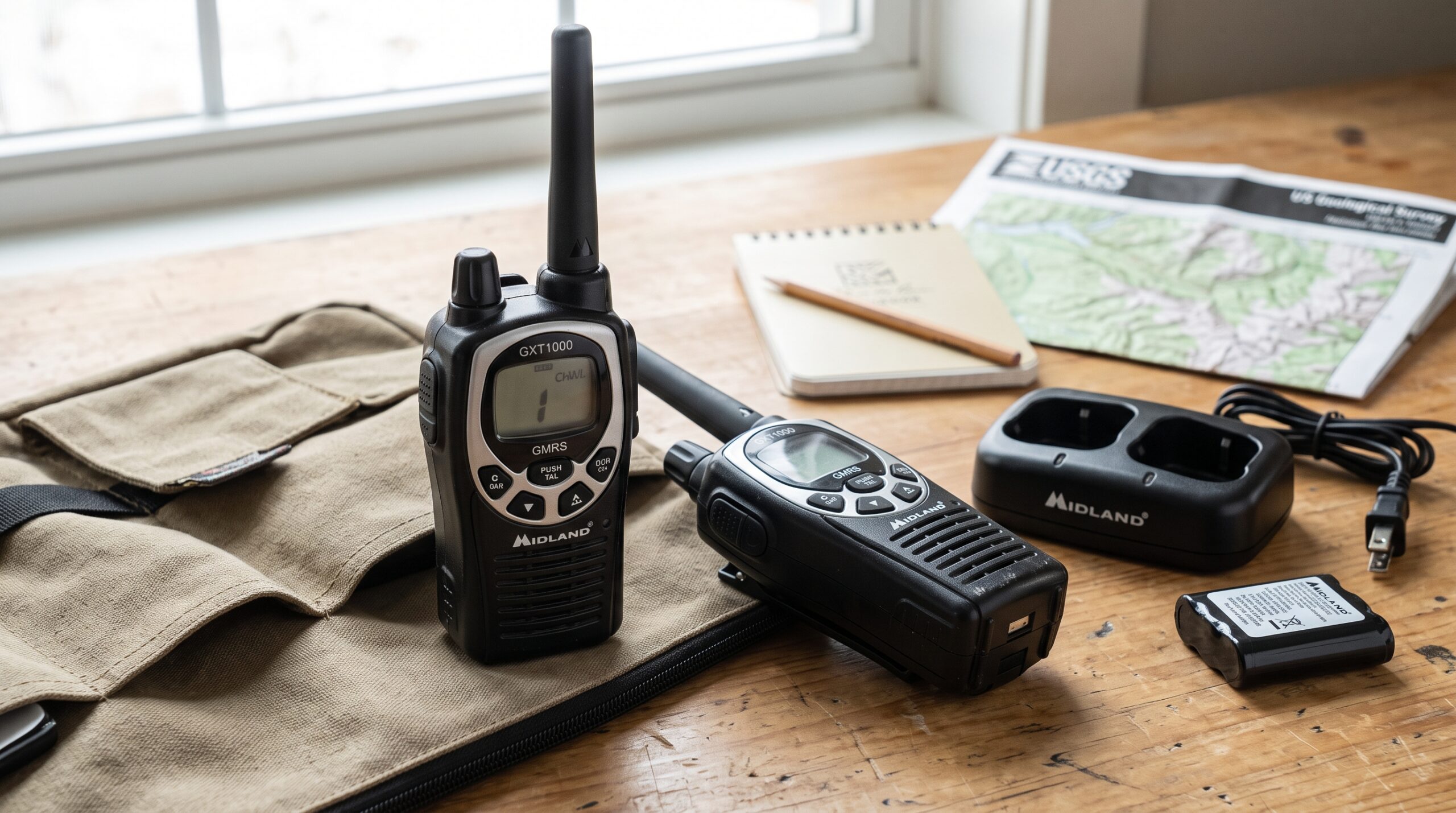
Short answer: the Midland GXT1000VP4 is a straightforward GMRS handheld for U.S. families and small groups that want a packaged radio kit without the learning curve of amateur radio. Its strengths are simple controls, NOAA weather alert reception, included charging accessories and practical interoperability with FRS radios on shared channels. Its main limitations are realistic handheld range, fixed antennas and the U.S. GMRS licensing requirement.
What the Midland GXT1000 is good at
The GXT1000 is best understood as a consumer GMRS radio rather than a long-range tactical radio. The kit is designed for people who want two-way voice communication between family members, vehicles or a small group with minimal setup. Midland packages the radios with rechargeable battery packs, a desktop charger, vehicle charging support, belt clips and boom-mic headsets in the common two-radio kit.
It also includes NOAA weather scanning and alert functionality. That gives the radio a second preparedness role in the United States: receiving weather information while still serving as a local two-way communicator.
Range: plan around terrain, not the number on the box
The most important expectation to correct is range. Midland’s maximum-range figure is based on unusually favorable line-of-sight conditions such as elevated positions with few obstructions. Buildings, hills, vegetation, vehicles and antenna height can reduce range substantially. Midland itself says the GXT series commonly averages roughly half a mile to two miles in normal conditions.
For preparedness, test the radios on the routes and between the locations that matter to you. A radio that works across an open field may perform very differently between houses, inside reinforced buildings or across uneven terrain.
GMRS licensing and FRS compatibility
GMRS is a U.S. radio service regulated by the Federal Communications Commission. The service requires a license, but not an examination. Midland notes that the license covers the licensee and qualifying immediate family members for the license term. These rules are specific to the United States; do not assume that GMRS frequencies or licensing arrangements apply in another country.
On channels shared with FRS, the GXT series can communicate with compatible FRS radios when both devices are set to the same channel and compatible code settings. That can be useful when some people in a group already own basic FRS handhelds.
Preparedness strengths and limitations
| Consideration | GXT1000 assessment |
|---|---|
| Ease of use | Good for family and group use after basic familiarization |
| Weather information | NOAA weather scan and alert features for U.S. use |
| Water resistance | JIS4 splash resistance; not a submersible radio |
| Range | Highly terrain-dependent; test locally rather than relying on the maximum marketing figure |
| Antenna | Fixed, limiting antenna-upgrade options |
| Licensing | FCC GMRS license required for legal GMRS operation in the U.S. |
Who should consider it?
The GXT1000 makes the most sense for U.S. households that want a ready-to-use local communication layer for neighborhood coordination, road trips, outdoor activities or a two-vehicle evacuation plan. It is less attractive for users who want removable antennas, extensive programming, digital modes or the broader technical flexibility of amateur radio.
Whatever radio you choose, store it with charged batteries, the correct charging accessories and a written channel plan. Test the equipment before an emergency and make sure every intended user can operate it.
Sources reviewed: Midland GXT1000VP4 current product documentation and Midland GMRS licensing guidance. Reviewed: September 2026.