Portuguese Prepper
GMRS vs. Ham Radio: Which Is Right for You?
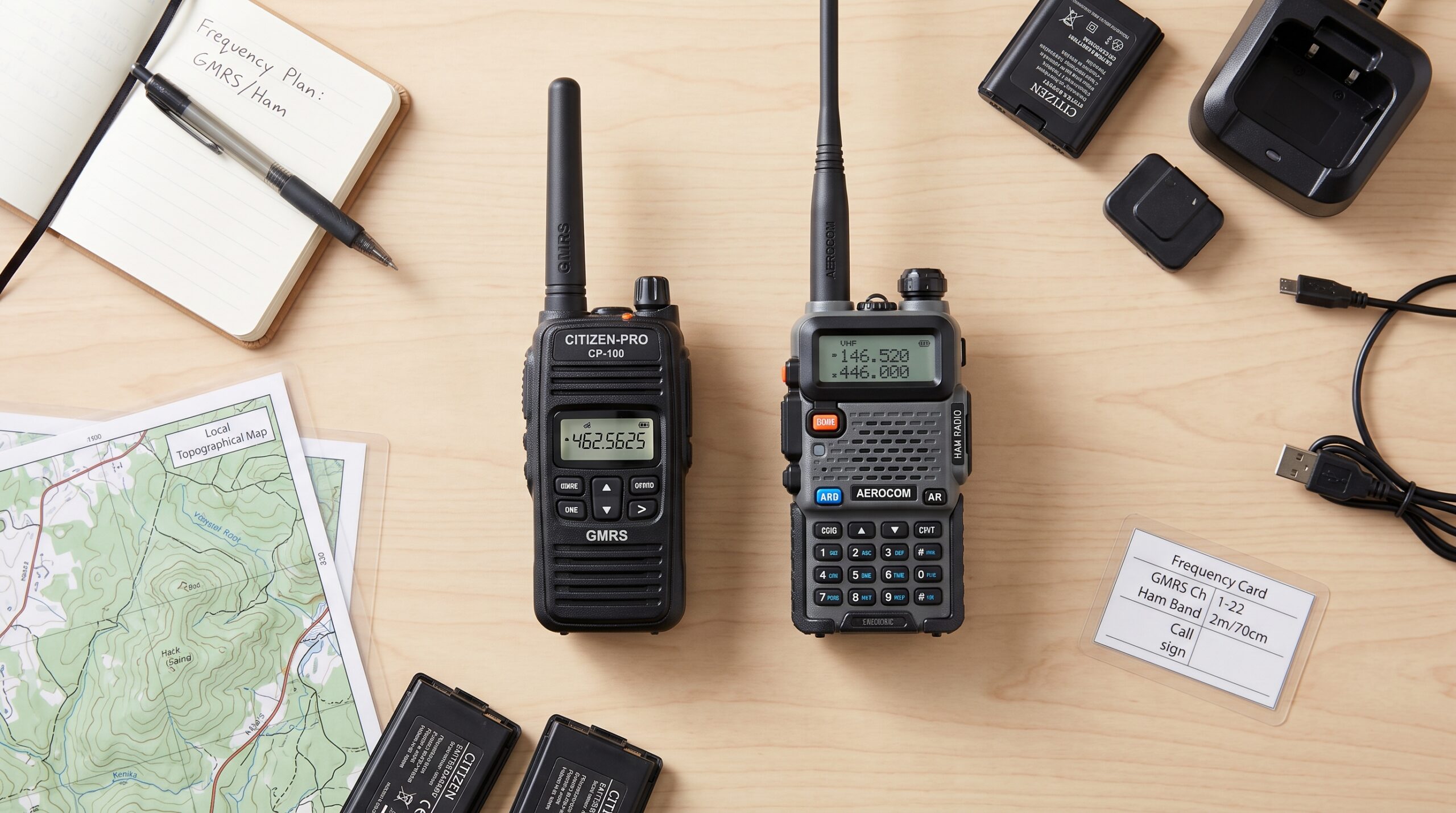
If you are building an emergency communication plan for your family or preparedness group, GMRS and amateur (Ham) radio solve different problems. GMRS prioritizes relatively simple local group communications, while amateur radio offers a much broader technical ecosystem and the potential for local, regional and long-distance communication.
For many preparedness households, the question is therefore not simply which service is “better,” but which one matches the communication task you need to solve.
GMRS vs. Ham Radio at a Glance
| Feature | GMRS | Ham Radio |
|---|---|---|
| Entry difficulty | Low | Moderate |
| U.S. examination | No exam | Exam required |
| License structure | One individual license can authorize certain immediate family members | Individual operator license |
| Typical preparedness role | Family, neighborhood and convoy communications | Local, regional and potentially long-distance communications |
| Technical flexibility | Lower | Much higher |
| Learning curve | Relatively simple | Can become highly technical |
When to Choose GMRS
GMRS is particularly useful when your priority is straightforward communication between family members or a small local group. Typical preparedness uses include coordinating vehicles in a convoy, communicating around a property, keeping contact between nearby family members and establishing neighborhood communications.
In the United States, obtaining a GMRS license does not require passing an examination. A GMRS license issued to an individual can also authorize certain immediate family members under FCC rules, making the service attractive for family preparedness.
Actual radio range is highly dependent on terrain, buildings, antenna height, radio configuration and whether repeaters are available. Treat manufacturer maximum-range figures as ideal-condition marketing rather than guaranteed real-world performance.
Affiliate disclosure: This page contains affiliate links. If you purchase through these links, we may earn a commission at no additional cost to you.
GMRS Pick: Midland GXT1000
The Midland GXT1000 is a practical option for family and group communications when you want a conventional handheld-radio format without moving immediately into the more technical amateur-radio ecosystem.
It is particularly suited to short-range group coordination, vehicle convoys, outdoor activities and preparedness kits. As with any handheld radio, actual range depends heavily on terrain and operating conditions.
Find it on AmazonWhen to Choose Ham Radio
Amateur radio is the stronger choice when you want to develop a broader communications capability. Depending on license privileges, equipment, frequencies, antennas and propagation conditions, amateur operators can build systems ranging from simple local handheld communications to regional repeater networks and long-distance HF stations.
That flexibility makes amateur radio particularly valuable for preparedness users who want more than simple family coordination. It can provide access to a large technical community, repeaters, multiple frequency bands and numerous communication modes.
The trade-off is complexity. In the United States, transmitting on amateur frequencies normally requires an individual FCC amateur-radio license, which requires passing an examination.
Budget Ham Pick: Baofeng UV-5R
The Baofeng UV-5R is one of the most widely recognized inexpensive handheld radios used by people entering amateur radio. Its low cost makes it useful as a learning platform and as an introduction to VHF/UHF radio operation.
It is not a substitute for an HF station and should not be interpreted as a long-distance radio simply because it is an amateur-radio handheld. Its practical communication range depends on terrain, antennas, repeaters and operating conditions.
Before transmitting, make sure the radio is configured for frequencies and services you are legally authorized to use.
Find it on AmazonWhat About Range?
Neither “GMRS range” nor “Ham range” can be reduced to a single number. Radio performance depends heavily on frequency, power, antenna efficiency and height, terrain, buildings, repeaters and atmospheric propagation.
Two handheld radios at street level in a dense urban environment can have relatively limited range. The same general radio service used through a well-positioned repeater can cover a substantially larger area. Amateur HF equipment can potentially communicate over hundreds or thousands of miles under suitable conditions, but that capability requires different equipment, antennas, skills and operating privileges than a basic handheld radio.
The Preparedness Strategy: Use Both
Build Communications in Layers
GMRS and amateur radio do not need to compete for the same role. A preparedness communications system can use GMRS for straightforward family and local coordination while amateur radio provides a broader technical communications capability.
Add other independent methods and the result becomes a more resilient PACE communication plan rather than a preparedness strategy dependent on a single radio or network.
Our Recommendation
Choose GMRS first if your immediate objective is simple family, vehicle or neighborhood coordination and you want the lowest technical barrier to entry.
Choose amateur radio if you are prepared to study, obtain an individual license and develop broader radio skills that can eventually include repeaters, more capable antennas, additional bands and long-distance communications.
For a serious preparedness communications plan, consider learning both. They solve different problems, and redundancy is more valuable than trying to force one radio service to perform every communications role.