Water Preparedness
WaterBOB vs. AquaPodKit: Best Bathtub Emergency Water Storage
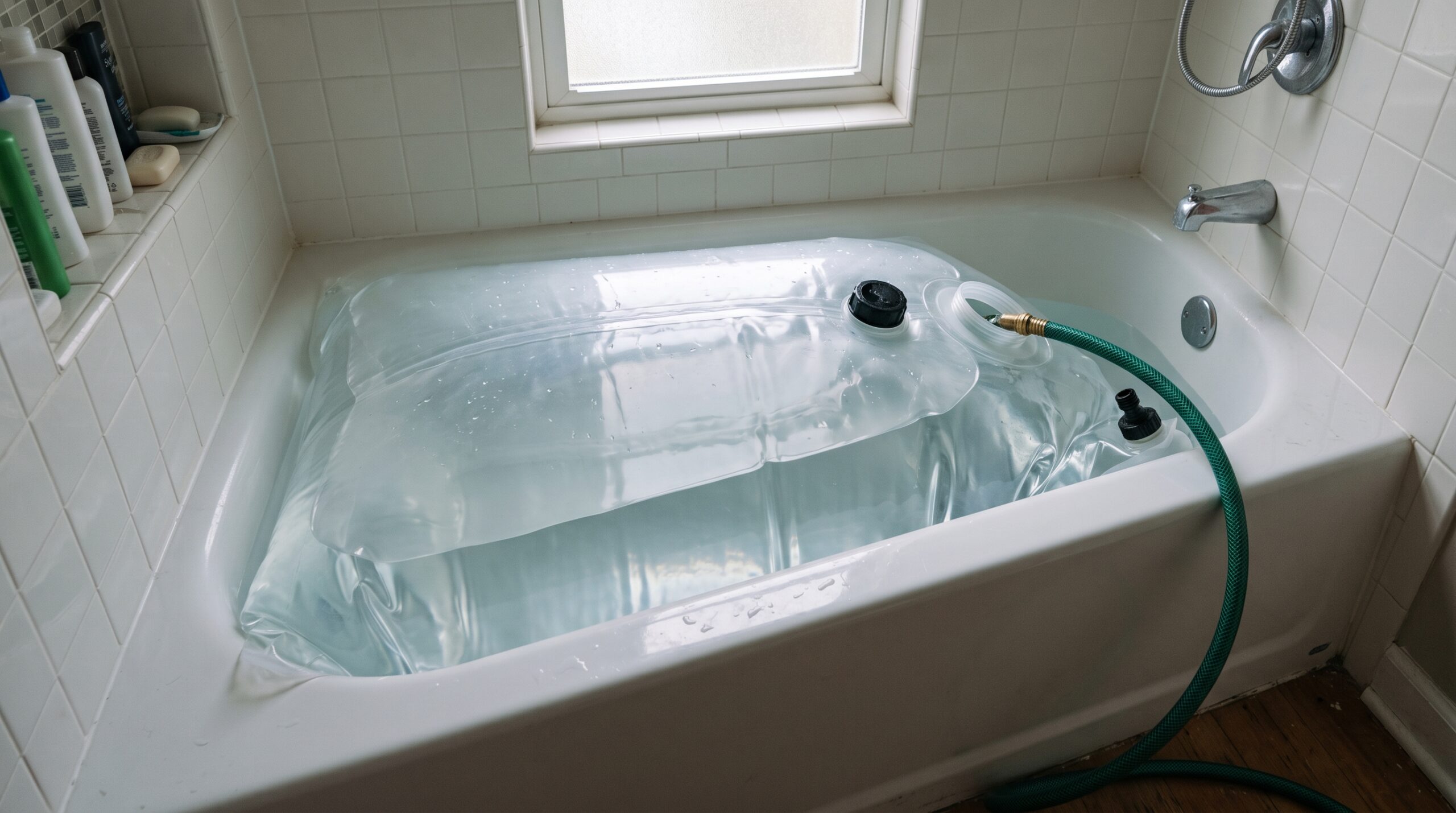
Short answer: both WaterBOB and AquaPodKit turn a bathtub into a large, enclosed emergency water reservoir. For most households, either is substantially better suited to storing drinking water than simply filling an open bathtub.
Our pick: WaterBOB remains the simplest established option if you want up to 100 gallons of temporary emergency storage and an included siphon pump. AquaPodKit is a strong alternative, particularly if you prefer a current Made-in-USA system; although its bladder can accommodate up to 100 gallons in some tubs, the manufacturer currently recommends 65 gallons as the standard fill level.
WaterBOB vs. AquaPodKit: Quick Comparison
| Feature | WaterBOB | AquaPodKit |
|---|---|---|
| Type | Enclosed bathtub bladder | Enclosed bathtub bladder |
| Maximum advertised capacity | Up to 100 gallons | Up to 100 gallons depending on bathtub |
| Recommended fill | Up to bladder/tub capacity | 65 gallons for most installations |
| Water storage period | Manufacturer states up to 16 weeks | Manufacturer recommends 8–16 weeks |
| Dispensing | Siphon pump included | Pump system included with kit configurations |
| Materials | Food-grade, FDA-compliant materials; BPA-free | FDA-compliant materials |
| Manufacturing | Verify current product listing | Made in USA |
| Best use | Maximum temporary bathtub storage | Alternative enclosed bathtub system |
Editorial verdict: there is no dramatic functional difference in the basic preparedness concept: both products isolate clean tap water from the bathtub itself. WaterBOB gets our slight preference because of its straightforward 100-gallon positioning and long-established design. AquaPodKit is a credible alternative with particularly useful current documentation about capacity and safe filling.
Why not just fill the bathtub with water?
An ordinary bathtub is not designed as a drinking-water storage container. Soap residue, cleaning products, dirt, hands, containers used to scoop water, and environmental debris can contaminate an open supply.
The CDC recommends storing drinking water in appropriate containers that can be tightly closed and protect safe water from recontamination. A bathtub bladder applies the same basic principle on a much larger scale: the tub supports the reservoir, but the water remains inside a separate enclosed container.
An open bathtub may still provide useful non-potable emergency water, depending on its condition and local guidance, but we would not count an open bathtub as part of the household’s protected drinking-water reserve.
WaterBOB: Our Top Pick
The WaterBOB Emergency Drinking Water Storage System is a disposable food-grade bladder designed to fit inside a standard bathtub and hold up to 100 gallons of fresh water.
Installation is straightforward: place the empty bladder inside the bathtub, connect its fill sleeve to the faucet, fill it while the water supply remains safe, and close the reservoir.
The included siphon pump is particularly useful. Instead of repeatedly opening the reservoir or dipping cups into stored water, you can dispense water into smaller containers as needed.
According to WaterBOB, the bladder is constructed from heavy-duty food-grade plastic using FDA-compliant materials, is BPA-free, and can keep properly stored water fresh for up to 16 weeks.
The WaterBOB is intended for one-time use. It should be treated as emergency consumable equipment rather than a permanent reusable water tank.
AquaPodKit: Best Alternative
The AquaPodKit uses the same fundamental strategy: an enclosed bladder sits inside the bathtub and provides a protected reservoir for water collected before the normal supply becomes unavailable or questionable.
There is an important capacity detail. AquaPodKit’s bladder can physically accommodate between approximately 65 and 100 gallons depending on the bathtub, but the manufacturer currently recommends 65 gallons as the normal fill level for most households.
That is a sensible distinction because bathtub dimensions and installations vary. More capacity is not automatically better if the tub or surrounding structure is unsuitable for the additional weight.
AquaPodKit currently recommends an emergency storage period of approximately 8–16 weeks and states that its bladders are manufactured in the United States using FDA-compliant materials.
Which Bathtub Water Storage System Should You Buy?
Affiliate disclosure: This page contains affiliate links. If you purchase through these links, we may earn a commission at no additional cost to you.
Top Pick: WaterBOB Emergency Water Storage
Best for households that want a simple, enclosed bathtub reservoir with up to 100 gallons of advertised capacity and an included siphon pump.
View on AmazonAlternative Pick: AquaPodKit
A strong alternative with an enclosed emergency bladder, current Made-in-USA production, and a recommended 65-gallon standard fill level.
View on AmazonHow Much Water Does 65–100 Gallons Actually Provide?
The CDC recommends storing at least 1 gallon per person per day for drinking, cooking, brushing teeth, and other essential uses, with a minimum target of 3 days and a 2-week supply where possible.
| Household | 65 Gallons | 100 Gallons |
|---|---|---|
| 1 person | 65 days | 100 days |
| 2 people | About 32 days | 50 days |
| 3 people | About 21 days | About 33 days |
| 4 people | About 16 days | 25 days |
| 5 people | 13 days | 20 days |
These figures are theoretical calculations based on exactly 1 gallon per person per day. Real consumption can be higher, particularly in hot weather, for people with specific health needs, households with pets, or when stored water is also used extensively for washing and sanitation.
The Weight Problem: 100 Gallons Is Extremely Heavy
Water weighs approximately 8.3 pounds per U.S. gallon. That means:
- 65 gallons: approximately 540 lb of water.
- 100 gallons: approximately 830 lb of water.
That weight is one reason not to assume that every bathtub should automatically be filled to a bladder’s theoretical maximum capacity.
AquaPodKit explicitly distinguishes between its maximum physical capacity and its recommended 65-gallon fill level. Follow the instructions supplied with the product and consider the bathtub, building, and installation before creating a very large indoor water load.
When Should You Fill a Bathtub Water Bladder?
Before the water supply becomes unsafe.
A bathtub bladder stores the water you put into it; it does not purify contaminated water. The ideal use case is therefore an emergency with advance warning—for example, an approaching hurricane, severe winter storm, expected infrastructure shutdown, or another event where loss of water service is credible.
Fill the bladder while authorities still consider the tap water safe. If a boil-water or do-not-drink advisory has already been issued, follow the instructions from local authorities rather than assuming that filling the bladder will make that water safe.
Bathtub Bladders Are Backup Capacity, Not Your Entire Water Plan
The major limitation of both WaterBOB and AquaPodKit is that they require advance warning and a functioning water supply.
An earthquake, sudden water-main failure, contamination incident, or unexpected infrastructure outage may give you no opportunity to fill the bathtub first.
For that reason, Portuguese Prepper recommends a layered strategy:
- Permanent reserve: keep at least a 3-day supply of drinking water already stored.
- Extended reserve: build toward 7–14 days where storage space permits.
- Bathtub bladder: add 65–100 gallons when an emergency provides advance warning.
- Treatment backup: maintain an appropriate method for treating additional water if your stored supply is exhausted.
WaterBOB vs. AquaPodKit: Final Verdict
| If You Prioritize… | Our Choice |
|---|---|
| Simple established design | WaterBOB |
| Up to 100-gallon advertised storage | WaterBOB |
| Current Made-in-USA manufacturing | AquaPodKit |
| Conservative documented fill guidance | AquaPodKit |
| Enclosed emergency bathtub storage | Either |
Our overall pick: WaterBOB. It remains a straightforward solution for converting an otherwise unused bathtub into a very large temporary emergency water reserve. AquaPodKit is a credible alternative and its current 65-gallon recommendation provides useful guidance for households that do not need—or should not use—the maximum theoretical capacity.
Neither replaces water that is already stored before an emergency occurs.
Frequently Asked Questions
Is WaterBOB water safe to drink?
WaterBOB is specifically designed to store fresh drinking water and uses food-grade, FDA-compliant materials. However, the bladder does not purify water. Fill it only with water considered safe at the time of filling and follow the manufacturer’s storage and dispensing instructions.
How long can water stay in a WaterBOB?
WaterBOB states that its system can keep properly stored water fresh for up to 16 weeks. This is a manufacturer specification for the product, not a general rule that applies to every water-storage container.
How much water does AquaPodKit hold?
The AquaPod bladder can accommodate approximately 65–100 gallons depending on bathtub size and shape. The manufacturer currently recommends 65 gallons as the standard fill level for most installations.
Can you drink water stored directly in a bathtub?
We do not recommend treating an ordinary open bathtub as a protected drinking-water storage container. Bathtubs are exposed to contamination and are not designed like closed food-grade water-storage containers. Use properly stored emergency water for drinking whenever possible.
Can WaterBOB or AquaPodKit purify unsafe tap water?
No. These products are storage systems, not water purifiers. If authorities say the tap water is unsafe, follow the applicable public-health instructions.
Can WaterBOB be reused?
WaterBOB describes its bladder as a one-time-use product. Do not plan your emergency system around draining, drying, and repeatedly reusing it.
Should I buy a generic bathtub liner instead?
For drinking-water preparedness, we prefer a purpose-built enclosed reservoir with documented materials, filling instructions, dispensing method, and manufacturer specifications. We do not recommend an undocumented generic bath liner as an equivalent substitute for WaterBOB or AquaPodKit.
Sources and Methodology
Product specifications were checked against current manufacturer documentation in September 2026. Emergency water-storage guidance was checked against current CDC recommendations. Manufacturer storage-duration and capacity claims are identified as product specifications rather than general public-health guidance.
- WaterBOB — Official product specifications
- AquaPodKit — Official FAQ and storage guidance
- CDC — How to Create and Store an Emergency Water Supply
- CDC — Safe Water Storage
Reviewed: September 2026. Product specifications and public-health guidance can change; verify current instructions before use.