
Portuguese Prepper
Portable solar panels for phones: watts, charging and emergency use
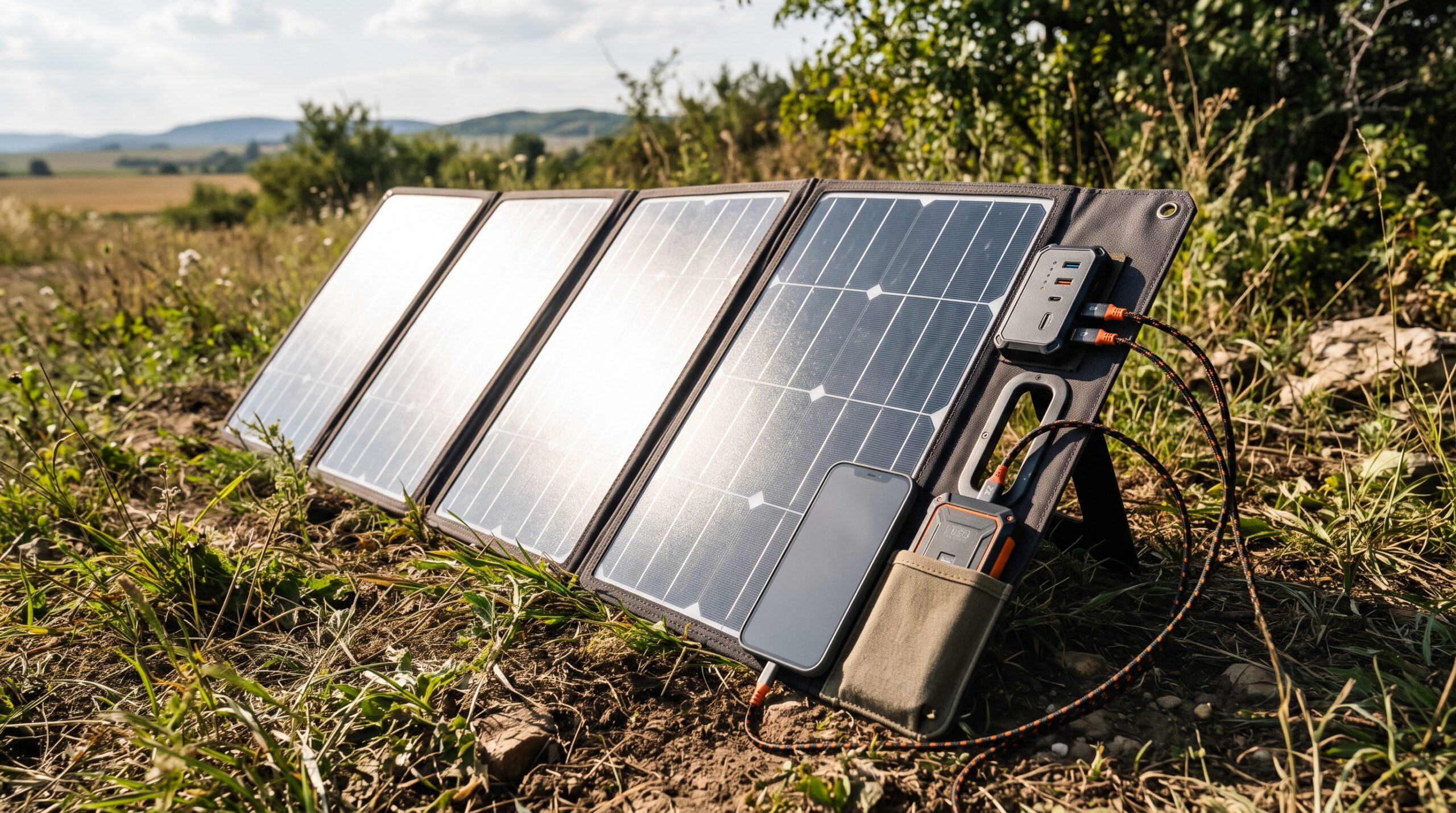
Short answer: for phone-focused emergency charging, a foldable USB solar panel in roughly the 20–30W class is a practical starting point. But the wattage printed on the panel is a peak rating, not a promise of continuous output. Sun angle, cloud, shade, temperature and the USB electronics all affect what reaches your device.
Affiliate disclosure: This page contains affiliate links. If you purchase through these links, we may earn a commission at no additional cost to you. As an Amazon Associate I earn from qualifying purchases.
Our emergency solar panel picks
Two solar panel classes for different preparedness needs. Choose based on the devices you need to charge, available USB/DC outputs and portability.
PORTABLE PHONE CHARGING
BigBlue SolarPowa 28
28W panel class
Foldable USB solar panel for phones and small power banks. Actual USB output depends on the exact model and sunlight conditions.
Find it on Amazon →POWER-STATION SOLAR BACKUP
Jackery SolarSaga 100W
100W peak panel class
Larger solar panel for compatible portable power stations, with greater collection potential but more weight and bulk.
Find it on Amazon →For preparedness, we prefer using the panel to recharge a power bank and then charging the phone from that battery. Direct solar-to-phone charging can work, but a battery provides a useful buffer when sunlight changes.
How many watts do you actually need?
Start with energy, not marketing wattage. A phone battery stores energy in watt-hours (Wh). If your phone needs roughly 15Wh for a full recharge, one recharge per day means you need to harvest more than 15Wh from the panel because conversion and battery-charging losses consume some of the energy.
A panel rated at 28W does not generate 28W all day. BigBlue, for example, currently rates its SolarPowa 28 at 28W panel power but lists 20W total working power on the ammeter version, with USB output shared across its ports. That distinction is more useful for planning than the headline number alone.
| Use case | Panel class | Why |
|---|---|---|
| One phone + small power bank | 20–30W USB panel | Portable and sufficient for modest daily energy needs in good conditions |
| Several phones/tablets | 30W+ with appropriate ports | More collection area and output headroom |
| Laptop / larger USB-C loads | Check USB-C PD output, not just panel watts | A high panel rating is useless if the USB port cannot supply the required voltage/power |
| Portable power station | Typically 60–200W+ DC solar | Designed to feed a solar input/MPPT rather than only small USB devices |
Our phone-focused pick: BigBlue SolarPowa 28
The current BigBlue SolarPowa 28 is a useful example of what to look for in a compact emergency panel. BigBlue lists a 28W rating, monocrystalline cells and multiple USB outputs. The ammeter version is rated for 20W total working power, has one USB-A and one USB-C port, and weighs about 0.67kg.
The ammeter is genuinely useful in preparedness because it gives immediate feedback while you change the panel angle or encounter intermittent shade. We prefer that measurable feedback to vague claims such as “charges a phone in two hours,” because actual charge time depends on the phone, battery state, sunlight and cable.
Best fit for phone-focused kits: BigBlue SolarPowa 28
A compact 28W-class panel with direct USB charging. Choose the exact current model carefully: BigBlue sells versions with and without an ammeter and their port specifications differ.
Find it on AmazonWhat happened to the Anker PowerPort Solar 21W?
The Anker PowerPort Solar 21W was a popular compact panel, but we no longer make it a primary recommendation because availability and current official product support are less clear than for actively documented alternatives. If you already own one, it can still be useful; for a new purchase, compare currently supported models and their actual USB output specifications.
Legacy option: Anker PowerPort Solar 21W
Worth keeping if you already own it. For a new purchase, verify current availability, warranty and port specifications before choosing it over an actively supported model.
For a power station: move to a larger panel
A phone panel and a power-station panel solve different problems. Jackery’s SolarSaga 100W family, for example, is designed around a much larger solar/DC output while also providing USB outputs on relevant models. Jackery Europe lists the SolarSaga 100W JS-100A at 100W peak, approximately 4kg, with 5V/2.4A USB-A and 5V/3A USB-C outputs.
That makes a 100W-class panel far more suitable when the objective is replenishing a portable power station for radios, lights, laptops or other loads. It is correspondingly much heavier and bulkier than a 20–30W phone panel.
Power-station class: Jackery SolarSaga 100W
Choose this class when you need meaningful energy for a compatible portable power station rather than just a phone or small USB battery.
Find it on AmazonWhy we recommend a power bank between the panel and phone
Solar conditions change constantly. A cloud, tree shadow or poor panel angle can reduce output in seconds. A power bank lets the solar panel collect energy whenever conditions are favorable and lets you charge the phone later from a stable source, including after sunset.
This also makes energy budgeting easier. If your power bank reports remaining capacity, you can see whether today’s solar collection covered your communications needs instead of guessing from the phone’s charging icon.
Exception: direct phone charging is reasonable when sunlight is stable and the panel has a suitable regulated USB output. The buffer-battery approach is a preparedness preference, not a universal technical requirement.
Solar charging mistakes to avoid
- Planning from peak watts alone. Check the USB/DC output specifications and the input limits of the device being charged.
- Ignoring shade. Keep the active panel surface clear of shadows from trees, railings, bags and your own equipment.
- Assuming a tiny panel can replenish a large battery quickly. Small integrated panels can be useful for trickle/emergency collection, but collection area limits the energy available.
- Leaving the phone baking in direct sun. Position the panel for sunlight while keeping batteries and electronics shaded when the cable arrangement allows it.
- Buying incompatible connectors. For power stations, verify voltage, connector type and supported solar-input range before purchase.
A simple emergency solar calculation
Use this planning formula: daily device energy (Wh) ÷ expected usable solar hours ÷ system efficiency = approximate panel watts required. For example, if your devices consume 30Wh/day, you expect 4 useful solar hours and assume 60% end-to-end collection efficiency, the calculation is 30 ÷ 4 ÷ 0.60 = 12.5W. A 20–30W panel gives useful margin for imperfect conditions.
This is a planning estimate, not a production guarantee. Weather and seasonal sun vary substantially, including within Portugal, so critical communications should have more than one charging method.
Our preparedness recommendation
For a lightweight communications kit, pair a reputable 20–30W foldable USB panel with a power bank large enough for several phone charges. For a household outage kit with laptops, radios and larger batteries, skip directly to a compatible 100W-class or larger panel and portable power station. Do not choose either system from panel wattage alone: check ports, voltage, device input limits, weight and current product support.
Sources and methodology
Specifications below are manufacturer-published figures, not Portuguese Prepper laboratory measurements. Recommendations are based on emergency-use fit, documented output, portability and current product documentation. Real-world solar production varies.
- BigBlue — SolarPowa 28 with ammeter specifications
- BigBlue — SolarPowa 28 specifications
- Jackery Europe — SolarSaga 100W specifications
Reviewed: September 2026.