
Portuguese Prepper
Eneloop vs. Energizer Ultimate Lithium: Rechargeable vs. Long-Term Storage
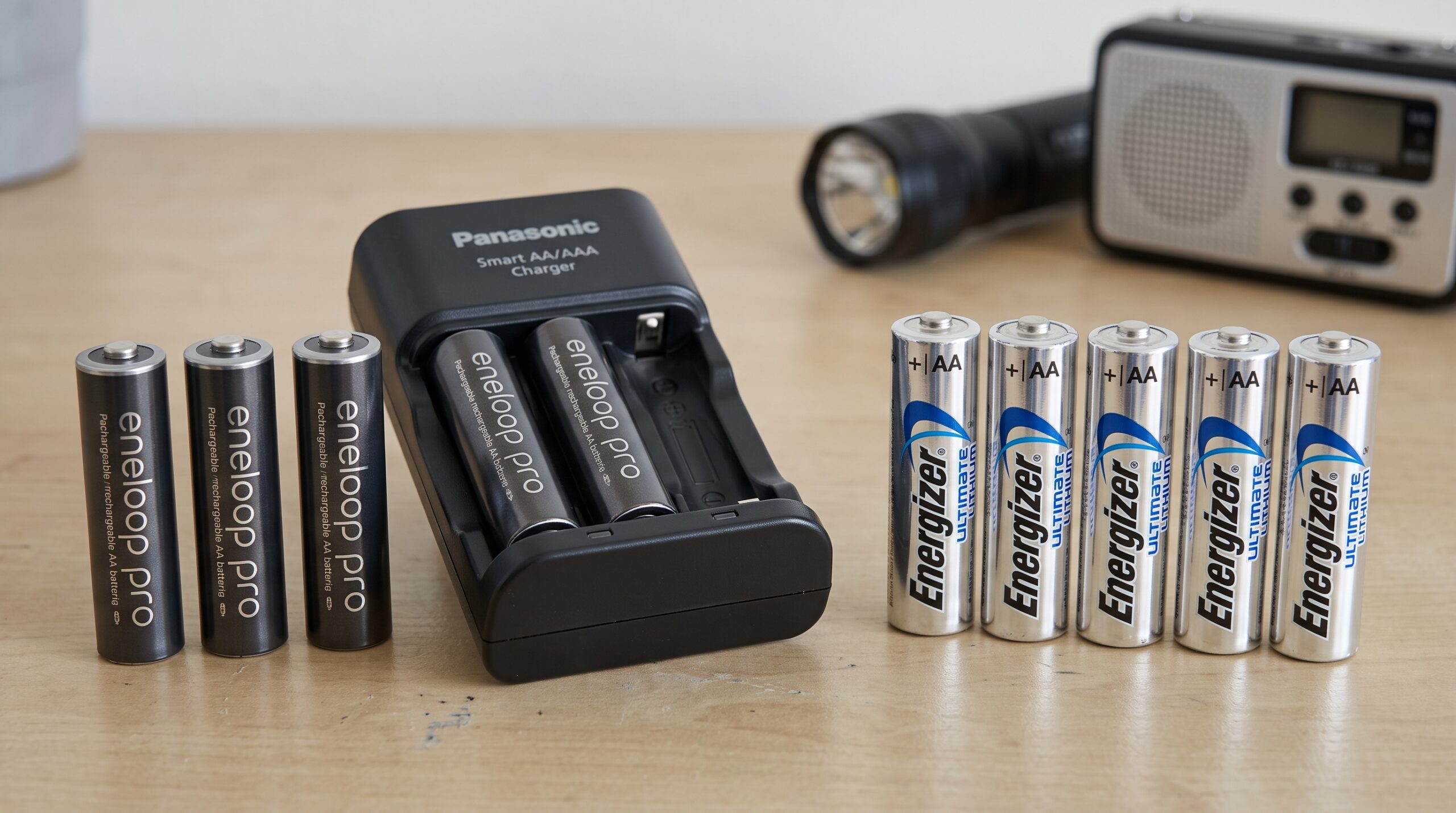
Short answer: Panasonic Eneloop and Energizer Ultimate Lithium solve different preparedness problems. Eneloop is a rechargeable NiMH battery designed to be used repeatedly, while Energizer Ultimate Lithium is a single-use lithium/iron disulfide battery designed for long storage life, low weight and reliable operation across a very wide temperature range.
Affiliate disclosure: This page contains affiliate links. If you purchase through these links, we may earn a commission at no additional cost to you. As an Amazon Associate I earn from qualifying purchases.
Our emergency battery picks
Two complementary battery types for different preparedness needs. Choose based on rechargeability, storage life and device compatibility.
RECHARGEABLE FOR REPEATED USE
Panasonic Eneloop AA
1.2 V NiMH rechargeable cells, with up to 2,100 recharge cycles under Panasonic’s stated conditions.
For regularly used compatible radios, flashlights and other AA devices.
Find it on Amazon →LONG-TERM EMERGENCY RESERVE
Energizer Ultimate Lithium AA
1.5 V primary lithium cells, with up to 25 years of shelf life under specified conditions.
For compatible emergency devices, long storage and extreme temperatures.
Find it on Amazon →For equipment you use and recharge regularly, Eneloop is usually the more practical system. For emergency equipment that may sit unused for years, especially in cold or hot environments, Energizer Ultimate Lithium has important advantages. A resilient preparedness battery system can include both rather than forcing one chemistry to do every job.
Eneloop vs. Energizer Ultimate Lithium: The Short Answer
The correct choice depends primarily on whether you expect to recharge the battery.
Eneloop makes sense for radios, flashlights, lanterns, cameras and other compatible AA or AAA devices that receive regular use. Instead of consuming a new disposable battery every time the device runs down, you recharge the same cells.
Energizer Ultimate Lithium makes more sense when long storage life, low weight, extreme-temperature performance and immediate availability without a charger are more important than reuse.
For preparedness, these roles complement each other. Rechargeables provide sustainable repeated use when charging power is available; primary lithium batteries provide an independent reserve that does not depend on your charging system.
Comparison at a Glance
| Feature | Panasonic Eneloop AA | Energizer Ultimate Lithium AA |
|---|---|---|
| Chemistry | NiMH rechargeable | Li/FeS₂ primary lithium |
| Nominal voltage | 1.2 V | 1.5 V |
| Capacity | Up to 2000 mAh / min. 1900 mAh | Performance depends on discharge conditions |
| Rechargeable | Yes | No |
| Published recharge life | Up to 2,100 cycles under Panasonic’s stated test method | Single-use |
| Storage performance | Retains 70% capacity after 10 years at 20°C under Panasonic’s stated conditions | Up to 25-year shelf life at 21°C |
| Operating temperature | −20°C to 50°C | −40°C to 60°C |
| Typical AA weight | 27 g | Approx. 15 g |
| Best role | Repeated use with access to charging | Long-term reserve and extreme-temperature equipment |
Specifications above apply to the current AA products referenced in the manufacturer’s documentation. AAA specifications differ.
Eneloop: Best for Repeated Use
Panasonic Eneloop is a low-self-discharge NiMH rechargeable battery. The standard AA model has a nominal voltage of 1.2 V, minimum capacity of 1900 mAh and published recharge capability of up to 2,100 cycles under Panasonic’s stated IEC-based test method.
Panasonic also states that standard Eneloop retains approximately 70% of its capacity after 10 years of storage at 20°C under its specified testing conditions. That distinguishes it from older rechargeable batteries that could lose a substantial amount of charge while sitting unused.
For preparedness, the main advantage is repeatability. If a blackout lasts several days and you have a working charging source, the same set of batteries can cycle between your equipment and charger instead of consuming a growing pile of disposable cells.
Panasonic rates Eneloop for operation between approximately −20°C and 50°C. It can therefore perform in cold conditions, although Ultimate Lithium has a substantially wider published operating-temperature range.
Eneloop vs. Eneloop Pro
Higher capacity does not automatically make Eneloop Pro the better preparedness battery.
The standard Eneloop AA is rated at a minimum 1900 mAh and up to 2,100 recharge cycles under Panasonic’s stated test method. Eneloop Pro increases AA capacity to approximately 2500 mAh / minimum 2450 mAh depending on market, but Panasonic publishes a substantially lower recharge figure of up to 500 cycles under the corresponding test method.
Panasonic also publishes different storage-retention figures: standard Eneloop retains 70% after 10 years under the stated conditions, while Eneloop Pro is listed at 85% after one year.
For equipment where maximum runtime between charges matters, Eneloop Pro can make sense. For a preparedness battery pool intended to be recharged repeatedly over a long period, standard Eneloop may be the more balanced choice.
Energizer Ultimate Lithium: Best for Long-Term Storage
Energizer Ultimate Lithium AA uses lithium/iron disulfide chemistry and has a nominal voltage of 1.5 V. Unlike Eneloop, it is a primary battery: once discharged, it must be replaced rather than recharged.
Its preparedness advantage is storage. Energizer currently specifies a 25-year shelf life at 21°C for the AA L91 and an operating-temperature range from −40°C to 60°C (−40°F to 140°F).
The AA cell weighs approximately 15 g, compared with approximately 27 g for a standard Eneloop AA. Energizer also markets Ultimate Lithium AA as up to 33% lighter than comparable alkaline batteries.
Those characteristics make primary lithium particularly attractive for emergency equipment that may spend long periods in storage, cold-weather equipment, lightweight evacuation kits and other applications where a charger may not be available when the battery is needed.
Energizer currently describes Ultimate Lithium AA as having leak-resistant construction and guarantees it against leakage under standard use. That is more precise than claiming that lithium batteries can never leak under any circumstances.
What Happens During a Long Blackout?
A short outage favors simplicity: install a fresh battery and use the device.
A prolonged outage changes the calculation. Disposable batteries represent a finite stockpile. Once they are exhausted, they cannot provide additional energy.
Rechargeable Eneloops can continue to be useful if you maintain a functioning source of electricity and a compatible charger. That source might be grid power when service returns, a power station, generator or an appropriately configured solar charging system.
Solar does not make batteries provide “infinite power.” Solar output depends on panel capacity, weather, season, location, charging losses and the rest of the electrical system. It does, however, create the possibility of replenishing rechargeable batteries without consuming additional disposable cells.
This is why a hybrid strategy is useful: rechargeables for repeated operation, backed by primary lithium batteries that remain available if the charging system fails.
Cold Weather: Ultimate Lithium Has the Wider Range
Temperature can materially affect battery performance.
Panasonic rates standard Eneloop for operation down to approximately −20°C. Energizer rates Ultimate Lithium AA down to −40°C and up to 60°C.
For a vehicle emergency kit exposed to severe winter temperatures or equipment intended for very cold environments, the wider published range of Ultimate Lithium is a significant advantage.
Always consider the operating-temperature limits of the device itself as well. A battery capable of operating at −40°C does not mean the flashlight, radio, GPS receiver or other electronics around it are rated for the same temperature.
Shelf Life vs. Rechargeability
Shelf life and rechargeability should not be treated as the same specification.
Ultimate Lithium’s 25-year shelf-life rating describes a primary battery intended to retain useful energy during long storage under specified conditions.
Eneloop’s published figure describes capacity retention: Panasonic estimates that the standard battery retains 70% of its minimum capacity after 10 years at 20°C under the manufacturer’s specified test conditions.
Eneloop can then be recharged. Ultimate Lithium cannot. Which characteristic matters more depends on whether the battery is being stored as an untouched reserve or used repeatedly.
Which Battery Fits Your Device?
Do not assume that every AA-powered device behaves identically with every AA chemistry.
Standard Eneloop AA has a nominal voltage of 1.2 V, while Energizer Ultimate Lithium AA is rated at 1.5 V. Panasonic states that Eneloop works in many devices designed for standard batteries, but there are exceptions.
Panasonic specifically notes that Eneloop should not be used in devices with airtight battery compartments, giving waterproof flashlights as an example. Check the equipment manufacturer’s battery requirements before changing chemistry.
Energizer states that Ultimate Lithium AA is interchangeable with other 1.5 V batteries of the same size, but the device manufacturer’s instructions should still take priority.
Which Batteries Should You Stock?
The Charger Is Part of the System
Rechargeable batteries are only useful during an extended outage if you can recharge them.
The Panasonic BQ-CC55 uses individual charge control and can charge one to four AA or AAA Eneloop or Eneloop Pro batteries in any combination. Panasonic states that Smart Charge detects when each battery is full and stops charging that slot individually.
The BQ-CC55 accepts 100–240 V AC input, but it is still an AC-powered charger. A portable solar panel cannot normally be connected directly to it. During a grid outage, it would need a suitable AC source such as a power station or inverter system.
If direct USB or DC charging from an off-grid electrical system is part of your preparedness plan, select a compatible charger specifically designed for that input and test the complete system before relying on it.
Should Batteries Be Stored Inside Emergency Devices?
Long-term emergency storage should account for both battery condition and device power consumption.
Some electronic devices continue to draw a small amount of current while apparently switched off. Over a sufficiently long period, that parasitic load can reduce the available battery capacity.
For equipment intended to remain untouched for long periods, storing spare batteries separately can reduce this risk and makes periodic inspection easier. However, the correct approach depends on how quickly the device must be ready for use.
A practical compromise is to keep batteries immediately beside the device in a protected holder or original packaging and periodically inspect both the equipment and batteries. Critical equipment should be tested on a schedule rather than assumed to work simply because it has been stored.
What Should a Prepper Store?
- Frequently used AA/AAA equipment: standard Eneloop provides reusable power and high published cycle life.
- High-drain equipment where runtime between charges matters: consider Eneloop Pro after checking device compatibility.
- Long-term emergency cache: Energizer Ultimate Lithium provides substantially longer manufacturer-rated shelf life.
- Cold-weather or vehicle equipment: Ultimate Lithium has the wider published operating-temperature range.
- Extended grid-down use: combine rechargeable batteries with a tested charging system.
- Redundancy: maintain primary lithium cells as a reserve even when rechargeables are your normal operating batteries.
The Bottom Line
There is no single winner between Panasonic Eneloop and Energizer Ultimate Lithium because they perform different roles.
For repeated use, standard Eneloop provides a rechargeable AA system with low self-discharge, long-term capacity retention and a high published cycle count. It becomes particularly useful when your preparedness setup includes a reliable way to recharge batteries during an extended outage.
For long-term storage, very cold conditions and emergency equipment that may sit unused for years, Energizer Ultimate Lithium provides a 25-year AA shelf-life rating, very wide operating-temperature range and significantly lower weight.
For a resilient preparedness system, the strongest answer is usually not Eneloop or Ultimate Lithium, but Eneloop plus Ultimate Lithium: rechargeable cells for repeated use and primary lithium cells as an independent long-term reserve.
Sources and Methodology
- Panasonic — Eneloop specifications
- Panasonic — Eneloop, Eneloop Pro and Eneloop Lite comparison
- Panasonic — BQ-CC55 charger specifications
- Energizer — Ultimate Lithium AA specifications
This comparison uses current manufacturer-published specifications rather than assuming that all NiMH, lithium or alkaline batteries have identical characteristics. Battery performance varies with device load, temperature, storage conditions, age and usage.
Reviewed: September 2026.