
Portuguese Prepper
Jackery vs. EcoFlow: Which portable power station is better for emergencies?
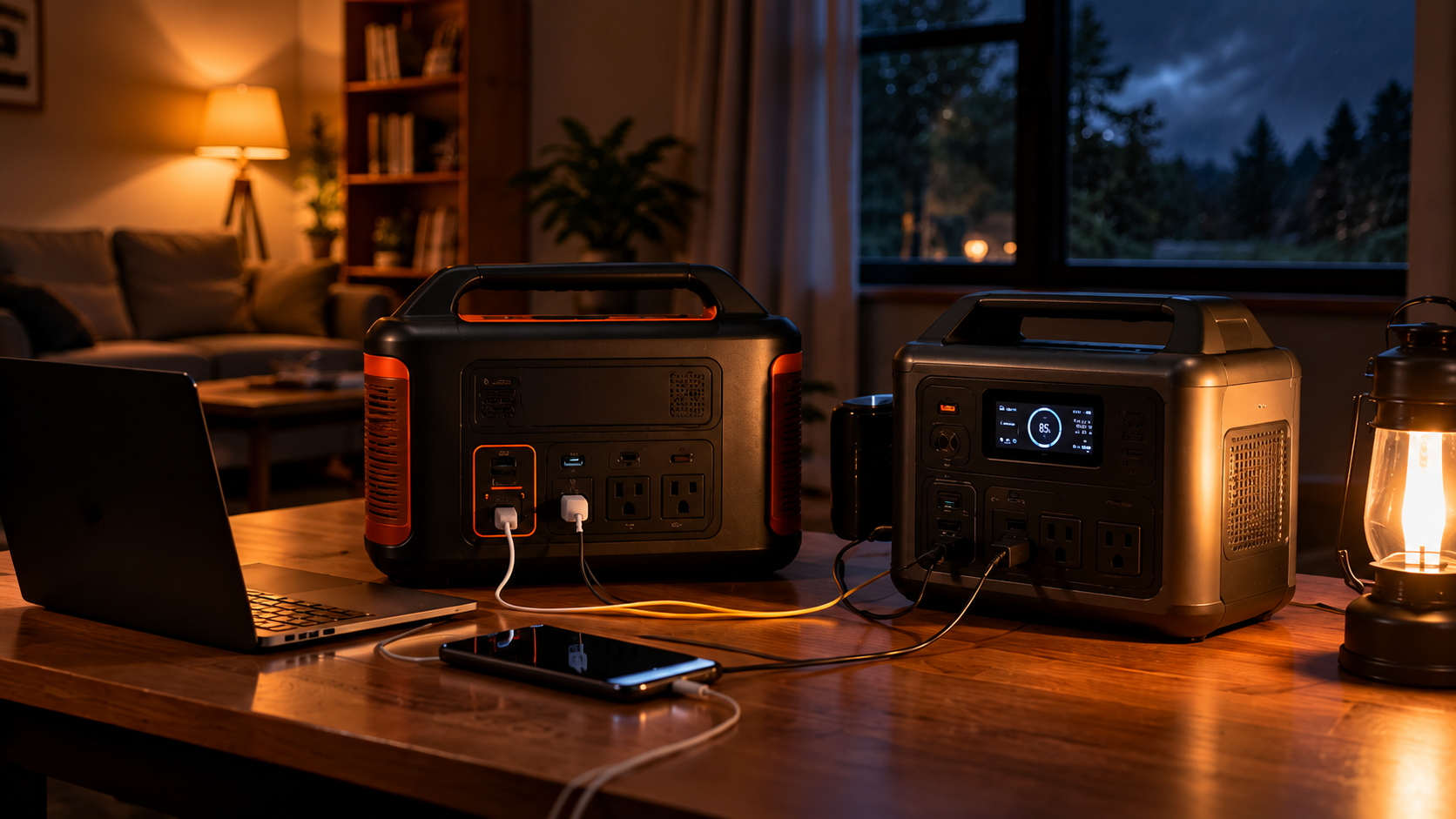
Short answer: there is no useful brand-wide winner. Compare models by usable battery capacity, continuous AC output, recharge time, solar-input limit, battery cycle rating, weight and expandability. In the roughly 1 kWh class, EcoFlow DELTA 2 offers 1024Wh, 1800W AC output and up to 500W solar input, while Jackery Explorer 1000 v2 offers 1070Wh, 1500W AC output and a lighter 10.8 kg package.
Affiliate disclosure: This page contains affiliate links. If you purchase through these links, we may earn a commission at no additional cost to you. As an Amazon Associate I earn from qualifying purchases.
Our two picks
Two roughly 1 kWh LFP power stations, with different strengths for emergency preparedness.
HIGHER OUTPUT & EXPANSION
EcoFlow DELTA 2
Higher output & expansion. 1024Wh, 1800W AC output, up to 500W solar input. Choose it when higher AC output, solar input and expandable storage matter most.
Find it Here →LIGHTER 1 kWh OPTION
Jackery Explorer 1000 v2
Lighter 1 kWh option. 1070Wh, 1500W AC output, about 10.8 kg. Choose it when lower weight and slightly more base capacity are priorities.
Find it on Amazon →For emergency preparedness, we currently prefer EcoFlow DELTA 2 when higher AC output, 500W solar input or add-on battery support matters, and Jackery Explorer 1000 v2 when lower weight and slightly more base capacity are more important than maximum inverter output or expansion. Availability and price can change that decision.
EcoFlow DELTA 2 vs. Jackery Explorer 1000 v2
| Specification | EcoFlow DELTA 2 | Jackery Explorer 1000 v2 |
|---|---|---|
| Battery capacity | 1024Wh | 1070Wh |
| Battery chemistry | LFP / LiFePO4 | LFP / LiFePO4 |
| Rated AC output | 1800W | 1500W |
| Manufacturer cycle rating | 3000 cycles to 80%+ capacity | 4000 cycles to 70%+ capacity |
| Maximum solar input | 500W | 400W using both DC inputs |
| Weight | about 12 kg | about 10.8 kg |
| Expansion | Supports one compatible extra battery | External battery packs not supported |
| Connectivity | Wi-Fi + Bluetooth app control | App control supported |
Specifications above are manufacturer ratings for current European product documentation reviewed in September 2026. Regional versions can differ.
Why EcoFlow DELTA 2 is our current starting recommendation
DELTA 2 combines a 1024Wh LFP battery, 1800W continuous AC output, up to 500W solar input, Wi-Fi/Bluetooth control and a manufacturer rating of 3000 cycles to at least 80% capacity. EcoFlow lists 1200W AC charging for the European model.
For preparedness, fast grid charging matters when electricity returns only briefly: a power station that can absorb energy quickly can make better use of an intermittent supply. The 12 kg weight also makes DELTA 2 easier to relocate than many larger expandable units.
The limitation is capacity. 1024Wh printed on the case does not mean 1024Wh will reach AC appliances; inverter and system losses reduce delivered energy. High-wattage heating appliances can also empty a 1 kWh-class battery very quickly.
EcoFlow DELTA 2
Our current value-oriented starting point for approximately 1 kWh of emergency home power. EcoFlow is an approved affiliate merchant through our Awin network.
Find it HereWhy choose Jackery Explorer 1000 v2 instead?
Jackery’s Explorer 1000 v2 provides 1070Wh capacity and 1500W rated AC output. Jackery specifies up to 400W solar input using both DC ports, about 1.7 hours for standard AC charging, and 4000 cycles with 70%+ of original capacity remaining.
Its strongest preparedness advantage in this comparison is portability. At about 10.8 kg, it is lighter than DELTA 2 while storing slightly more nominal energy.
The tradeoff is lower rated AC output, lower maximum solar input and no support for external battery packs. If expansion is a priority, the Explorer 1000 Plus is a different Jackery model and should not be confused with the 1000 v2 linked here.
Jackery Explorer 1000 v2
Better suited to buyers who value a lighter 1 kWh-class unit with 1070Wh capacity, 1500W output and long-cycle LFP chemistry.
Find it on AmazonSmall emergency loads: EcoFlow RIVER 2
Not every emergency requires a 1 kWh power station. EcoFlow RIVER 2 is a 256Wh LFP unit rated for 300W AC output, 110W maximum solar input and approximately 3.5 kg weight. EcoFlow specifies 0–100% AC charging in about 60 minutes and 3000 cycles to 80%+ capacity.
That class is appropriate for phones, lights, USB devices, some routers and laptop charging, but not as a general substitute for a larger refrigerator/home-backup system.
EcoFlow RIVER 2
Our compact option when communications, lighting and small electronics matter more than running large AC loads.
Find it on AmazonHow to choose the correct size
Start with energy, not marketing categories. Multiply each device’s approximate watts by the hours you need it to operate. A 60W device running for 8 hours requires roughly 480Wh before conversion losses. A 1000W heating appliance running for one hour requires roughly 1000Wh by itself. Before selecting battery storage capacity, use our watt and watt-hour sizing guide to calculate your daily energy budget.
Also check power separately from energy. Watt-hours (Wh) tell you how much energy is stored; watts (W) tell you how much load the inverter can supply at one time. A battery can have enough energy for an appliance but still be unable to start or run it if the appliance exceeds the station’s output limits.
Do not use generic refrigerator runtime claims
The previous version of this guide claimed a DELTA 2 would run a full-size refrigerator for 7–10 hours. We removed that claim because refrigerators differ substantially in compressor power, duty cycle, ambient temperature and startup behavior. Estimate runtime from the measured energy consumption of your own refrigerator and allow for conversion losses.
LFP cycle ratings: what they actually mean
Both models compared here use lithium iron phosphate (LiFePO4/LFP) cells, but cycle-life figures are not directly interchangeable unless the remaining-capacity threshold is also stated. EcoFlow rates DELTA 2 at 3000 cycles to 80%+ capacity; Jackery rates Explorer 1000 v2 at 4000 cycles to 70%+ capacity. Neither figure means the battery suddenly stops working at that cycle count.
Our verdict by scenario
- Value-oriented ~1 kWh home backup: EcoFlow DELTA 2.
- Lighter ~1 kWh option with slightly more base energy: Jackery Explorer 1000 v2.
- Phones, lights, router and laptops: a smaller unit such as EcoFlow RIVER 2 may be enough.
- Refrigerator backup: measure or estimate your refrigerator’s actual Wh/day before choosing.
- Electric cooking/heating: calculate carefully; resistive heating can consume a 1 kWh battery rapidly.
- Long outage: solar-input capacity, available panel area and weather become as important as battery size.
Sources and methodology
This comparison uses current manufacturer specifications rather than treating older brand reputations as permanent characteristics. We compare capacity, rated AC output, chemistry, cycle-life threshold, solar input, weight and expandability. Prices are intentionally not hard-coded because they change frequently.
- EcoFlow Europe — DELTA 2 specifications
- EcoFlow Europe — RIVER 2
- Jackery Europe — Explorer 1000 v2 specifications
Reviewed: September 2026. Specifications, regional models, availability and pricing can change.