
Portuguese Prepper
Gravity vs. Pump Water Filters: Which Is Better for a Group?
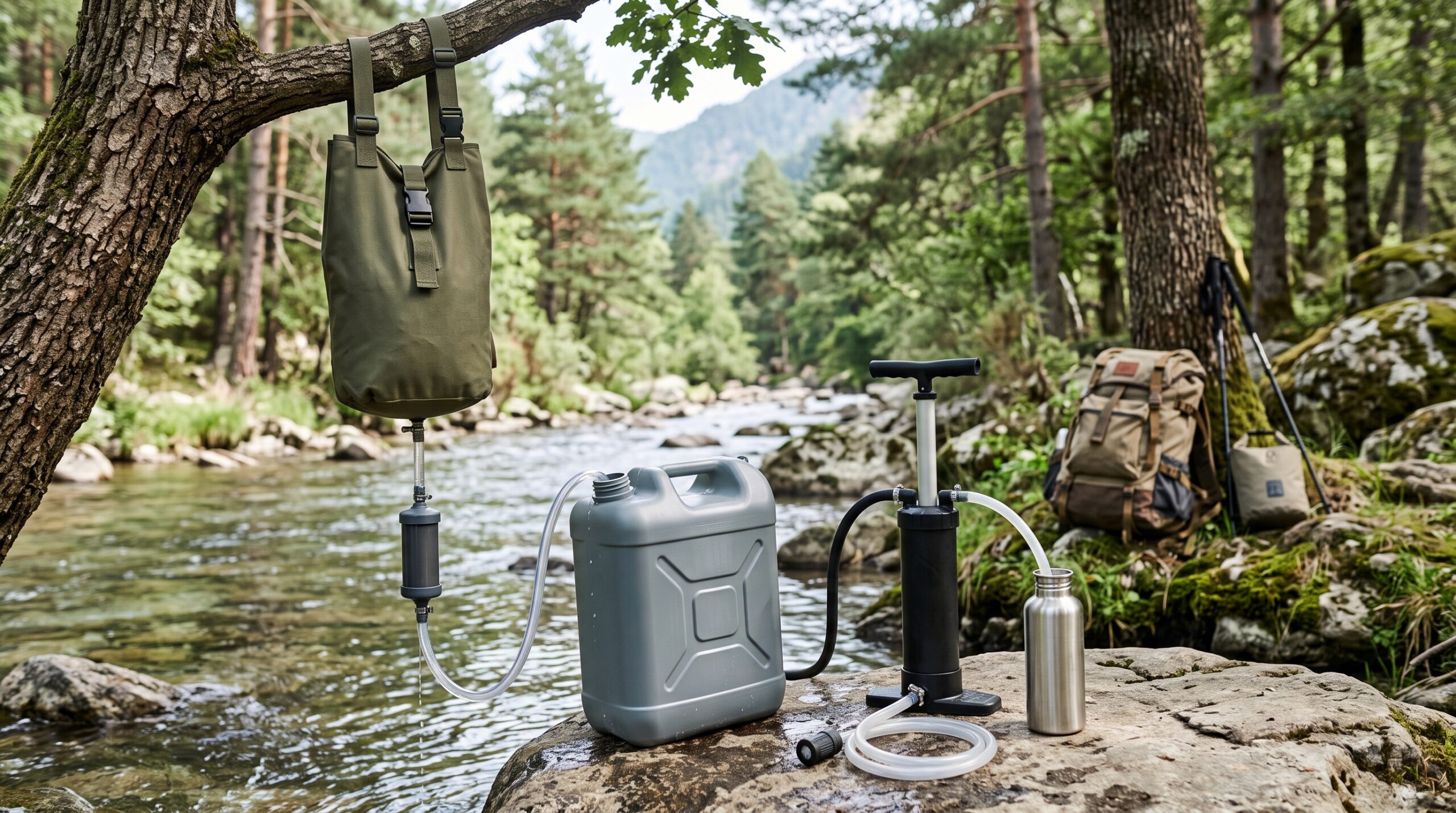
Short answer: for most families and groups, a gravity water filter is the better primary system. It can process several liters with little effort while you handle other tasks. A pump filter becomes more useful when the water source is difficult to scoop from or when you need to draw water directly through an intake hose.
Affiliate disclosure: This page contains affiliate links. If you purchase through these links, we may earn a commission at no additional cost to you. As an Amazon Associate I earn from qualifying purchases.
Our Group Water Filtration Picks
Choose gravity filtration for hands-off group water processing or a pump system when access to the source makes filling a reservoir difficult. Check the limitations of each filter for your water source.
BEST FOR GROUPS
Platypus GravityWorks 4L
A gravity-fed system for processing water in batches with minimal hands-on effort, suited to family and group setups.
Find it on Amazon →PUMP FILTER ALTERNATIVE
Katadyn Hiker Pro
A manual pump option for drawing water directly from sources where filling a gravity reservoir is impractical.
Find it on Amazon →
For a family emergency kit or basecamp, our primary choice is the Platypus GravityWorks 4L. The Katadyn Gravity BeFree 3L is a lighter gravity alternative, while the Katadyn Hiker Pro makes sense when direct-source pumping is more practical than filling a reservoir.
The important safety distinction is that gravity versus pump describes how water moves through the system—not what contaminants the filter removes. Always check the specifications of the actual filter element for bacteria, protozoa, viruses and other contaminants.
Gravity vs. Pump: Practical Comparison
| Question | Gravity Filter | Pump Filter |
|---|---|---|
| Best use | Families, groups, basecamp, bugging in | Individual/small group, awkward water access |
| Effort while filtering | Mostly hands-off after setup | Requires manual pumping |
| Water collection | Dirty-water reservoir must be filled | Intake hose draws directly from source |
| Batch processing | Excellent | Less convenient |
| Typical example | Platypus GravityWorks 4L | Katadyn Hiker Pro |
| Viruses | Depends on filter; GravityWorks does not remove viruses | Depends on filter; Hiker Pro is not a virus purifier |
Editorial verdict: if we were building one filtration kit for a household emergency, we would normally start with a gravity system. It produces several liters while requiring relatively little attention. A pump is better viewed as an alternative or complementary tool for situations where collecting water into a reservoir is difficult.
Why Gravity Filters Work So Well for Families
A gravity system separates collection from filtration. Fill the dirty-water reservoir, hang it above the clean reservoir or receiving container, and let gravity create the pressure needed to move water through the filter.
That matters when you are supplying several people. Instead of manually pumping every bottle, you can start the filtration process and use that time for cooking, shelter, communications or other preparedness tasks.
The Platypus GravityWorks 4L is specifically designed around this approach. Platypus lists a flow rate of up to 1.75 liters per minute and filter life of up to 1,500 liters, depending on water conditions and maintenance.
A four-liter system is particularly practical for a family because filtered water is often needed for much more than drinking: cooking, filling bottles, preparing food and supporting several people during an extended outage.
Where a Pump Filter Earns Its Place
A pump solves a different problem. Instead of filling a dirty-water bag, you place an intake hose in the source and manually pull water through the filter.
The Katadyn Hiker Pro is rated at approximately 1 liter per minute, with filter capacity of up to 1,150 liters depending on water quality.
Its 0.2-micron glass-fiber filter element also incorporates activated carbon, which can help reduce unpleasant tastes and odors. That gives the Hiker Pro a somewhat different role from the hollow-fiber gravity systems compared here.
A pump is particularly useful beside a steep bank, narrow opening, shallow accessible source or other location where repeatedly filling a large reservoir is inconvenient.
However, do not assume that an intake hose makes every tiny puddle usable. The prefilter still needs sufficient water around it, sediment can reduce performance, and filtration does not make chemically contaminated water safe.
Three Systems Compared
| System | Mechanism | Published Flow | Published Capacity | Best Fit |
|---|---|---|---|---|
| Platypus GravityWorks 4L | Gravity / hollow fiber | Up to 1.75 L/min | Up to 1,500 L | Families and groups |
| Katadyn Gravity BeFree 3L | Gravity / 0.1-micron hollow fiber | Up to 2 L/min | Up to 1,000 L | Lightweight group kit |
| Katadyn Hiker Pro | Manual pump / 0.2-micron glass fiber + activated carbon | About 1 L/min | Up to 1,150 L | Direct-source pumping |
These capacity figures are manufacturer-rated maximums rather than guaranteed cartridge lifespans. Actual performance depends on factors including sediment, water quality, cleaning and maintenance.
Which Water Filter Should You Buy?
Best for Groups: Platypus GravityWorks 4L
Our primary choice for a family or group preparedness kit. The 4-liter dirty and clean reservoirs allow relatively fast, hands-off filtration without manually pumping every bottle.
Find Platypus GravityWorks 4L on Amazon →Best Pump: Katadyn Hiker Pro
A strong choice when drawing water directly through an intake hose is more practical than repeatedly filling a gravity reservoir. The activated-carbon component can also help reduce unpleasant tastes and odors.
Find Katadyn Hiker Pro on Amazon →Best Lightweight Gravity Option: Katadyn BeFree 3L
A lighter alternative for a mobile preparedness kit. Katadyn specifies flow up to 2 L/min, a 3-liter reservoir and a 0.1-micron hollow-fiber membrane.
Find Katadyn BeFree 3L on Amazon →Filter vs. Purifier: Do Not Confuse the Two
One of the most important distinctions in emergency water treatment is the difference between a filter and a purifier.
Gravity and pump simply describe the mechanism used to move water through a treatment element. They do not tell you whether that element addresses bacteria, protozoa, viruses, chemicals or other contaminants.
The GravityWorks and BeFree systems are designed around microfiltration for microorganisms such as bacteria and protozoa. The Hiker Pro is likewise specified for bacteria and protozoan cysts. These products should not be treated as universal virus purifiers.
If viruses are a credible concern, use a treatment method specifically documented for virus reduction or combine appropriate filtration with an effective disinfection method. If chemical or toxic contamination is suspected, neither ordinary backpacking filtration nor disinfection should be assumed to make the source safe.
A Better Family Emergency Water Strategy
A portable filter should be one layer of your water plan—not the entire plan.
- Store potable water first. Stored drinking water avoids the uncertainty and labor of emergency collection.
- Use the cleanest available source. Never choose visibly contaminated water simply because you own a filter.
- Use gravity filtration for volume. A multi-liter system is efficient for supplying a household.
- Keep a secondary treatment option. Appropriate chemical disinfection or boiling provides another layer when the situation requires it.
- Maintain redundancy. A small individual filter or purification method can remain usable if the primary group system is damaged or lost.
For a typical family preparedness kit, our preferred structure would therefore be a multi-liter gravity filter as the primary system, backed by an appropriate secondary treatment method and stored potable water.
Maintenance Matters More Than the Headline Capacity
Dirty water gradually reduces flow through any filter. Manufacturer capacity figures should therefore be treated as maximum ratings under suitable conditions rather than promises that every cartridge will process exactly that volume.
GravityWorks is designed for field backflushing, and Platypus recommends regular backflushing when flow decreases. Katadyn’s BeFree membrane can be cleaned by shaking or swishing it in clean water. The Hiker Pro uses an intake prefilter and filter protector, while its cartridge eventually requires replacement.
Learn the maintenance procedure before an emergency. Keep the required hoses, adapters, cleaning components and replacement elements with the filter rather than stored somewhere else.
Sources and Methodology
Product specifications were checked against manufacturer documentation. We distinguish manufacturer specifications from Portuguese Prepper editorial recommendations.
- Platypus GravityWorks — official specifications
- Katadyn Gravity BeFree 3L — official fact sheet
- Katadyn Hiker Pro — official manual
- CDC — water treatment while hiking, camping and traveling
Reviewed: September 2026. Product specifications, filter elements and availability can change. Verify current manufacturer specifications before purchase.