
Portuguese Prepper
Sawyer Squeeze vs. LifeStraw: Which is better?
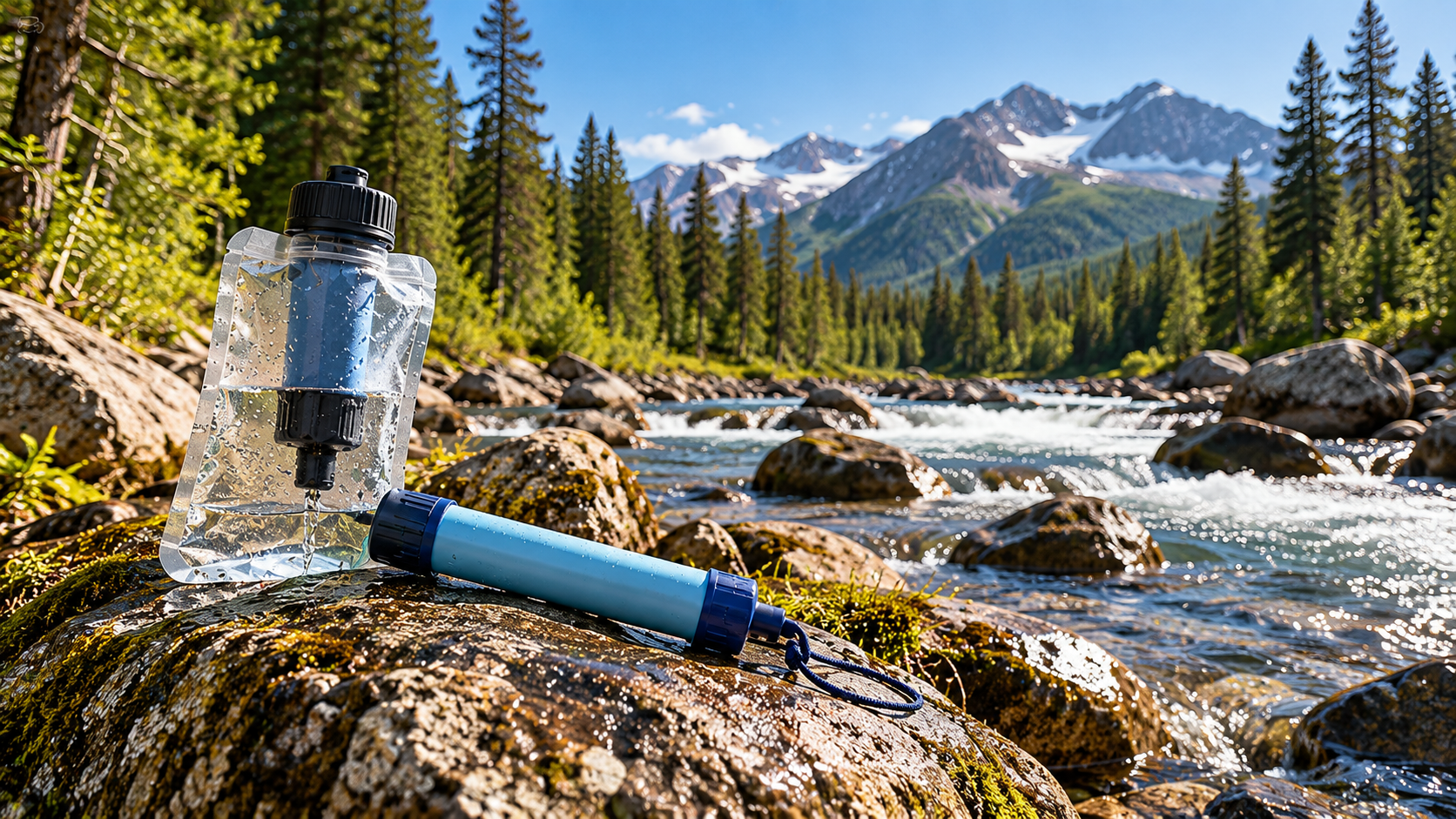
The Sawyer Squeeze and the original LifeStraw Personal are two popular portable water filters for bug-out bags, emergency kits and outdoor use. Both use hollow-fiber membrane filtration, but they function very differently in the field.
For most preparedness kits, the Sawyer Squeeze is our preferred primary filter because it can filter water into other containers, works with compatible bottles and pouches, can be configured for gravity filtration, and is designed to be backwashed and reused. The LifeStraw Personal is simpler and lighter, making it useful as an inexpensive personal backup.
Affiliate disclosure: This page contains affiliate links. If you purchase through these links, we may earn a commission at no additional cost to you. As an Amazon Associate I earn from qualifying purchases.
Our Emergency Water Filter Picks
A versatile primary filter and a lightweight personal backup for different preparedness needs.
PRIMARY WATER FILTER
Sawyer Squeeze
Filter into clean containers, use compatible bottles or pouches, and maintain the filter according to Sawyer’s backwashing instructions.
Find it on Amazon →PERSONAL BACKUP FILTER
LifeStraw Personal
A simple, lightweight drinking filter to keep as an independent backup. It does not replace treatment for viruses or chemical contamination.
Find it on Amazon →The core difference: Straw vs. system
The biggest practical difference is how you use the filters. The LifeStraw Personal is primarily designed for drinking directly through the filter. You place the inlet in the water source or a container and draw water through the filter by suction.
That simplicity is useful for personal emergency use, but it is less convenient when you need filtered water for another purpose, such as filling a clean bottle or preparing food.
The Sawyer Squeeze is a more flexible filtration system. Its 28 mm threading allows it to connect to the included pouch and compatible disposable water bottles. You can drink directly through the filter or squeeze filtered water into another bottle, pot or storage container. Compatible configurations can also turn it into a gravity filtration system.
Filtration performance
According to Sawyer, the Squeeze uses a 0.1-micron absolute hollow-fiber membrane and removes 99.99999% of bacteria such as Salmonella, Cholera and E. coli, 99.9999% of protozoa such as Giardia and Cryptosporidium, and 100% of microplastics.
LifeStraw specifies a 0.2-micron membrane microfilter for the LifeStraw Personal. The manufacturer states that it removes 99.999999% of bacteria, 99.999% of parasites and 99.999% of microplastics, dirt, sand and cloudiness. LifeStraw also states that the Personal meets US EPA and NSF P231 drinking-water standards for removal of bacteria and parasites.
Those percentages should not be interpreted as meaning that either product removes every possible water contaminant. The standard versions discussed here are microbiological filters rather than universal water purifiers.
Longevity and maintenance
The Sawyer Squeeze is designed to be backwashed when sediment and debris reduce its flow rate. Sawyer rates the filter for up to 100,000 gallons when properly maintained.
LifeStraw rates the Personal membrane microfilter for up to 1,000 gallons (4,000 liters). LifeStraw also provides cleaning and long-term storage procedures for the filter. The manufacturer states that the filter eventually reaches the end of its usable life when water can no longer pass through it.
For emergency preparedness, the practical advantage of the Sawyer is therefore not simply its theoretical capacity. Its combination of high rated lifetime, backwashing and multiple ways of dispensing filtered water makes it better suited to repeated use as a primary filtration system.
Which one should you buy?
Critical limitations of both
Neither standard filter discussed here should be treated as a universal water purifier. Sawyer states that the Squeeze does not remove contaminants such as dissolved chemicals, pesticides, VOCs, hydrocarbons, metals or salt. The standard LifeStraw Personal is likewise a membrane microfilter intended primarily for bacteria, parasites, microplastics and particulate contamination.
Most importantly, the standard Sawyer Squeeze and LifeStraw Personal should not be relied upon to remove viruses. If viral contamination is a realistic concern—for example, where water may be contaminated by human sewage—use an appropriate purification method or a purifier specifically rated for viruses.
Our preparedness recommendation
For a primary bug-out or emergency water kit: we prefer the Sawyer Squeeze. Its ability to dispense filtered water into other containers makes it substantially more useful when one filter needs to support drinking, cooking and more than one person.
For redundancy: the LifeStraw Personal makes sense as a compact secondary filter. Its simplicity is an advantage when the objective is simply to give one person an independent method of drinking filtered water.
For a robust preparedness system, do not rely on either portable filter as your only source of emergency water. Store potable water first, then use portable filtration and purification methods as additional layers of redundancy.
Sources and methodology
Product specifications and filtration claims were checked against current manufacturer information rather than relying solely on retailer descriptions. Filter performance, accessories and product specifications can change, so verify the current manufacturer’s documentation before depending on any filter for emergency use.
Reviewed: September 2026.