
Portuguese Prepper
Jase Case vs. Duration Health: Emergency prescription medication kits compared
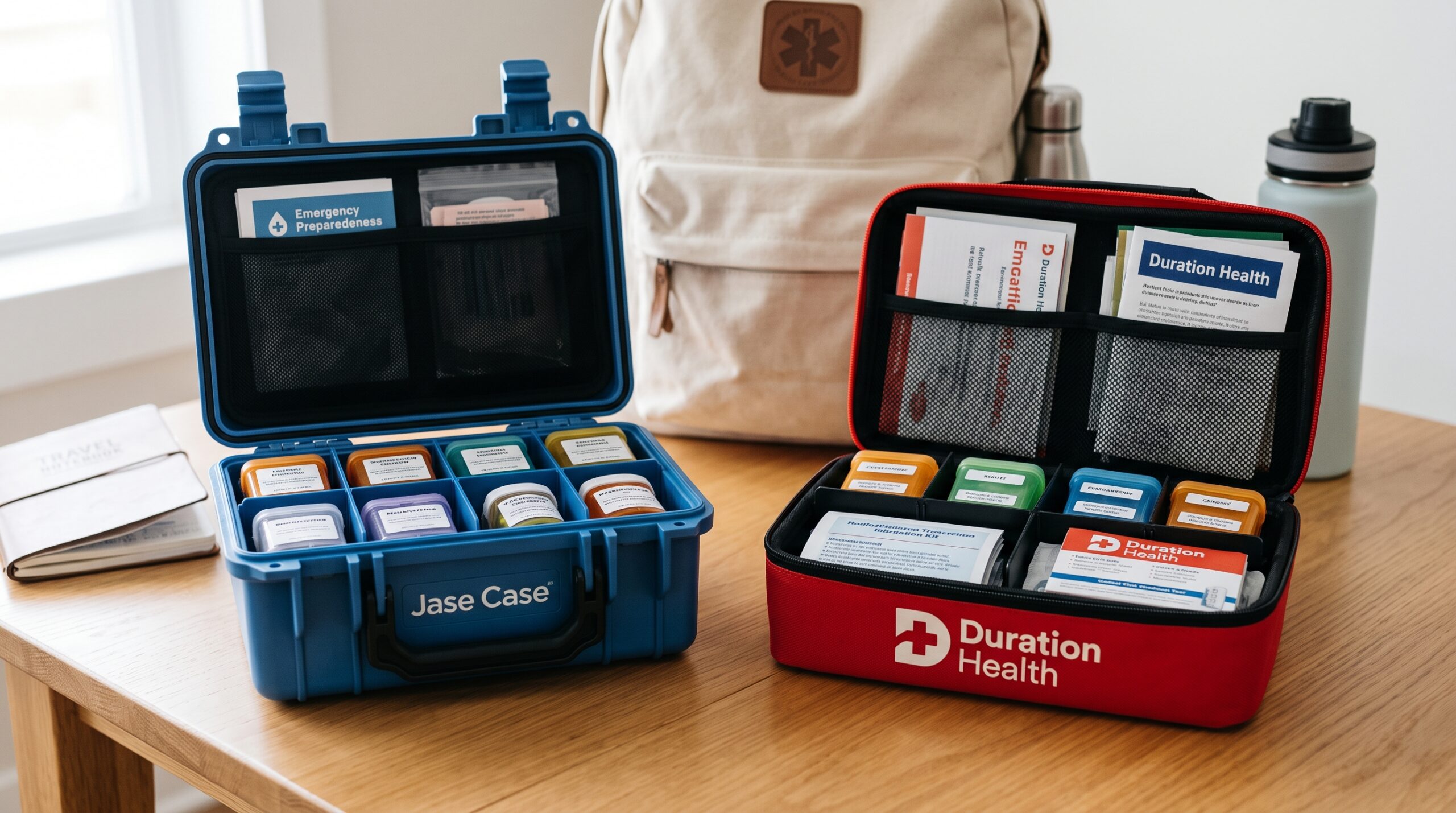
Short answer: Jase Medical and Duration Health both use telehealth and licensed medical professionals to provide eligible patients with prescription medications for emergency preparedness, but their approaches are different. Jase Case offers a relatively standardized core emergency-medication package with optional add-ons, while Duration Health offers multiple kit configurations with a broader range of possible medications and greater customization.
Neither service should be treated as a way to bypass medical care or independently diagnose and treat future illnesses. Prescription medications are issued to an individual patient after medical review, and the appropriate medication depends on that patient’s history, allergies, contraindications and circumstances.
Medical disclaimer: This page compares emergency-preparedness services and is not medical advice. Prescription medications should be obtained and used only under appropriate medical supervision and according to the prescribing clinician’s instructions. Seek professional medical care whenever it is available.
Jase Case vs. Duration Health: The Short Answer
For someone who wants a relatively straightforward emergency prescription-medication reserve, Jase Case is the simpler concept. Its current core package contains five antibiotics plus five additional symptom-relief medications, with optional medications available depending on medical appropriateness.
Duration Health takes a broader kit-based approach. It offers multiple configurations for adults, children, families, travel, off-grid use and other situations. Some of its larger kits contain more than 20 medications, while the company’s wider formulary includes more than 70 possible items.
The important qualification is that neither company’s website functions as a conventional online pharmacy shelf. A clinician determines whether prescription medication is appropriate for the individual patient.
Comparison at a Glance
| Feature | Jase Medical | Duration Health |
|---|---|---|
| Core approach | Standardized emergency medication case with optional add-ons | Multiple configurable Med Kits |
| Current core offering | 10 medications: 5 antibiotics + 5 additional medications | Varies by selected Med Kit |
| Customization | Optional add-on medications | Broad formulary and multiple specialized kits |
| Medical review | Required | Required |
| Prescription | Patient-specific | Patient-specific |
| Pharmacy fulfillment | Pharmacy network | Partner pharmacy / prescription pharmacy options |
| Daily medication preparedness | Separate Jase Daily service | Depends on service and medical eligibility |
| Best fit | Simpler standardized preparedness approach | Broader or more specialized preparedness requirements |
Offerings, prices, formulary options, eligibility and state availability can change. Always verify the current service before purchasing.
What These Services Actually Provide
Jase Medical and Duration Health are better understood as telehealth-based preparedness services rather than retailers selling unrestricted prescription medication.
With Jase, an order is reviewed by a licensed physician. When approved, the medications are prescribed for that patient and fulfilled through a pharmacy network. Depending on state requirements and individual circumstances, additional communication or an audio/video consultation may be required.
Duration Health similarly requires an online telehealth visit, including medical history and identity verification, before prescription medications can be issued. Duration explicitly states that not every patient will be medically eligible for every medication shown in its kits.
This distinction matters. You are not simply choosing pharmaceuticals from a preparedness catalog. The clinician remains responsible for determining what can appropriately be prescribed.
Jase Case: The More Standardized Approach
The Jase Case originally became known primarily as an emergency antibiotic kit, but the current product is broader.
Jase currently advertises a core package containing 10 medications: five antibiotics and five additional medications for symptom relief. The company also lists multiple optional add-on medications, subject to medical review and eligibility.
This makes the Jase Case relatively easy to understand as a preparedness product: begin with a defined core package and customize it where appropriate rather than designing an entire medication reserve from scratch.
The service includes physician review, pharmacy fulfillment and access to treatment-related support. Exact medication contents and availability should always be confirmed when ordering because the company’s offering can change.
Duration Health: The More Configurable Approach
Duration Health structures its offering around multiple Med Kits rather than one primary standardized case.
Its options include general adult and family kits as well as more specialized configurations for off-grid living, travel and particular preparedness needs. Duration states that its kits are built from a formulary containing more than 70 possible items.
Its larger Lifesaver Med Kit, for example, currently lists more than 20 medications and includes categories extending beyond antibiotics, such as antivirals, antifungals and other prescription medications.
That broader scope does not mean every customer can simply select every medication. Duration states that its provider determines what is medically appropriate based on the patient’s medical history and other factors.
Standardized vs. Customizable
This is the most useful distinction between the two services.
Jase Case: start with a recognizable core emergency-medication package and add eligible options where needed.
Duration Health: choose among multiple kit architectures and potentially build a broader or more specialized reserve through clinical review.
Neither philosophy is inherently better. A larger formulary is useful only if the additional medications are appropriate for the patient, understood by the patient and maintained correctly.
Which Service Makes More Sense?
Jase Case: Simpler Starting Point
A relatively standardized emergency medication reserve with a defined core package and optional add-ons. Consider it if simplicity and a straightforward preparedness model are priorities.
Duration Health: More Configurable
Multiple Med Kits and a broader formulary make Duration worth considering when your preparedness requirements are more specialized, subject to clinician approval and eligibility.
What About the Medications You Take Every Day?
Emergency medication preparedness is not only about antibiotics.
For someone who relies on a prescription medication every day, interruption of that existing treatment during an evacuation, supply-chain disruption or extended emergency may be a more immediate preparedness problem than not having a broad collection of antibiotics.
Jase addresses this separately through Jase Daily, which is designed around an extended supply of medications that the patient already uses. Jase currently lists support for medication categories including blood pressure, diabetes, cholesterol, heart health and others.
Do not stop, substitute, stockpile or alter the use of regular prescription medication without discussing the plan with the appropriate clinician or pharmacist.
One Prescription, One Patient
Prescription emergency kits should not be treated as a communal household medicine cabinet.
The medications are prescribed following evaluation of a particular patient. Allergies, other medications, medical conditions, pregnancy status, age and other factors can affect whether a medication is appropriate.
A prescription issued to one adult therefore should not be assumed to be appropriate for a spouse, child, friend or other family member.
If several household members need emergency medication preparedness, each person’s requirements should be addressed through the appropriate clinical process.
Expiration Dates Matter
Do not build a medication preparedness plan around the assumption that prescription drugs will remain suitable for use indefinitely after their printed expiration dates.
The FDA explains that an expiration date represents the period during which a medication is known to retain its strength, quality and purity when stored according to its labeled conditions.
The FDA advises consumers not to use expired medicines. Degraded medication may have reduced strength or other changes, and ineffective antibiotic treatment can have particularly serious consequences.
Check your emergency medications periodically and plan for replacement before or when they reach their labeled expiration dates according to the guidance supplied by the pharmacy, manufacturer and prescribing service.
What About the FDA Shelf-Life Extension Program?
You may encounter preparedness discussions claiming that government research proves medications remain usable long after expiration. This requires important context.
The FDA’s Shelf-Life Extension Program (SLEP) evaluates selected medical products held in controlled federal stockpiles. Specific products can receive extensions after appropriate testing and under controlled storage conditions.
That does not create a general expiration-date extension for medication stored in a household. The FDA specifically notes that consumer medications may have experienced widely varying storage conditions, making those institutional results unsuitable as a universal rule.
For a personal preparedness supply, follow the expiration information applicable to the medication you actually received.
Medication Storage Is Part of Preparedness
A prescription reserve is only useful if it is stored under appropriate conditions.
Follow the storage instructions supplied with each medication. The FDA notes that many medicines should be stored in a cool, dry location and protected from temperature extremes, while some products have more specific requirements.
Do not assume that a vehicle is an appropriate long-term location for an emergency medication kit. Cars can experience extreme heat and cold, and the FDA specifically warns against leaving medicines in a vehicle during summer or winter.
Keep medications secure from children and from anyone for whom they were not prescribed, and retain the labeling and information needed to identify each medication.
Emergency Antibiotics Are Not for Every Illness
Antibiotics treat particular bacterial infections. They do not treat viral illnesses simply because medical care is difficult to reach.
Unnecessary or inappropriate antibiotic use can cause adverse effects and contributes to antimicrobial resistance. Having antibiotics available in advance therefore does not remove the need for appropriate medical judgment.
Follow the instructions and clinical guidance supplied with your prescribed medications. When professional medical advice is available, use it rather than attempting to diagnose an infection solely from a preparedness guide or internet article.
Avoid Fish Antibiotics and Unapproved Animal Drugs
Do not substitute animal antibiotics for prescription medication intended for humans.
The FDA specifically warns that animal drugs should not be used to treat people. It has also taken action against sellers of unapproved antimicrobial products marketed for aquarium fish and other animals.
Some may carry familiar drug names such as amoxicillin or ciprofloxacin, but that does not make an animal product an appropriate substitute for medication prescribed and dispensed for a human patient.
For emergency medication preparedness, use legitimate medical and pharmacy channels.
What These Kits Cannot Replace
An emergency prescription kit does not turn a household into a clinic.
- It does not replace diagnosis by a qualified healthcare professional.
- It does not guarantee that a stored medication is appropriate for a future illness.
- It does not replace emergency medical services when they are available.
- It does not replace first-aid and bleeding-control equipment.
- It does not eliminate contraindications, allergies, interactions or adverse effects.
- It does not make one person’s prescription appropriate for another person.
- It does not eliminate the need to monitor expiration dates and storage conditions.
Think of these services as one additional layer in a broader medical-preparedness plan, not as a substitute for the healthcare system.
The Bottom Line
Jase Case makes the most sense when you want a relatively simple, standardized emergency-medication package with the possibility of adding eligible medications.
Duration Health makes the most sense when you want to evaluate a broader or more specialized medication kit and value greater configurability, subject to the prescribing clinician’s assessment.
The decision should not be based simply on which service supplies the largest number of medications. A useful emergency prescription reserve is one that is medically appropriate for the individual patient, properly stored, within its expiration dates and accompanied by clear clinical instructions.
For people dependent on regular prescriptions, continuity of those existing medications should also be part of the preparedness plan rather than focusing exclusively on emergency antibiotics.
Sources and Methodology
- Jase Medical — Current Jase Case and Jase Daily information
- Jase Medical — Frequently Asked Questions
- Duration Health — Med Kits, eligibility and telehealth information
- Duration Health — Med Kit formulary information
- FDA — Expiration Dates: Questions and Answers
- FDA — Expiration Dating Extension and SLEP
- FDA — Ornamental Fish Drugs and You
This comparison evaluates the current structure of the two preparedness services rather than recommending particular prescription drugs or treatment protocols. Medication offerings, prices, eligibility, state availability and clinical policies can change.
Reviewed: September 2026.
Related pages
Medical disclaimer: This content is for general preparedness and educational purposes only. It does not provide diagnosis, treatment instructions or individualized medical advice. Prescription medications should be obtained and used under appropriate medical supervision. Seek professional medical care whenever available and emergency medical services when required.