
Portuguese Prepper
First Aid Kit Checklist: Build Your Own or Buy a Pre-Made Kit?
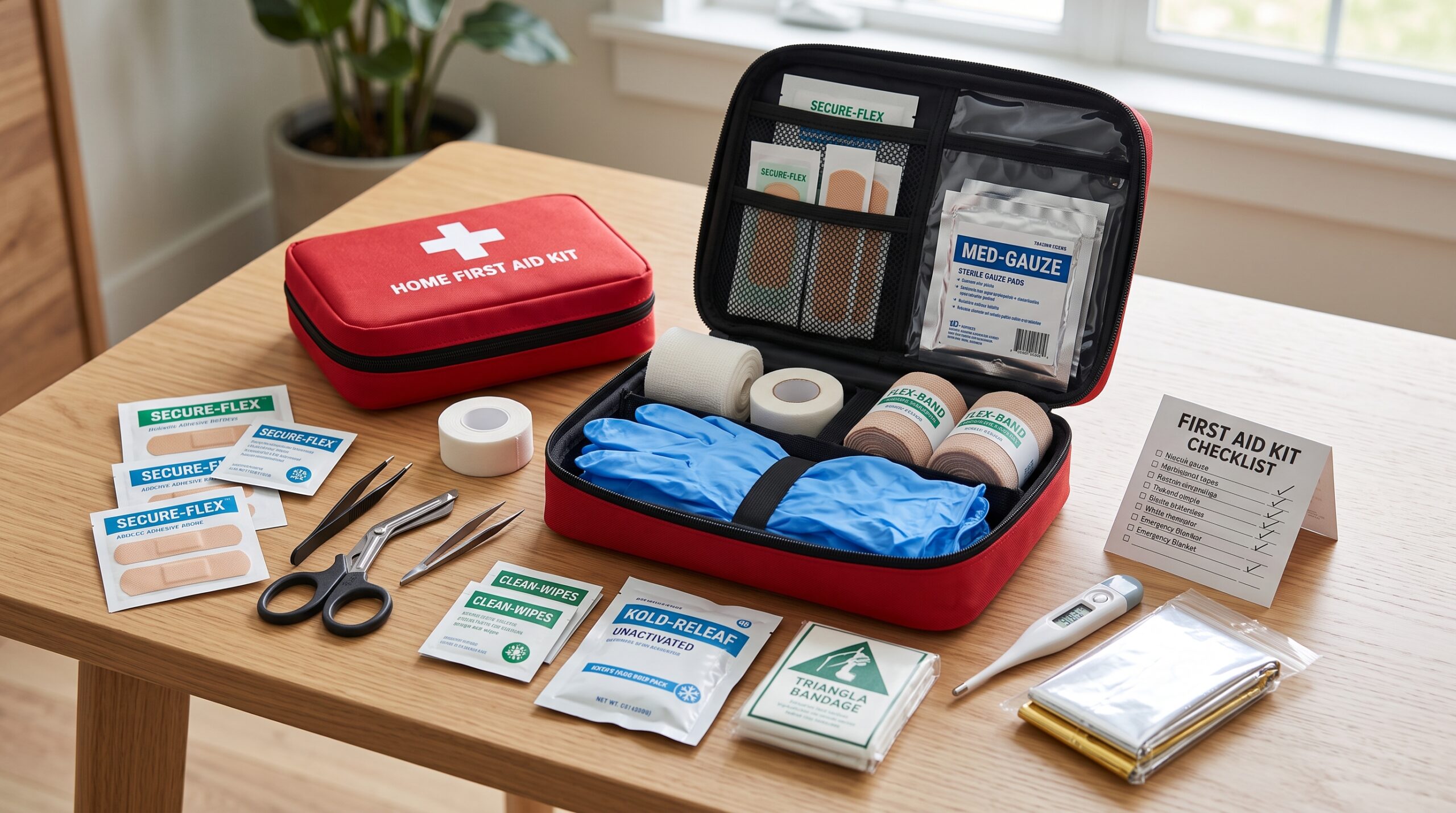
Short answer: a good household first aid kit should handle common injuries first—cuts, scrapes, burns, sprains and minor wounds—while a separate bleeding-control module adds capability for life-threatening hemorrhage. You can either build the system yourself or start with a reputable pre-made kit and customize it.
There is no universal rule that building is cheaper or that buying is better. Pre-made kits offer convenience and organization; DIY kits give you control over quantities, brands and specialized equipment. For most households, our preferred approach is hybrid: buy or assemble a solid general first aid kit, then add a dedicated bleeding-control module and personal medical supplies.
Affiliate disclosure: This page contains affiliate links. If you purchase through these links, we may earn a commission at no additional cost to you.
The First Aid Kit Checklist at a Glance
| Module | Purpose | Examples |
|---|---|---|
| Minor wounds | Cuts, scrapes and routine wound care | Adhesive bandages, sterile gauze, tape, antiseptic wipes, antibiotic ointment |
| Bandaging & support | Larger wounds and basic support | Roller bandages, triangular bandages, absorbent dressings |
| Severe bleeding | Life-threatening hemorrhage | Tourniquet, wound-packing gauze, pressure dressing |
| Personal protection | Reduce exposure while giving aid | Non-latex gloves, CPR breathing barrier |
| Tools | Assessment and access | Trauma shears/scissors, tweezers, thermometer, marker |
| Medications | Household-specific needs | Personal prescriptions and appropriate OTC medications |
| Information | Help guide response | First aid instructions, medication list, emergency contacts |
1. Core First Aid Supplies
Start with the supplies you are most likely to use. The American Red Cross recommends that a family first aid kit include equipment for wounds, bandaging, protection and basic assessment.
- Adhesive bandages: assorted sizes.
- Sterile gauze pads: several sizes.
- Absorbent compress dressings: for larger wounds.
- Roller gauze/bandages: for securing dressings.
- Medical cloth tape: for securing gauze and dressings.
- Antiseptic wipes: for appropriate first aid use.
- Antibiotic ointment packets: where appropriate for the user.
- Triangular bandages: useful for slings and bandaging.
- Instant cold compress: for appropriate minor injuries.
- Emergency blanket: useful for maintaining warmth.
- Tweezers: for appropriate minor foreign-object removal.
- Digital thermometer: non-mercury and non-glass.
These supplies may look less dramatic than trauma equipment, but they are likely to account for much of the actual use of a household first aid kit.
2. Personal Protection and CPR
- Non-latex examination gloves: keep several pairs in appropriate sizes.
- CPR breathing barrier: preferably with a one-way valve.
- Hand-cleaning supplies: where appropriate for your kit and situation.
Protecting yourself is part of providing first aid. Keep gloves readily accessible rather than buried beneath the rest of the kit.
3. Severe Bleeding Module
A standard household first aid kit and a bleeding-control kit are not exactly the same thing. We recommend adding a clearly identifiable severe-bleeding module rather than assuming ordinary adhesive bandages and gauze are sufficient for catastrophic hemorrhage.
- Commercial tourniquet: for appropriate life-threatening extremity bleeding.
- Compressed or hemostatic gauze: for wound packing when appropriate.
- Pressure dressing: to help maintain pressure over a wound.
- Trauma shears: to expose an injury quickly.
- Non-latex gloves: immediately accessible.
- Permanent marker: useful for recording information such as tourniquet application time.
- Bleeding-control instructions: stored with the module.
The American College of Surgeons Stop the Bleed program includes these types of components in its bleeding-control kits and emphasizes training in recognizing and controlling life-threatening bleeding.
4. What About Chest Seals?
Chest seals are specialized trauma equipment intended for penetrating chest injuries. Stop the Bleed includes them in some enhanced bleeding-control kits, rather than treating them as a universal component of every basic first aid kit.
They can make sense in an expanded trauma module for someone who has received appropriate training. We would not make them the defining requirement for a basic household first aid kit.
5. Skip Advanced Airway Devices Unless You Are Trained
The previous version of this checklist included a nasopharyngeal airway (NPA) as a standard component. We do not consider that necessary for a general household first aid checklist.
Advanced or specialized equipment is useful only when the person expected to use it has the appropriate knowledge and training. A larger inventory of medical equipment does not automatically create a more capable household responder.
6. Medications and Personal Medical Needs
Medication is where a generic checklist becomes personal. CDC recommends tailoring emergency supplies to the medical needs of the people who will use them, including prescription medicines and necessary medical equipment.
Depending on household needs and individual contraindications, a first aid inventory may include appropriate over-the-counter products such as:
- pain and fever medication;
- antihistamine;
- anti-diarrheal medication;
- hydrocortisone or other appropriate topical treatment;
- personal prescription medications;
- other medications recommended by your healthcare provider.
Medication choice and dosing depend on age, medical conditions, allergies, pregnancy, drug interactions and other individual factors. Keep medicines clearly labeled and follow their instructions.
7. Personal Medical Information
One of the most useful additions costs almost nothing: information.
Keep an updated record of relevant:
- emergency contacts;
- medical conditions;
- prescription medications and doses;
- known allergies;
- healthcare providers;
- insurance or other relevant medical information.
CDC recommends maintaining medication and medical information as part of emergency preparedness, particularly for people with ongoing health needs.
8. First Aid Instructions
Do not assume you will remember every procedure under stress.
The American Red Cross includes emergency first aid instructions in its recommended family kit, while Stop the Bleed includes bleeding-control instructions with its kits.
Keep concise instructions physically inside the kit so they remain available when a phone, internet connection or power source is not.
Build vs. Buy: Which Is Better?
| Factor | Pre-Made Kit | DIY Kit |
|---|---|---|
| Convenience | High | Lower |
| Organization | Usually ready immediately | You design the system |
| Component control | Limited to supplied contents | Complete control |
| Customization | Requires additions | Excellent |
| Cost | Depends on contents and brand | Depends on quantities and sourcing |
| Replacement | Individual items still need replenishment | Easy to standardize once established |
| Best for | Fast starting point | Users who know exactly what they want |
We would not claim that either approach is universally cheaper. Prices, quantities, component quality and the contents of commercial kits vary too much for a fixed comparison to remain reliable.
Our Preferred Approach: Buy, Audit, Customize
For many households, the easiest system is:
- Start with a reputable general first aid kit or assemble the Red Cross-style core supplies yourself.
- Open it and audit every component. Do not assume a large piece count means comprehensive capability.
- Add a dedicated bleeding-control module with equipment you know how to use.
- Add household-specific medications and medical supplies.
- Add written medical information and instructions.
- Train with the equipment before an emergency.
This avoids the false choice between an inexpensive bandage kit and an expensive trauma bag. They serve different purposes and can be combined into one organized household medical system.
Pre-Made and DIY Options
Pre-Made Option: MyMedic MyFAK
A commercially assembled option for users who value organization and convenience. Audit the exact current contents against your household requirements before relying on it.
Trauma-Focused Option: RHINO RESCUE Trauma IFAK
A trauma-oriented commercial option designed around emergency bleeding-control capability. Compare its current contents with the general first aid supplies you also need rather than treating one trauma kit as your entire medical inventory.
DIY Bag Option: Vanquest FATPack
An empty organizational platform for users who prefer to select and arrange individual medical components themselves.
Where Should You Keep First Aid Kits?
The American Red Cross recommends keeping a first aid kit at home and in your vehicle, and knowing where kits are located at work.
For preparedness, accessibility matters. A comprehensive kit that cannot be reached quickly is less useful than a smaller kit positioned where an injury is likely to occur.
Consider separate or appropriately sized kits for:
- home;
- vehicles;
- workplace;
- travel;
- outdoor activities;
- evacuation or emergency bags.
Maintain the Kit
A first aid kit is not a one-time purchase.
Inspect it regularly. Replace supplies after use, check medication and product expiration dates, verify packaging integrity and make sure batteries or electronic equipment still function where applicable.
CDC also recommends keeping individual emergency supplies updated and tailoring them as household needs change.
Training Is Part of the Kit
Buying trauma equipment does not teach you how to recognize life-threatening bleeding, perform CPR or respond to a medical emergency.
Consider recognized first aid, CPR/AED and bleeding-control training. Practice also reveals practical problems—such as equipment you cannot find quickly or packaging you struggle to open—that are difficult to discover by simply storing a sealed kit.
The best first aid kit is not the one with the highest piece count. It is the one containing appropriate supplies that you can identify, reach and use correctly.
Sources and Methodology
This checklist separates general household first aid from severe-bleeding equipment. Core first aid supplies are based primarily on current American Red Cross recommendations, while the severe-bleeding module uses American College of Surgeons Stop the Bleed guidance. CDC preparedness guidance informs personalization, medication and emergency medical information.
- American Red Cross — Make a First Aid Kit
- American College of Surgeons Stop the Bleed — Bleeding Control Kit Components
- CDC — Personal Needs and Emergency Medical Supplies
- American Red Cross — Survival Kit Supplies
Product contents and prices change. Commercial kits mentioned on this page should be evaluated according to their current contents rather than brand name or advertised piece count alone.
Reviewed: September 2026.
Related Pages
Medical safety note: This checklist is for preparedness and educational purposes and is not a substitute for professional medical advice or training. Use medical equipment and medications according to appropriate training, labeling and healthcare guidance.