
Portuguese Prepper
N95 vs. P100 Respirators: Which Is Better for Smoke, Dust and Fallout?
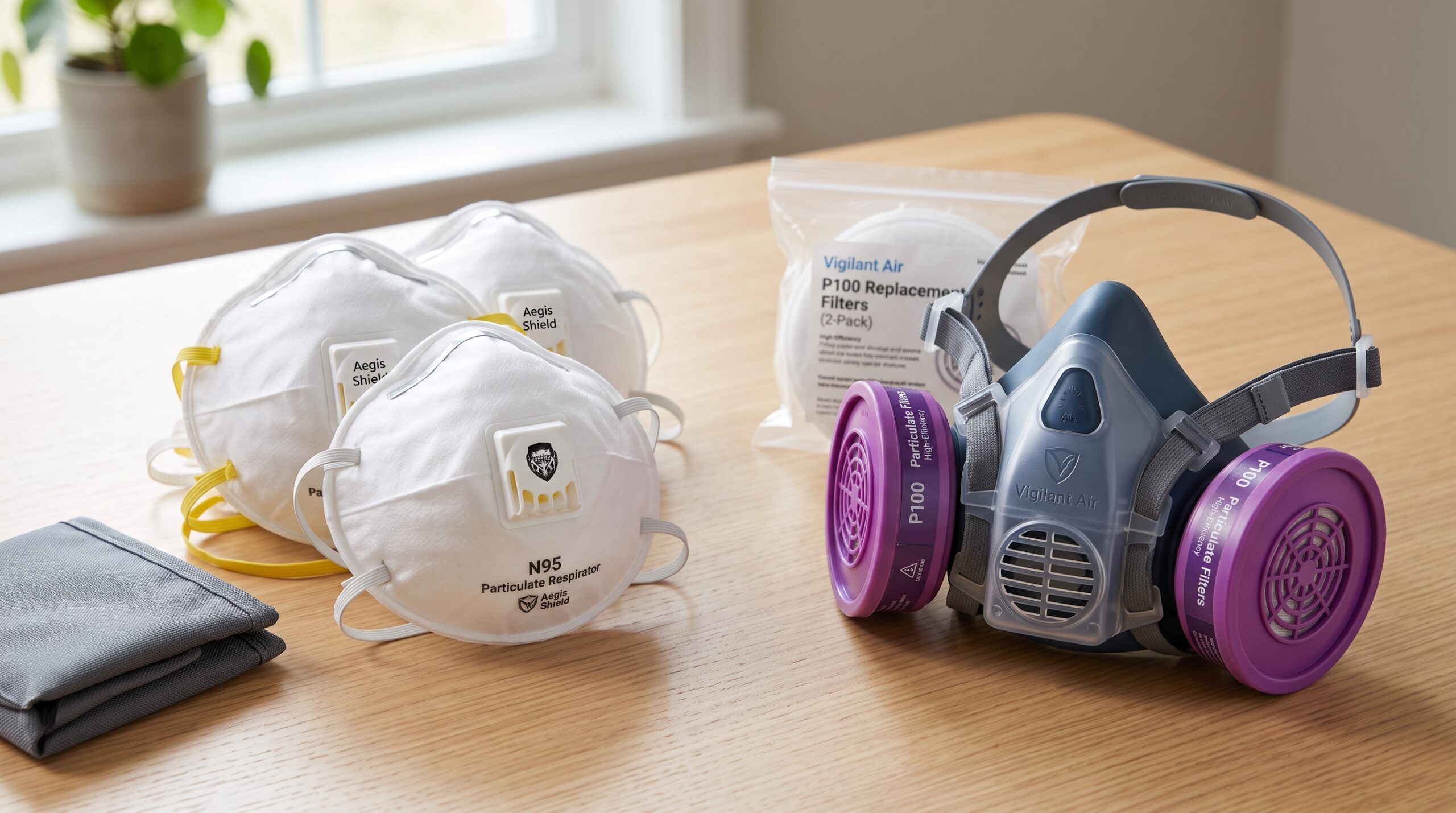
Short answer: a properly fitting NIOSH Approved N95 is a practical choice for wildfire smoke and many other non-oil particulate hazards. A P100 provides a higher particulate filtration rating and is strongly resistant to oil aerosols. For preparedness, however, the higher number does not automatically make P100 the better choice in every situation: fit, comfort, breathing resistance, availability and the specific hazard all matter.
For radioactive fallout, particulate respirators can help reduce inhalation of airborne radioactive particles. They do not protect you from external radiation, gamma radiation or every airborne chemical hazard. Respiratory protection is only one part of a fallout plan.
Affiliate disclosure: This page contains affiliate links. If you purchase through these links, we may earn a commission at no additional cost to you.
N95 vs. P100 at a Glance
| Feature | N95 | P100 |
|---|---|---|
| NIOSH particulate efficiency | At least 95% | At least 99.97% |
| Oil resistance | Not resistant to oil | Strongly resistant to oil |
| Wildfire smoke particles | Appropriate when properly selected and fitted | Appropriate when properly selected and fitted |
| Radioactive particles | Can reduce inhalation of particulate contamination | Higher particulate filtration class |
| Gases and vapors | No, unless the complete respirator is specifically approved for them | P100 alone does not provide gas/vapor protection |
| Typical preparedness format | Disposable filtering facepiece respirator | Often replaceable filters on a reusable elastomeric respirator; P100 filtering facepieces also exist |
| Best preparedness role | Portable, disposable particulate protection | Higher-efficiency reusable particulate-protection system |
Our recommendation: stock properly fitting NIOSH Approved N95 respirators for accessible, portable particulate protection. Consider a reusable respirator with P100 filters as an additional preparedness layer when you understand its fit, maintenance and limitations.
What N95 and P100 Actually Mean
NIOSH classifies particulate filters using a letter and a number.
The letter describes resistance to oil aerosols:
- N — not resistant to oil;
- R — resistant to oil;
- P — strongly resistant to oil.
The number describes the minimum particulate filtration efficiency under the applicable NIOSH test:
- 95 — at least 95%;
- 99 — at least 99%;
- 100 — at least 99.97%.
This means an N95 and a P100 differ in both particulate filtration classification and resistance to oil aerosols.
These ratings apply to the filter’s performance under standardized testing. The protection you actually receive also depends on whether the respirator fits and seals correctly.
N95: The Practical Disposable Option
A NIOSH Approved N95 filtering facepiece respirator is designed to filter at least 95% of airborne particles under the NIOSH test conditions and is not resistant to oil.
NIOSH specifically recommends NIOSH Approved N95 or P100 respirators as options for protection from wildfire-smoke particles when respirators are needed and can be worn correctly.
The main preparedness advantages of N95 filtering facepieces are portability, relatively low cost, compact storage and the absence of reusable facepiece maintenance.
Their limitation is that protection depends heavily on fit. Different faces fit different models, so there is no single disposable respirator that is automatically best for everyone.
P100: Higher Particulate Filtration
A P100 filter has a NIOSH particulate filtration rating of at least 99.97% and is strongly resistant to oil aerosols.
P100 filters are commonly encountered as replaceable filters fitted to reusable elastomeric half-mask or full-face respirators, although P100 filtering facepiece respirators also exist.
A reusable elastomeric respirator can be a useful preparedness tool because the facepiece is retained and compatible filters can be replaced according to the manufacturer’s instructions.
But reusable does not mean maintenance-free. The facepiece must be inspected, cleaned, stored correctly and used only with compatible filters or cartridges approved as part of the respirator system.
Which Is Better for Wildfire Smoke?
Wildfire smoke contains fine particulate matter that can penetrate deep into the respiratory system. NIOSH identifies properly selected NIOSH Approved N95 and P100 respirators as options for reducing exposure to smoke particles.
For most household preparedness kits, a well-fitting N95 can therefore be a practical first-line option for particulate smoke exposure.
A P100 provides a higher particulate filtration rating, but filtration percentage is not the only consideration. A respirator that fits poorly can allow contaminated air to leak around the seal instead of passing through the filter.
Neither an N95 nor a P100 particulate filter should be interpreted as universal protection from all gases and vapors that may be present in smoke or at a fire scene.
What About Radioactive Fallout?
Radioactive fallout can include particles that may be inhaled. A particulate respirator can reduce the amount of airborne particulate contamination you breathe when it fits and is used correctly.
But this limitation is critical:
An N95 or P100 respirator does not shield your body from penetrating external radiation.
Respiratory protection therefore does not replace sheltering. During a radiological emergency, follow official instructions and prioritize getting inside an appropriate building, increasing distance from radioactive material and placing shielding between yourself and the source where applicable.
Think of a particulate respirator as one tool for limiting inhalation of contaminated particles—not as a radiation suit.
P100 Does Not Mean Protection From Every Chemical
This is one of the most important distinctions when choosing respiratory protection.
N95 and P100 are particulate filter classifications. Particulate filters do not automatically protect against hazardous gases or vapors.
Protection against specific gases or vapors requires an appropriate respirator and cartridge combination approved for those contaminants.
Do not select a cartridge based on its color, appearance or the assumption that a more expensive filter provides universal protection. Identify the hazard first and use the manufacturer’s selection information for the complete respirator system.
What the 3M 2097 P100 Filter Actually Does
The 3M 2097 is a P100 particulate filter compatible with specified 3M reusable facepieces. It is rated for oil and non-oil particulate aerosols and provides at least 99.97% particulate filtration efficiency under the applicable NIOSH P100 criteria.
It also incorporates a carbon layer that 3M recommends for nuisance-level organic vapor relief.
That wording matters. Nuisance-level relief applies below applicable occupational exposure limits and should not be interpreted as respiratory protection against hazardous concentrations of organic vapors.
Fit Can Matter More Than N95 vs. P100
A tight-fitting respirator works by forcing inhaled air through its filtering material. Air that leaks around the edges bypasses that filter.
NIOSH recommends performing a user seal check every time you put on a tight-fitting respirator, following the manufacturer’s instructions.
In occupational settings where tight-fitting respirators are required, formal fit testing is part of the respiratory-protection program. Even outside the workplace, trying different models and sizes can help identify a respirator that seals better to your face.
Do not assume that a higher-rated P100 with a poor seal will necessarily provide better real-world protection than a properly fitting N95.
Facial Hair Is a Serious Problem
Facial hair that crosses the sealing surface of a tight-fitting respirator can create gaps and reduce protection.
NIOSH guidance states that tight-fitting respirators require the sealing surface to contact clean-shaven skin. Facial hair that does not interfere with the seal may be acceptable, but beards or stubble beneath the sealing surface can cause leakage.
This applies to both disposable N95 respirators and reusable tight-fitting elastomeric respirators.
What About Exhalation Valves?
Some filtering facepiece and reusable respirators incorporate exhalation valves. The valve can reduce exhalation resistance and may make a respirator more comfortable in hot conditions or during physical activity.
The presence of a valve does not change the need for proper fit or correct hazard selection.
If source control—reducing particles expelled by the wearer—is also important, follow current public-health and workplace guidance for the specific environment rather than assuming every valved respirator performs identically for outward emissions.
When Should You Replace a Respirator or Filter?
There is no universal rule that a particulate filter lasts a fixed number of days or months.
For disposable filtering facepiece respirators, NIOSH advises replacing the respirator when it becomes damaged, dirty or difficult to breathe through. Storage and reuse decisions should also follow the manufacturer’s instructions.
For reusable respirators, inspect the facepiece, valves, straps and filters before use and follow the manufacturer’s replacement, cleaning and storage requirements.
If the respirator has been exposed to contamination that makes safe reuse uncertain, do not assume that the filter’s appearance means it remains safe.
Which Respirator Belongs in Your Emergency Kit?
We would not choose between N95 and P100 as an either/or decision.
A layered household system can make more sense:
- NIOSH Approved N95 respirators: compact disposable protection for each household member against appropriate particulate hazards;
- spares: enough properly fitting respirators to replace units that become damaged, dirty or difficult to breathe through;
- reusable P100 respirator: an additional higher-efficiency particulate option for an adult who has selected, fitted and practiced with the system;
- replacement filters: compatible with the exact reusable facepiece;
- eye protection: where the hazard also threatens the eyes and the selected respirator does not provide full-face protection.
Do not wait until smoke, dust or another airborne hazard arrives to discover that the respirator you purchased does not fit.
How to Identify a NIOSH Approved Respirator
Look for the required NIOSH approval markings rather than relying only on marketplace descriptions or packaging claims.
NIOSH Approved filtering facepiece respirators display markings including NIOSH, the filter classification such as N95, and a NIOSH approval number in the form TC-84A-XXXX.
Counterfeit and misrepresented respiratory-protection products have appeared in the market, so verify unfamiliar models against the NIOSH Certified Equipment List when necessary.
The Bottom Line
For most household particulate-emergency kits, a properly fitting NIOSH Approved N95 is a practical foundation. It is compact, disposable and appropriate for hazards such as wildfire-smoke particles when used correctly.
A P100 provides a higher particulate filtration classification and strong resistance to oil aerosols. A reusable respirator equipped with P100 filters can therefore provide a useful additional preparedness layer for someone who understands its fit, maintenance and limitations.
But neither rating means universal respiratory protection. N95 and P100 filters do not automatically protect against gases and vapors, and neither protects your body from external ionizing radiation.
The correct sequence is: identify the hazard → select an appropriate NIOSH Approved respirator → obtain a proper seal → learn how to use it before the emergency.
Sources and Methodology
We compare N95 and P100 using current NIOSH filter classifications and manufacturer documentation for the specific products discussed. Filtration ratings describe standardized particulate-filter performance; they should not be interpreted as guarantees of individual protection without proper respirator selection, fit and use.
- NIOSH — Filtering Facepiece Respirators and Filter Classes
- NIOSH — Protecting Workers and the Public From Wildfire Smoke
- NIOSH — How to Use Your N95 Respirator
- NIOSH — Respirator Fit Testing
- 3M — Aura 9205+ N95 Specifications
- 3M — 2097 P100 Filter Specifications
Respirator approvals, product configurations and public-health guidance can change. Verify the current NIOSH approval and manufacturer’s instructions for the exact respirator or filter before relying on it.
Reviewed: September 2026.
Related Pages
Safety note: Respirator selection depends on the hazard. Particulate respirators do not provide oxygen and do not protect against every gas, vapor or immediately dangerous atmosphere. Follow official emergency guidance and the manufacturer’s instructions for the exact respirator you use.