
Portuguese Prepper
18650 vs. AA Flashlights: Which battery system is better for emergencies?
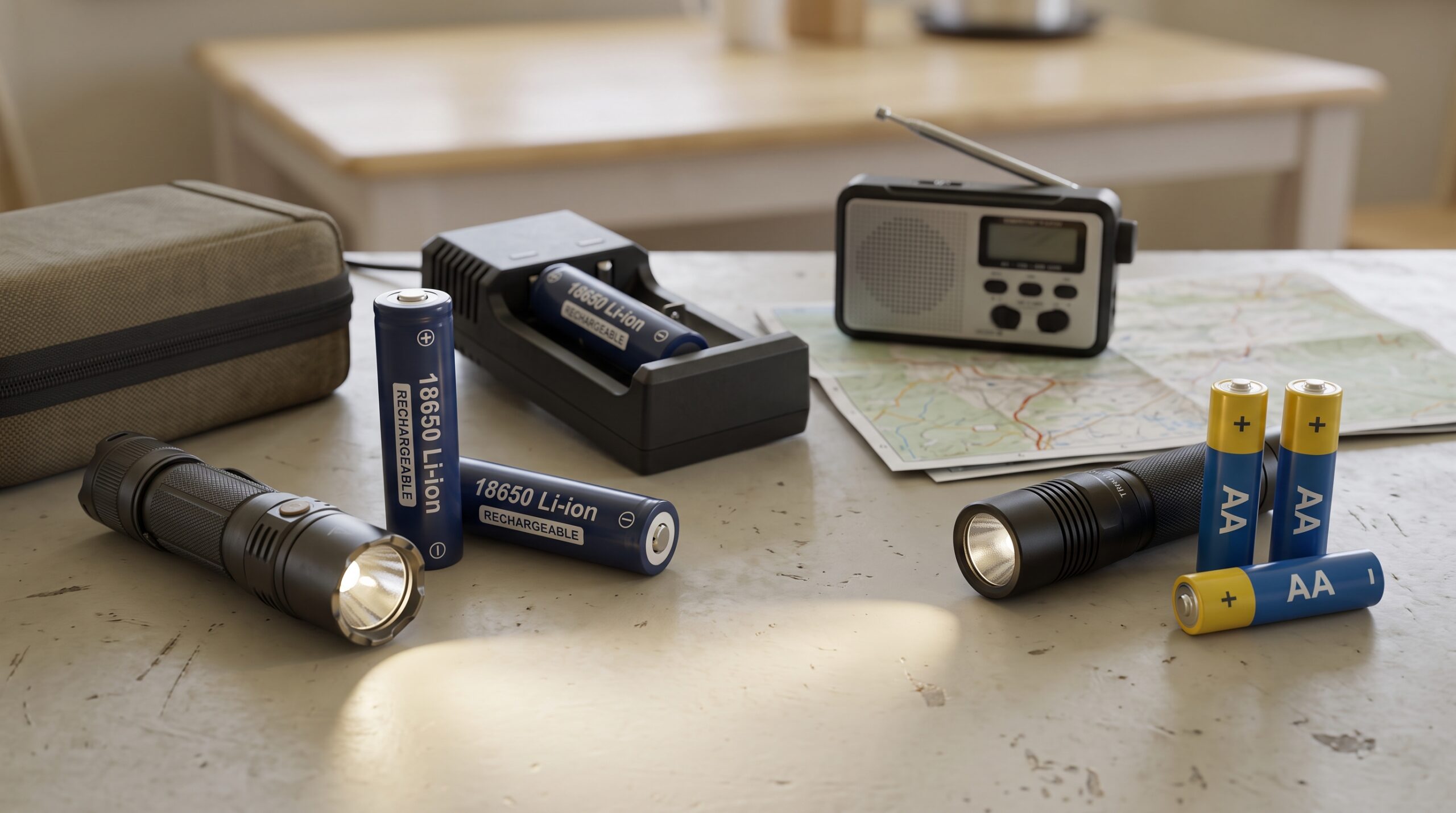
Short answer: neither battery format is universally better. A good 18650 flashlight can provide high output, substantial rechargeable energy capacity and excellent performance in a compact package. An AA flashlight trades some of that performance for a battery format that is widely available and can support several different battery chemistries when the flashlight manufacturer allows them.
Affiliate disclosure: This page contains affiliate links. If you purchase through these links, we may earn a commission at no additional cost to you. As an Amazon Associate I earn from qualifying purchases.
Our Emergency Flashlight Picks
Two practical options for building a primary-and-backup lighting system around different battery formats.
18650 PRIMARY FLASHLIGHT
Fenix PD35 V3.0
A rechargeable 18650-based flashlight suited to a higher-performance primary lighting setup. Check compatible cells and charging requirements.
Find it on Amazon →AA BACKUP FLASHLIGHT
ThruNite Archer 2A
A two-AA flashlight offering a practical backup based on a widely available battery format. Verify supported AA chemistries.
Find it on Amazon →18650 vs. AA: The Short Answer
| Feature | 18650 system | AA system |
|---|---|---|
| Typical chemistry | Rechargeable lithium-ion | Alkaline, Ni-MH rechargeable or primary lithium |
| Typical nominal voltage | About 3.6–3.7 V per Li-ion cell | About 1.2 V Ni-MH or 1.5 V alkaline/primary lithium |
| High-output flashlight potential | Excellent | More limited, depending on light and cell configuration |
| Rechargeability | Yes | Yes with rechargeable Ni-MH; no with primary AA cells |
| Battery availability | Specialized | Very widely available |
| Charging | Compatible Li-ion charger or supported in-light charging | Compatible charger for rechargeable AA cells |
| Best preparedness role | High-performance primary flashlight | Flexible backup and common-cell flashlight |
These are general characteristics, not compatibility rules. Always follow the battery specifications provided by the flashlight manufacturer.
Battery Size Is Not Battery Chemistry
One of the easiest mistakes to make when comparing flashlight batteries is treating 18650 and AA as two competing battery chemistries.
They are primarily physical formats.
The 18650 format is commonly associated with rechargeable lithium-ion cells used in higher-performance flashlights. A typical flashlight 18650 Li-ion battery operates at approximately 3.6 or 3.7 volts nominal, although the exact specifications depend on the cell.
AA is a standardized cylindrical format that can contain different chemistries. Common examples include 1.5 V alkaline batteries, 1.2 V rechargeable Ni-MH batteries such as Panasonic Eneloop, and 1.5 V primary lithium batteries such as Energizer Ultimate Lithium.
That distinction matters because chemistry affects voltage, rechargeability, self-discharge, temperature performance and other characteristics.
Why Comparing mAh Can Be Misleading
Battery listings frequently advertise capacity in milliamp-hours (mAh), but comparing mAh between batteries operating at different voltages can be misleading.
A better approximation of stored energy is watt-hours:
Watt-hours (Wh) = nominal voltage × amp-hours (Ah)
For example, a hypothetical 3.6 V 18650 rated at 3,000 mAh has approximately:
3.6 V × 3.0 Ah = 10.8 Wh
A hypothetical 1.2 V Ni-MH AA rated at 2,000 mAh has approximately:
1.2 V × 2.0 Ah = 2.4 Wh
That illustrates why mAh alone cannot tell you which battery stores more energy. It also does not mean that every 18650 contains a fixed multiple of the energy of every AA battery. Actual capacities, chemistries, discharge conditions and flashlight designs vary.
The Case for an 18650 Flashlight
The main preparedness advantage of the 18650 format is its combination of rechargeable energy storage and the ability to support compact, high-performance flashlight designs.
That makes an 18650-based light attractive as a primary flashlight for regular use, power outages, property checks and other situations where substantial output and repeated recharging are useful.
Modern 18650 flashlights may also offer convenient charging systems. Some charge the battery inside the flashlight through USB, while others require the cell to be removed and placed in a compatible external charger.
The disadvantage is logistical dependence on the correct battery and charging system. An 18650 is not something you should expect to find alongside ordinary household batteries in every store during an emergency.
If your emergency lighting system depends on rechargeable lithium-ion cells, spare compatible cells and a realistic way to recharge them should be part of the plan.
The Case for an AA Flashlight
The major advantage of AA is not maximum flashlight performance. It is logistical flexibility.
AA batteries are used in a huge range of household and commercial products and are widely sold. A flashlight designed around this format therefore gives you access to a much more common battery ecosystem.
Some AA flashlights can also operate with more than one AA chemistry, giving the owner different options for routine rechargeable use and emergency storage.
However, compatibility must be confirmed for the specific flashlight. Do not assume that alkaline, Ni-MH and lithium AA cells are interchangeable in every device merely because their dimensions are similar.
For preparedness, this makes a good AA flashlight particularly attractive as a backup even when a higher-performance rechargeable light is the primary system.
AA Alkaline vs. Ni-MH vs. Lithium
| AA chemistry | Rechargeable? | Main preparedness advantage | Main tradeoff |
|---|---|---|---|
| Alkaline | No | Cheap and extremely common | Leakage risk and weaker performance in demanding applications |
| Low-self-discharge Ni-MH | Yes | Reusable and suitable for frequently used compatible devices | Requires a compatible charging system |
| Primary lithium | No | Long storage life, low weight and strong temperature performance | Higher purchase cost and not rechargeable |
This is why saying that an “AA flashlight” has a particular runtime, shelf life or cold-weather performance is too simplistic. Those characteristics depend partly on which AA chemistry the flashlight supports and which battery is installed.
For a deeper comparison of AA battery chemistries, see our Eneloop vs. Energizer Ultimate Lithium guide.
Lumens Come From the Flashlight, Not the Battery
A battery does not have a lumen rating.
The flashlight’s output depends on the complete system: LED, driver electronics, battery configuration, thermal management, operating mode and other design decisions.
Higher-energy battery systems can enable manufacturers to build very powerful compact flashlights, which is one reason lithium-ion cells are common in high-output models. But it is incorrect to say that AA batteries universally “max out” at a particular lumen figure or that an 18650 automatically produces thousands of lumens.
When comparing actual flashlights, use the manufacturer’s specifications for that specific model rather than assigning performance to the battery format alone.
Runtime Is a System Specification Too
The same principle applies to runtime.
A flashlight running at a low output can operate much longer than another light using a similar battery at maximum output. Some high-output modes also reduce output as the flashlight heats or the battery voltage changes.
For emergency preparedness, maximum runtime at the brightest setting is rarely the only useful specification.
Look at manufacturer runtime information across several modes. A moderate or low mode can be much more important during a multi-day outage than a short-lived maximum-output mode.
Charging During a Power Outage
Rechargeable batteries are only useful long term if you have a way to recharge them.
For an 18650-based system, that may mean:
- a flashlight with supported USB charging;
- a compatible external lithium-ion charger;
- a power bank;
- a portable power station;
- or another suitable off-grid power source capable of powering the charging system.
For rechargeable AA batteries such as Ni-MH Eneloops, you likewise need a compatible Ni-MH charger and a way to power it.
A solar panel can become one component of this system, but the practical chain is normally solar generation → suitable power storage/regulation → compatible battery charging. Do not assume that every charger can be connected directly to every solar panel.
18650 Battery Safety
Lithium-ion cells store substantial energy in a small package and should be treated accordingly.
Use the battery type specified by the flashlight manufacturer and follow its charging, handling and storage instructions. Do not use cells with damaged wrappers, visible deformation, corrosion or other signs of damage.
Loose lithium-ion cells should be protected from contact with conductive objects such as keys, coins or tools that could short the terminals. Use an appropriate battery case when carrying or storing spare cells.
Avoid unknown or counterfeit cells with implausible capacity claims. For a preparedness system, traceable batteries from reputable manufacturers or the flashlight manufacturer are preferable to choosing cells solely on advertised mAh or price.
A battery being physically similar in size is not proof that its voltage, current capability, protection system or dimensions are appropriate for your flashlight.
Can One Flashlight Use Both 18650 and AA Batteries?
Not normally.
A single 18650 and a single AA have different physical dimensions and substantially different nominal voltages. A flashlight designed for one should never be assumed to support the other.
Some flashlight designs support multiple battery formats or use manufacturer-approved adapters, but this is a feature of the specific flashlight.
Never insert a different battery type simply because it can be made to fit. Check the manufacturer’s compatibility list first.
Our Preferred Preparedness Strategy: Primary + Backup
For emergency preparedness, redundancy can be more useful than declaring one battery format the universal winner.
A practical system can look like this:
- Primary flashlight: a quality rechargeable lithium-ion light for regular use and higher-performance requirements.
- Spare battery: a manufacturer-compatible rechargeable cell stored and transported correctly.
- Backup flashlight: a quality AA model compatible with the battery chemistry you plan to stock.
- Rechargeable AA supply: low-self-discharge Ni-MH cells for routine use where supported.
- Long-storage AA reserve: appropriate primary batteries where supported by the flashlight.
- Charging redundancy: a charging system that does not depend exclusively on a functioning wall outlet.
This prevents one failed charger, depleted battery type or unavailable cell format from eliminating your entire portable-lighting capability.
Flashlights to Consider
USB-Rechargeable 18650 Batteries
Some 18650 batteries incorporate their own USB charging port, which can reduce dependence on a separate external charger. Examples include rechargeable cells sold by established flashlight manufacturers.
These should not be treated as universal replacement cells. Confirm physical dimensions, voltage, protection requirements and explicit flashlight compatibility before purchase or use.
The Bottom Line
Choose 18650 when your priority is a compact rechargeable system capable of supporting high-performance flashlights and you are prepared to maintain the correct batteries and charging infrastructure.
Choose AA when battery availability, format redundancy and flexibility are more important than maximizing performance from a single cell.
For a dedicated preparedness system, our preferred answer is often both: a rechargeable lithium-ion flashlight as the primary light and a common-cell AA flashlight as an independent backup.
Whichever platform you choose, buy the flashlight first and then build the battery system around the manufacturer’s specifications. Do not select batteries based solely on size, mAh, price or the assumption that anything that fits will work.
Sources and Methodology
- Fenix Lighting — PD35 V3.0 specifications and battery compatibility
- Fenix Lighting — Battery Guide
- Panasonic — Eneloop FAQ and battery guidance
- Energizer — Battery chemistry and performance information
- Nitecore — Battery and charger information
This comparison evaluates battery systems for emergency lighting rather than treating battery format alone as a measure of flashlight performance. Output, runtime, compatibility, charging requirements and supported battery chemistries must be verified for the specific flashlight and battery combination.
Reviewed: September 2026.