
Portuguese Prepper
Headlamp vs. Flashlight: Which is better for emergencies?
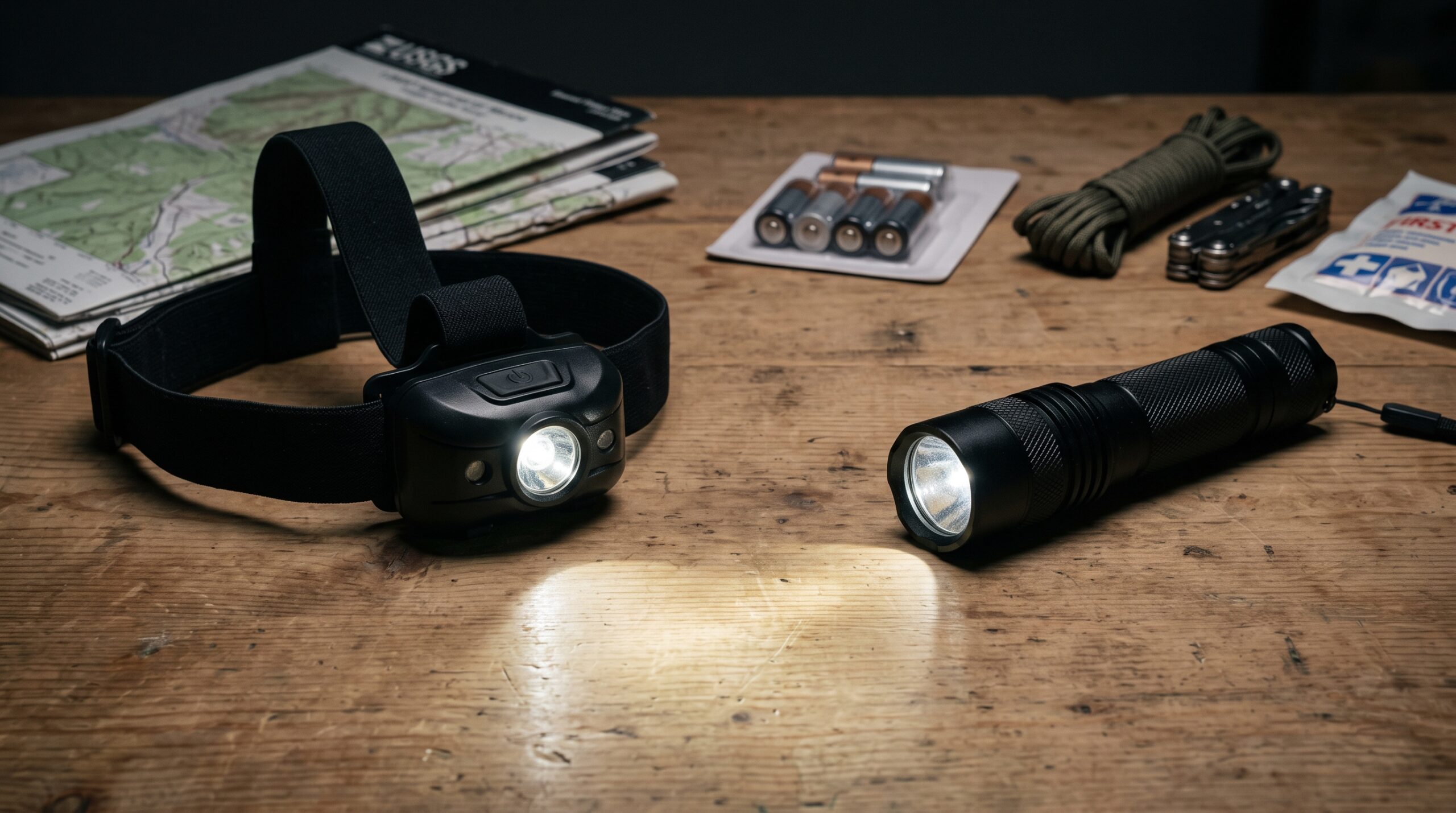
Short answer: a headlamp is usually the more useful primary light for emergency tasks because it keeps both hands free. A handheld flashlight is better when you need to deliberately aim the beam, inspect an area without moving your head, or use a light independently of the person wearing it.
Affiliate disclosure: This page contains affiliate links. If you purchase through these links, we may earn a commission at no additional cost to you. As an Amazon Associate I earn from qualifying purchases.
Our emergency lighting picks
Two complementary lights for emergency preparedness. A headlamp keeps your hands free, while a handheld flashlight gives you independent beam control.
HANDS-FREE EMERGENCY LIGHTING
Petzl ACTIK CORE
Rechargeable headlamp with manufacturer-supported compatibility with the CORE battery and suitable AAA batteries.
For repairs, first aid, walking and other tasks requiring both hands.
Find it on Amazon →HANDHELD BACKUP LIGHTING
Streamlight ProTac 1L-1AA
Compact handheld flashlight designed to accept multiple manufacturer-specified battery types.
For directed inspection, independent beam control and backup illumination.
Find it on Amazon →For preparedness, we prefer both. Use a headlamp as your hands-free task light and keep a separate flashlight as an independent backup. A lantern can then provide area lighting for a room or campsite.
Headlamp vs. Flashlight at a Glance
| Feature | Headlamp | Flashlight |
|---|---|---|
| Hands-free operation | Excellent | No |
| Task lighting | Excellent | Good |
| Independent beam aiming | Limited by head position | Excellent |
| Comfort over long periods | Depends on weight and headband | No head-mounted weight |
| Long-distance capability | Depends on model and beam | Depends on model and beam |
| Battery options | AAA, proprietary rechargeable packs or Li-ion depending on model | AA, CR123A, 18650 and other formats depending on model |
| Best emergency role | Hands-free working light | Directed inspection and backup light |
Our verdict: if you can only carry one light for hands-on emergency work, a headlamp has a major practical advantage. For a complete preparedness system, however, a headlamp and flashlight complement rather than replace each other.
Why Headlamps Work So Well in Emergencies
Many emergency tasks require two hands. Changing a tire, shutting off utilities, preparing food, carrying equipment, administering first aid or making repairs becomes substantially easier when the light follows your line of sight without occupying a hand.
That is the fundamental advantage of a headlamp. It is not necessarily brighter or more powerful than a flashlight; it simply places the light where it can illuminate your work while leaving your hands available.
For prolonged close-range tasks, a useful low or medium mode can be more valuable than an extremely bright maximum setting. Lower output also generally reduces battery consumption and glare.
Why You Still Need a Flashlight
A handheld flashlight provides something a headlamp cannot: you can point the light independently of where you are looking.
That is useful when inspecting a roof, tree line, vehicle, building exterior or other area while keeping your head and attention oriented elsewhere. It also makes it easy to hand the light to another person.
Some handheld models are designed around larger rechargeable cells and optics optimized for longer-distance illumination, but this is not an inherent property of all flashlights. Beam distance depends on the specific light’s output, reflector or optic, beam intensity and design.
Do not choose a flashlight solely because it advertises the highest lumen number. Beam pattern, useful runtime, controls, battery compatibility and durability can matter more during an extended outage.
Flood vs. Throw: Beam Pattern Matters
Portable lights are often described in terms of flood and throw.
A flood-oriented beam spreads light across a wider nearby area. That is useful for repairs, walking, cooking, setting up equipment and other close-range work.
A throw-oriented beam concentrates more intensity toward the center and can illuminate objects at greater distances.
Neither beam type belongs exclusively to headlamps or handheld flashlights. There are wide-beam flashlights and long-range headlamps. Check the beam characteristics and manufacturer specifications of the actual model rather than choosing solely by form factor.
What About Red Light Mode?
A red-light mode can be useful when you need relatively low illumination while trying to preserve more of your dark adaptation than you would under a bright white light.
It can also reduce glare when reading, checking equipment or working around other people at night.
However, red light should not be treated as mandatory for every emergency headlamp. Good low-output white modes can also be extremely useful, and the best mode depends on the task.
For general preparedness, we value a headlamp with several sensible brightness levels and easy controls more than one selected purely because it has a red LED.
Battery Flexibility: Petzl’s Hybrid Approach
The Petzl ACTIK CORE is particularly interesting for preparedness because Petzl’s HYBRID CONCEPT allows compatible models to use the rechargeable CORE battery or standard AAA/LR03 batteries.
That gives the user two energy paths: recharge the CORE battery during normal use, while retaining compatibility with an extremely common disposable battery format.
Battery flexibility is useful, but always follow the manufacturer’s compatibility instructions. Similar-looking batteries are not automatically interchangeable.
A Dual-Fuel Handheld Option
Battery flexibility also exists in handheld flashlights.
The Streamlight ProTac 1L-1AA is designed to accept more than one specified battery type. That can be useful in an emergency because the flashlight is not dependent on a single cell format.
The important point is that this compatibility is engineered into the specific flashlight. Never substitute batteries merely because they can physically fit.
A Weather-Ready Headlamp Alternative
Water resistance matters for emergency lighting because outages and evacuations do not necessarily happen in dry conditions.
The Black Diamond Spot 400 is another headlamp option worth considering where weather resistance and a compact hands-free format are priorities. Check the current manufacturer’s ingress-protection rating and operating instructions before relying on any light around water.
Battery Standardization vs. Battery Redundancy
It is tempting to make every emergency light use exactly the same battery. Standardization simplifies inventory, charging and spare-cell management.
But complete standardization also creates a single point of failure. If every light depends on one rechargeable battery format and the charger fails, your entire portable-lighting system may eventually become unusable.
For that reason, we prefer controlled redundancy rather than forcing every light onto one battery platform.
For example:
- Primary headlamp: rechargeable system with a manufacturer-supported common-cell alternative where available.
- Primary flashlight: rechargeable or multi-fuel system appropriate to its intended use.
- Backup light: a common-cell format such as AA or AAA.
- Spare batteries: stored according to manufacturer guidance and matched to the devices that actually support them.
This gives you some logistical simplicity without making every light dependent on one cell, charger or charging method.
Lumens Are Not the Whole Story
Maximum lumens are useful for comparing one aspect of flashlight performance, but they do not tell you how useful the light will be during a long emergency.
Also consider:
- runtime at low and medium settings;
- beam pattern and useful beam distance;
- ease of changing modes in the dark;
- battery availability and rechargeability;
- water and impact resistance;
- weight and comfort for headlamps;
- lockout features that prevent accidental activation in a bag;
- availability of replacement batteries or rechargeable packs.
A lower-output light that runs for many hours on a useful setting may be more valuable during a multi-day blackout than a very high-output light that rapidly consumes its battery at maximum power.
How Many Lights Should You Have?
A single flashlight is a fragile emergency-lighting plan. Lights can be misplaced, damaged, accidentally discharged or separated from the person who needs them.
For household preparedness, we prefer multiple independent layers:
- a headlamp for each person who may need to work or move independently;
- at least one handheld flashlight for directed illumination;
- an area light or lantern for rooms and shared spaces;
- compatible spare batteries or charging capability;
- at least one backup light that does not depend entirely on the same power system as every other light.
The exact quantity depends on household size, evacuation plans and how long you are preparing to operate without grid power.
Our Preferred Emergency Lighting System
For most preparedness kits, the question is therefore not really headlamp or flashlight.
We would build the system in three layers:
1. Headlamp — personal task lighting.
Use it for walking, repairs, cooking, first aid and other jobs where both hands matter.
2. Handheld flashlight — directed lighting.
Use it when you need independent control of the beam or want to inspect something at a distance.
3. Lantern — area lighting.
Use it to illuminate a room or shared workspace without requiring someone to wear or hold the light.
This is more resilient than trying to make one extremely powerful flashlight perform every lighting task.
The Bottom Line
If you can only choose one light for hands-on emergency work, choose a headlamp. Keeping both hands free is a substantial practical advantage during repairs, medical tasks, evacuation and power outages.
But a headlamp does not make a handheld flashlight obsolete. A flashlight gives you independent beam control and can serve as a separate backup lighting system.
For a complete preparedness setup, we recommend headlamp + flashlight + lantern, supported by a battery and charging strategy that includes redundancy rather than depending entirely on one device or one power source.
Sources and Methodology
We compare lighting formats by practical emergency role rather than assuming that one form factor is inherently brighter or more durable than another. Product specifications should always be verified against the current manufacturer documentation for the exact model.
- Petzl — Headlamps, CORE Battery and HYBRID CONCEPT Information
- Streamlight — ProTac Flashlight Specifications and Battery Compatibility
- Black Diamond Equipment — Headlamp Specifications
Maximum output, runtime, beam distance, battery compatibility and ingress-protection ratings can change between product generations. Verify current specifications before purchase.
Reviewed: September 2026.