
Portuguese Prepper
Best Emergency Lanterns: How to Light a Room During a Blackout
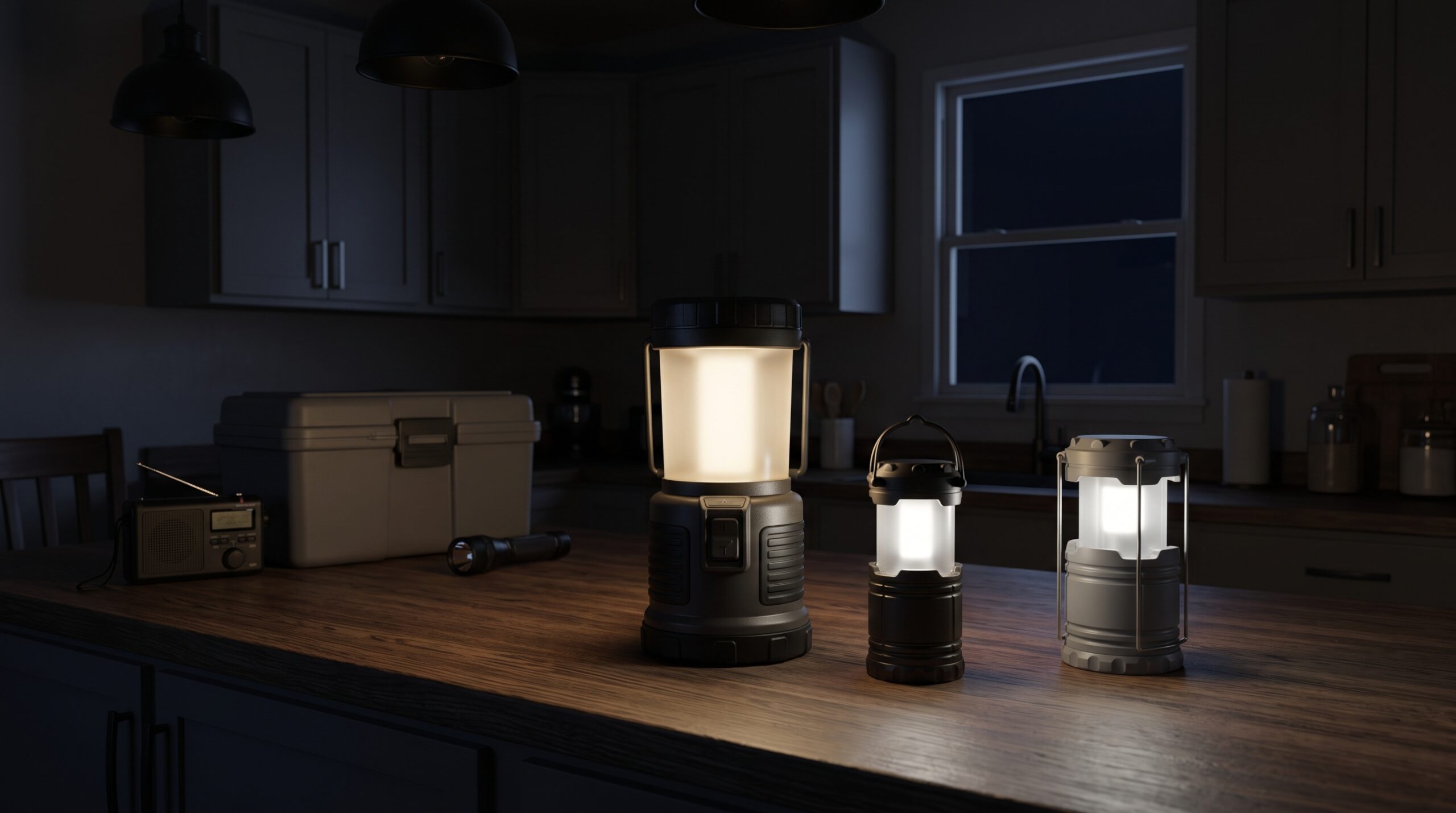
Short answer: an emergency lantern should provide useful area lighting for many hours without consuming your battery reserve unnecessarily. For a primary household lantern, we prefer a durable model with multiple brightness levels and long runtime. Smaller AA lanterns can then provide distributed backup lighting around the home.
Affiliate disclosure: This page contains affiliate links. If you purchase through these links, we may earn a commission at no additional cost to you. As an Amazon Associate I earn from qualifying purchases.
Our emergency lantern picks
Two complementary options for household blackouts. Choose a long-runtime primary lantern or a compact AA-powered backup.
PRIMARY HOUSEHOLD LIGHTING
Streamlight Siege
3 × D batteries · 55 lumens / 295 hours on low
Durable area lantern with multiple brightness levels and long manufacturer-rated runtime for extended household outages.
Find it on Amazon →COMPACT BACKUP LIGHTING
Streamlight Siege AA
3 × AA batteries · 50 lumens / 37 hours on low
Smaller lantern for secondary rooms and backup lighting, using the common AA battery format.
Find it on Amazon →A lantern serves a different role from a headlamp or flashlight. Headlamps are ideal for hands-free personal tasks, flashlights provide directed light, and lanterns illuminate shared spaces such as kitchens, bathrooms and living areas.
What Makes a Good Emergency Lantern?
The brightest lantern is not automatically the best emergency lantern. During an extended outage, you usually need enough light to move safely, prepare food, read, organize supplies and illuminate a shared space—not maximum output continuously.
We prioritize:
- Useful low and medium modes for conserving batteries;
- Long runtime at practical brightness levels;
- stable placement on tables, floors and other surfaces;
- hanging capability for overhead lighting;
- simple controls that are easy to operate in the dark;
- battery-status information where available;
- water and impact resistance appropriate to emergency use;
- a battery strategy that fits the rest of your preparedness equipment.
Emergency Lanterns at a Glance
| Option | Power | Best Role | Main Tradeoff |
|---|---|---|---|
| Streamlight Siege | 3 × D alkaline | Primary household area light | Large and relatively heavy |
| Streamlight Siege AA | 3 × AA alkaline | Compact room or backup lantern | Much shorter white-light runtime than D-cell Siege |
| Budget collapsible LED | Typically common replaceable cells; varies by model | Distributed backup lighting | Specifications and durability vary substantially |
| Headlamp used as area light | Depends on headlamp | Improvised backup | Not optimized for room illumination |
Our strategy: use one dependable lantern as the main shared light, then distribute smaller independent lights through important rooms. This provides redundancy without requiring every space to have an expensive primary lantern.
Streamlight Siege: Our Primary Household Pick
The full-size Streamlight Siege is a battery-powered area lantern designed around three D-cell alkaline batteries.
According to Streamlight’s current specifications, its white-light modes provide:
- High: 540 lumens — 30 hours;
- Medium: 275 lumens — 70 hours;
- Low: 55 lumens — 295 hours.
That low setting is particularly relevant to preparedness. Maximum brightness may be useful temporarily, but 55 lumens with a manufacturer-rated runtime of 295 hours provides a very different capability during an extended outage.
The Siege also has red-light modes, a battery-level indicator and multiple ways to hang the lantern. Streamlight rates it IPX7 for water resistance to 1 metre, states that it floats, and lists 2-metre impact-resistance testing.
With three D batteries installed, Streamlight lists its weight at approximately 879 g / 1 lb 15 oz. That makes it substantially less convenient for personal carry than a headlamp or small lantern, but portability is not its primary role in our system.
Streamlight Siege AA: Smaller and Easier to Distribute
The Streamlight Siege AA follows the same general area-lighting concept in a smaller package using three AA alkaline batteries.
Its current white-light specifications are:
- High: 200 lumens — 7 hours;
- Medium: 100 lumens — 15.5 hours;
- Low: 50 lumens — 37 hours.
The comparison with the full-size Siege illustrates why maximum lumens alone are not enough. At low output the two lanterns produce broadly similar nominal brightness—55 versus 50 lumens—but their manufacturer-rated runtimes are dramatically different because the larger lantern carries three D cells.
The Siege AA is IPX7 rated, floats and is impact-resistance tested to 2 metres. It also has a battery-level indicator, hanging hardware and red-light modes.
A magnetic base is included with the current yellow magnetic-base version; Streamlight also lists magnetic-base accessories for other configurations. Check the exact model before assuming the magnet is included.
What About Cheap Collapsible LED Lanterns?
Inexpensive collapsible LED lanterns can still have a legitimate role in a preparedness system.
Their main advantage is distribution. Instead of depending on one central lantern, several inexpensive lights can be placed in bedrooms, bathrooms, stairways or other locations where people may need immediate illumination when the power fails.
The problem is that performance varies considerably between products. Do not assume that every inexpensive lantern has poor runtime or durability, but also do not assume that an unverified lumen or runtime claim will match real-world performance.
Check the specifications of the exact product, inspect the battery compartment periodically and test emergency lights before you need them.
Runtime Matters More Than Maximum Lumens
A blackout lasting several days changes how lighting should be managed.
High mode can be useful for short periods when you need maximum visibility. For routine evening activities, lower output may provide enough illumination while preserving far more of your battery reserve.
For example, Streamlight rates the full-size Siege at 30 hours on its 540-lumen high mode, 70 hours at 275 lumens and 295 hours at 55 lumens.
That is why we would evaluate an emergency lantern by its entire output/runtime curve rather than selecting the model with the largest lumen figure printed on the packaging.
Battery Strategy: D Cells vs. AA
The full-size Siege and Siege AA illustrate a preparedness tradeoff between energy capacity and logistics.
D cells allow the larger Siege to provide very long runtime, but they are another battery format that must be stored specifically for that equipment.
AA batteries are used by a much wider range of emergency electronics and can therefore simplify inventory if other equipment already uses them.
Do not automatically choose one format for every device. As with our flashlight strategy, some controlled redundancy can be useful. A primary long-runtime lantern and smaller common-cell backup lights do not have to use identical batteries.
Whatever system you choose, keep compatible spare batteries available and follow the battery and device manufacturers’ storage instructions.
Where Should You Keep Emergency Lanterns?
A lantern stored at the bottom of an unlit cupboard is difficult to retrieve after the electricity has already failed.
Consider placing lighting in predictable, accessible locations:
- beside or inside each household emergency kit;
- near sleeping areas;
- near the main electrical panel or other utility controls;
- in or near the kitchen;
- on each occupied floor of the home;
- with evacuation equipment where appropriate.
Each household member should know where the lights are before an outage occurs.
Avoid Fuel-Burning Lanterns Indoors
For indoor emergency lighting, battery-powered LED lanterns avoid the combustion hazards associated with fuel-burning equipment.
Carbon monoxide is colorless and odorless. The CDC warns that fuel-burning devices can produce carbon monoxide and that it can accumulate indoors or in other enclosed or partially enclosed spaces.
Do not use portable fuel-burning camping equipment indoors contrary to safety guidance. During an outage, use battery-powered lighting indoors and maintain working battery-operated or battery-backup carbon-monoxide detectors.
The Headlamp Diffuser Trick
If your lantern fails or is unavailable, a headlamp or flashlight can provide improvised area lighting by shining it through or against a suitable translucent object that diffuses the beam.
A translucent water container is sometimes used for this purpose. The objective is simply to spread a concentrated beam across a wider area.
Treat this as a temporary improvisation rather than a substitute for dedicated emergency area lighting. Keep the light stable and follow the light manufacturer’s operating and heat-management instructions.
How Many Lanterns Do You Need?
There is no universal number because household size and layout vary. The objective is to avoid a single point of failure while providing light where people actually need it.
A practical household system might include:
- one primary lantern for the main shared living or working area;
- smaller lanterns or backup lights on other occupied floors or in important rooms;
- one headlamp per person who may need to work or move independently;
- at least one handheld flashlight for directed inspection;
- compatible spare batteries or charging capability for the expected outage duration.
This creates multiple independent lighting layers rather than depending on one device.
Our Preferred Emergency Lighting System
For household preparedness, we would divide lighting into three functional layers:
1. Headlamp — personal task lighting.
For repairs, cooking, first aid, walking and any other activity where both hands should remain free.
2. Flashlight — directed lighting.
For inspecting specific objects or areas and for keeping an independent portable backup.
3. Lantern — shared area lighting.
For kitchens, living spaces, bathrooms and other locations where several people benefit from the same light source.
The system is more resilient when those functions are distributed across several devices instead of expecting one very bright flashlight to do everything.
The Bottom Line
For a primary battery-powered household lantern, the Streamlight Siege remains our preferred option because its multiple output levels, long manufacturer-rated low-mode runtime and rugged design fit the requirements of extended outages particularly well.
The Siege AA sacrifices substantial runtime but gains a smaller form factor and the logistical convenience of AA batteries.
Lower-cost LED lanterns can complement either one by distributing backup lighting throughout the home. They should be treated as another layer of redundancy rather than automatically dismissed or assumed to perform like a premium lantern.
For indoor blackout preparedness, prioritize battery-powered lighting and reserve fuel-burning equipment for uses consistent with its manufacturer’s safety instructions and public-health guidance.
Sources and Methodology
We evaluate emergency lanterns primarily by their role in a prolonged power outage: usable output levels, manufacturer-rated runtime, battery requirements, durability features and ability to provide shared area lighting. Product performance figures below are manufacturer specifications, not measurements performed by Portuguese Prepper.
- Streamlight — The Siege Specifications
- Streamlight — Siege AA Specifications
- CDC — Emergency Power Sources and Lighting
- CDC — Carbon Monoxide Poisoning Basics
Output, runtime, battery compatibility, ingress-protection ratings and included accessories can change between product versions. Verify the current specifications of the exact model before purchase.
Reviewed: September 2026.