
Portuguese Prepper
Emergency power calculator: How many watts and watt-hours do you need?
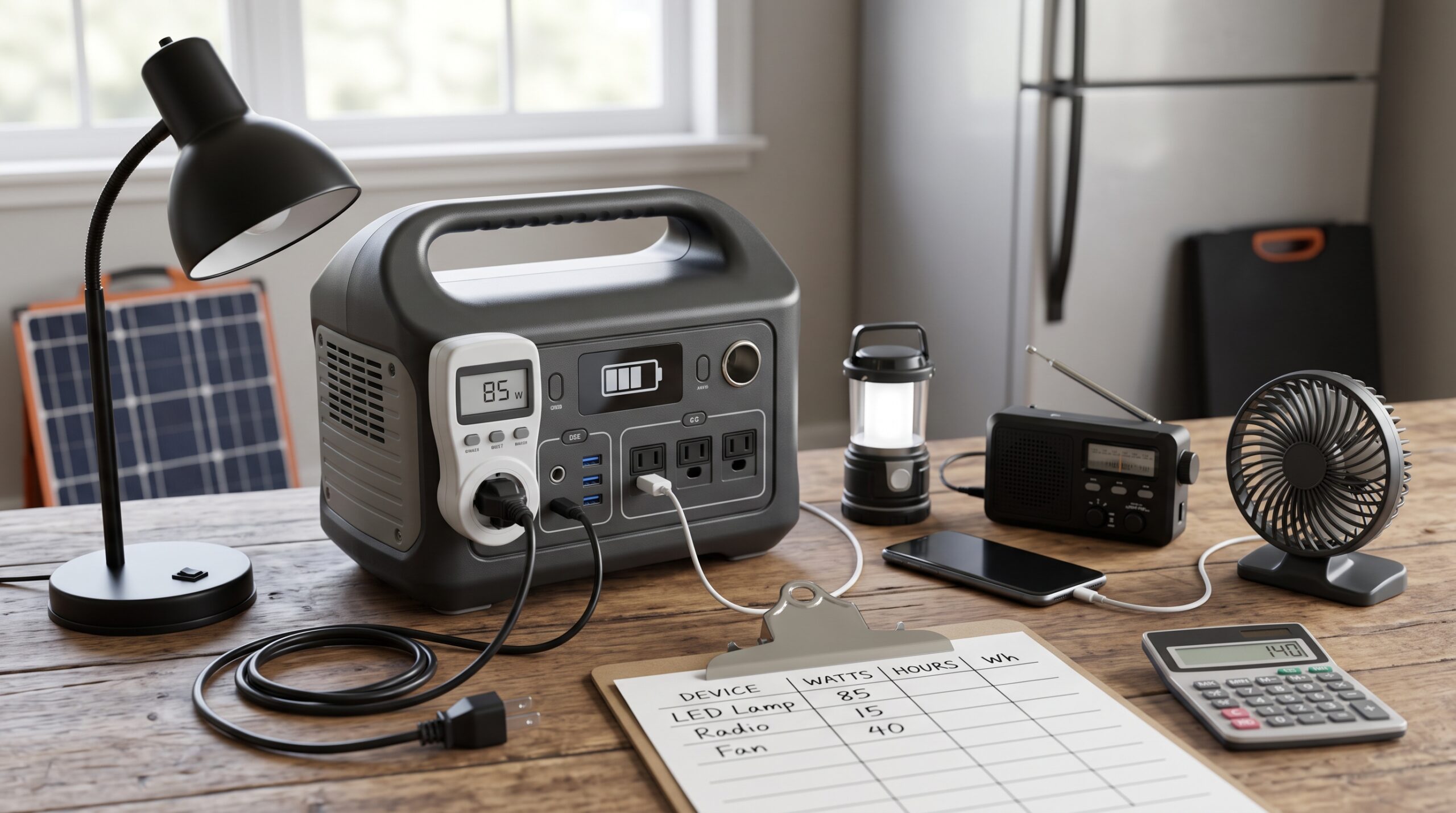
Short answer: you need to calculate both watts (W) and watt-hours (Wh). Watts determine whether a power station or generator can run your appliances at the same time. Watt-hours determine how long a battery can run them. Buying from watts alone can leave you with too little battery; buying from Wh alone can leave you with an inverter that trips when a motor starts.
Affiliate disclosure: This page contains affiliate links. If you purchase through these links, we may earn a commission at no additional cost to you. As an Amazon Associate I earn from qualifying purchases. The calculations and sizing methodology are independent of affiliate availability.
Our Emergency Power Planning Picks
Measure your actual electricity needs before choosing a backup power system. These two options support different stages of the planning process.
MEASURE YOUR POWER NEEDS
Electricity Usage / Watt Meter
Measure running watts and energy consumption from compatible plug-in appliances to build a more accurate emergency power budget.
Find it on Amazon →PORTABLE BACKUP POWER
EcoFlow DELTA 2
A portable power station to consider once you have calculated your required watts, daily watt-hours and expected backup duration.
Find it Here →Step 1: calculate simultaneous watts
List everything that may operate at the same time and add its actual running power. Then check whether any compressor, pump or motor has a higher starting demand. Your inverter/generator must accommodate the real combination of simultaneous loads and relevant starting demand.
Do not automatically add every appliance’s maximum surge together. Whether starting demands overlap depends on how the equipment operates. Conversely, do not assume a refrigerator always has a fixed 1,200W surge. Measure the appliance or use manufacturer data where possible.
Measure instead of guessing
For plug-in household appliances, an electricity usage meter can help you replace generic estimates with measurements from your own equipment. This is particularly useful for loads that operate for long periods or cycle on and off.
Electricity Usage / Watt Meter
Use a plug-in energy meter to measure watts and accumulated energy consumption from compatible household appliances before sizing your emergency power system.
Find it on AmazonStep 2: calculate daily watt-hours
For each load:
watts × hours used per day = Wh/day.
Example: a 10W LED lamp used for 5 hours needs about 50Wh. A 60W laptop averaging 4 hours of charging/use represents about 240Wh. Add all loads to estimate the daily energy budget.
Cycling appliances such as refrigerators are better measured with an energy meter over 24 hours or longer rather than calculated as rated watts × 24.
Worksheet
| Load | Measured/rated W | Hours/day | Wh/day | Starting demand? |
|---|---|---|---|---|
| Phone charging | Enter yours | Enter | W × hours | Usually not a motor-start issue |
| Router/modem | Enter yours | Enter | W × hours | Check power adapter |
| LED lighting | Enter yours | Enter | W × hours | Usually modest |
| Refrigerator | Measure | Use measured daily energy | Meter/label data | Yes: compressor |
| CPAP/medical equipment | Manufacturer data | Enter | W × hours or measured Wh | Check exact device/accessories |
| Pump/AC | Manufacturer/measure | Enter | W × hours | Often significant |
Step 3: convert the energy budget into battery capacity
If your essential loads total 800Wh/day, a nominal 800Wh battery is not a one-day guarantee. AC conversion, standby consumption, temperature, battery management and other losses reduce usable delivered energy. Battery capacity also changes with age and conditions.
A useful planning equation is:
required nominal battery Wh ≈ required delivered Wh ÷ expected system efficiency.
For example, using an illustrative 85% end-to-end allowance, delivering 800Wh would require about 941Wh nominal (800 ÷ 0.85). This is a planning assumption, not a universal efficiency rating; use manufacturer data or your own measurements when available.
Step 4: decide how many days you need without recharging
| Daily essential energy | 1 day | 2 days | 3 days |
|---|---|---|---|
| 300Wh/day | 300Wh delivered | 600Wh | 900Wh |
| 800Wh/day | 800Wh | 1,600Wh | 2,400Wh |
| 1,500Wh/day | 1,500Wh | 3,000Wh | 4,500Wh |
Then add the appropriate loss/margin allowance and subtract energy you can realistically replace through solar, vehicle charging or intermittent grid power.
Useful system classes
Communications and lighting: roughly 250–500Wh class
Useful for phones, radios, LED lights, routers and many laptops. Actual requirements depend on how many devices you have and how long they operate.
Refrigerator and household essentials: roughly 1kWh+ class
A ~1kWh station can be a practical starting point once you have measured the refrigerator and verified inverter output/start capability. EcoFlow DELTA 2 and DELTA 3-series products occupy this class; larger batteries increase runtime rather than changing the underlying calculation.
EcoFlow DELTA 2
A ~1kWh-class portable power station to consider after calculating your actual load, daily energy requirement and required inverter output.
Find it HereMultiple high-power household loads
Do not assume batteries are automatically unsuitable once demand exceeds 5kW. Large expandable battery systems now exist, as do fuel generators and hybrid systems. At this scale, electrical installation, transfer equipment, load prioritization, local electrical rules, fuel logistics and cost become central to the decision. Permanent home connections should be designed/installed appropriately; never backfeed a house through an improvised outlet connection.
Step 5: size solar from energy, not battery size
A battery stores energy; solar replaces it. If your essential loads consume 1,000Wh/day, your solar system must generate roughly that amount plus charging/system losses to remain energy-neutral over time.
Planning equation:
panel watts ≈ daily Wh required ÷ usable peak-sun-hours ÷ system-efficiency allowance.
Example only: 1,000Wh/day ÷ 4 usable sun-hours ÷ 0.75 = about 333W of panel rating. Real output varies with season, cloud, shading, orientation and temperature, so a preparedness system needs margin and an alternative charging strategy.
A worked emergency example
Suppose measurements show:
- Refrigerator: 700Wh/day
- Router: 10W × 12h = 120Wh/day
- Lighting: 20W × 5h = 100Wh/day
- Phones: 40Wh/day
- Laptop: 150Wh/day
Total = 1,110Wh/day delivered. At an illustrative 85% overall battery-to-load efficiency, that suggests about 1,306Wh nominal battery capacity for one day before adding further reserve. You would separately verify that the inverter can handle the refrigerator’s measured start demand and any other loads operating simultaneously.
This example demonstrates why a single “how many watts?” number is insufficient: the same household needs both adequate inverter watts and adequate battery watt-hours.
Before buying: 7-point checklist
- Measure or verify appliance running power.
- Identify compressor/motor starting requirements.
- Calculate Wh/day for every essential load.
- Decide how many hours/days must be covered between recharges.
- Add realistic conversion and reserve margin.
- Calculate realistic solar/other recharge energy.
- Choose the power station or generator only after completing the load budget.
Sources and methodology
The calculations on this page use the electrical definitions 1 watt = 1 joule per second and watt-hours as power multiplied by time. Appliance tables on the internet should be treated only as rough screening tools because actual products differ. For motor-driven equipment, manufacturer data or measurement is preferable.
- U.S. Department of Energy — Estimating Appliance and Home Electronic Energy Use
- ENERGY STAR — refrigerator energy-use data
- OSHA — portable generator safety
Reviewed: September 2026.