
Portuguese Prepper
What size power station do you need to run a refrigerator?
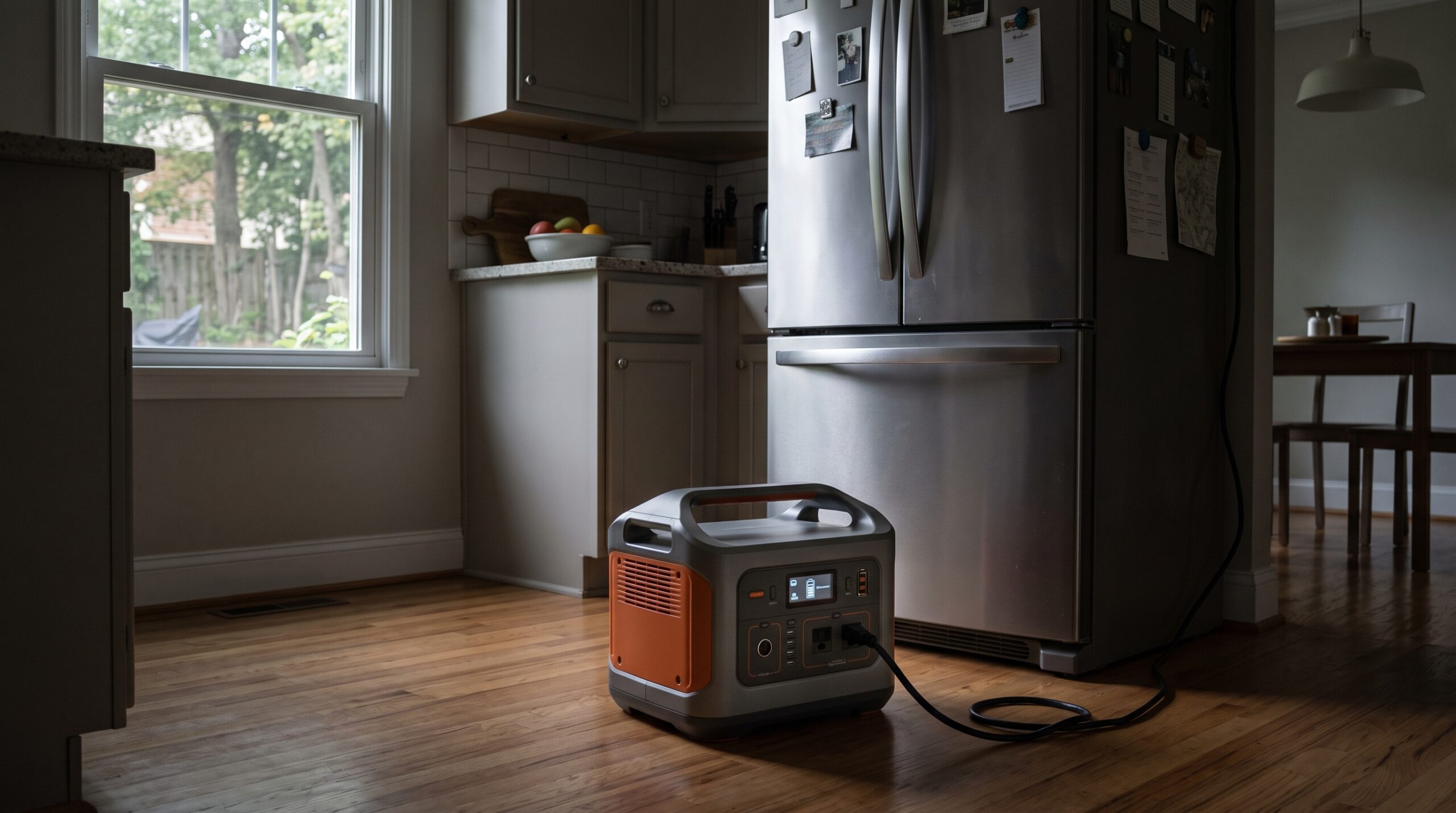
Short answer: when sizing a solar generator for refrigerator backup, use the refrigerator’s measured energy consumption and compressor starting demand rather than a universal runtime rule. A roughly 1kWh power station is a useful starting class for many household refrigerators, while ~2kWh gives substantially more energy and power margin. Actual runtime varies by appliance, ambient temperature, door opening, inverter losses and other connected loads.
Affiliate disclosure: This page contains affiliate links. If you purchase through these links, we may earn a commission at no additional cost to you. As an Amazon Associate I earn from qualifying purchases.
Our refrigerator backup picks
Two battery sizes for different backup needs. Check your refrigerator’s measured consumption and starting power before choosing.
PORTABLE ~1 kWh BACKUP
EcoFlow DELTA 3 Plus
1,024 Wh · 1,800 W AC
A starting option for refrigerator backup when the appliance’s measured demand fits.
Find it on Amazon →MORE CAPACITY & OUTPUT
EcoFlow DELTA 3 Max Plus
2,048 Wh · 3,000 W AC
More stored energy and inverter headroom for longer backup or additional essential loads.
Find it on Amazon →For preparedness, check two separate numbers: power (W), which determines whether the inverter can start and run the compressor, and energy (Wh/kWh), which determines runtime.
The runtime formula
A practical estimate is:
usable battery energy (Wh) ÷ refrigerator average consumption (W) = approximate runtime in hours.
If you know annual energy consumption instead, divide the appliance’s kWh/year figure by 365 to estimate an average kWh/day under the test conditions used for that label. ENERGY STAR notes that actual consumption varies with use, room temperature, door opening and how full the refrigerator is.
Example only: a refrigerator rated at 456 kWh/year averages about 1.25 kWh/day under the applicable test procedure. A nominal 1,024Wh battery therefore cannot be assumed to run it for a full day, especially after conversion losses. A more efficient refrigerator could run considerably longer.
Do not ignore compressor starting power
Refrigerators cycle rather than drawing their rated power continuously. The compressor can require more power when starting than while running. We do not use a universal “3×–4×” multiplier because starting behavior varies by compressor and appliance design.
The safest approach is to measure the refrigerator with an energy/power meter that captures its actual running and starting behavior, then choose a power station whose AC output and surge capability provide margin above the observed demand.
Two useful power-station classes
| Class | Example | Manufacturer capacity/output | Preparedness role |
|---|---|---|---|
| ~1kWh | EcoFlow DELTA 3 Plus | 1024Wh / 1800W AC | Portable refrigerator backup with capacity for smaller essential loads where measured demand fits. |
| ~2kWh | EcoFlow DELTA 3 Max Plus | 2048Wh / 3000W AC | More runtime and power margin for refrigerator backup plus additional essential household loads. |
These are battery and inverter specifications, not guaranteed refrigerator runtimes. The DELTA 3 Plus represents the portable ~1kWh class, while the DELTA 3 Max Plus doubles nominal battery capacity to 2048Wh and provides substantially greater AC output for larger backup loads.
Our picks by use case
Best ~1kWh Refrigerator Backup: EcoFlow DELTA 3 Plus
With 1024Wh of battery capacity and 1800W AC output, the DELTA 3 Plus is the logical starting point for a refrigerator backup system where the appliance’s measured starting and running demand fits within the station’s capabilities.
Its relatively compact capacity keeps the system portable while still providing enough stored energy to support a refrigerator and selected smaller essentials during shorter outages.
Best for More Runtime: EcoFlow DELTA 3 Max Plus
The DELTA 3 Max Plus moves into the ~2kWh class with 2048Wh of battery capacity and 3000W AC output. That makes it better suited to longer refrigerator backup, larger appliances and systems where several essential loads may need to operate from the same power station.
For home preparedness where portability is less important than stored energy and inverter headroom, this is the stronger option.
How to measure before buying
- Find the refrigerator’s annual kWh figure on its energy label or documentation.
- For a better real-world estimate, plug it into an energy meter for at least 24 hours; longer measurement captures more normal cycling.
- Record total Wh/kWh used and, where the meter supports it, peak/start power.
- Add the other loads you intend to run: router, lights, phone charging, medical devices or freezer.
- Allow margin for inverter losses and for battery capacity declining with age and conditions.
- Only then choose battery capacity, AC output and solar/recharging capacity.
Food safety still matters
A battery is not a substitute for monitoring food temperature. USDA guidance says an unopened refrigerator keeps food safely cold for about four hours during a power outage. A full freezer can hold temperature for about 48 hours, or about 24 hours when half full, if kept closed. Keep appliance thermometers in the refrigerator and freezer and minimize door opening.
This also means you may not need to run the refrigerator continuously from the instant an outage begins. Your strategy should preserve safe food temperature while conserving stored energy, based on actual thermometer readings and the appliance’s behavior—not an arbitrary fixed cycling schedule.
Solar changes the calculation
For multi-day outages, battery capacity alone is only half the system. Solar input determines how much energy you may be able to replace during daylight. A station with 1kWh of storage and inadequate generation can still be depleted after one or two poor charging days.
Compare the refrigerator’s measured daily Wh requirement with realistic daily solar production rather than assuming a solar panel will always “keep up.” Panel rating is a laboratory peak; weather, angle, temperature, shading and daylight hours reduce real production.
1kWh or 2kWh: Which should you choose?
Choose the DELTA 3 Plus when portability, lower system cost and refrigerator-focused backup are the priorities. For many efficient refrigerators, this is the class to evaluate first after measuring the appliance.
Choose the DELTA 3 Max Plus when you want substantially more stored energy, more inverter headroom or intend to power additional essential appliances alongside the refrigerator.
For preparedness, buying the largest battery you can afford is not automatically the best strategy. A properly measured load combined with adequate recharging capability produces a more resilient system than simply adding battery capacity.
Sources and methodology
- ENERGY STAR — certified residential refrigerators and annual energy-use data
- USDA FSIS — food safety during power outages
- EcoFlow — DELTA 3 Plus manufacturer specifications
- EcoFlow — DELTA 3 Max Plus manufacturer specifications
Product specifications above are manufacturer specifications. Runtime recommendations are our preparedness analysis and deliberately avoid guaranteeing a fixed number of hours for an unknown refrigerator.
Reviewed: September 2026. Product lineups, specifications and availability can change.