
Portuguese Prepper
Driveway Alarms: Perimeter Security & Early Warning
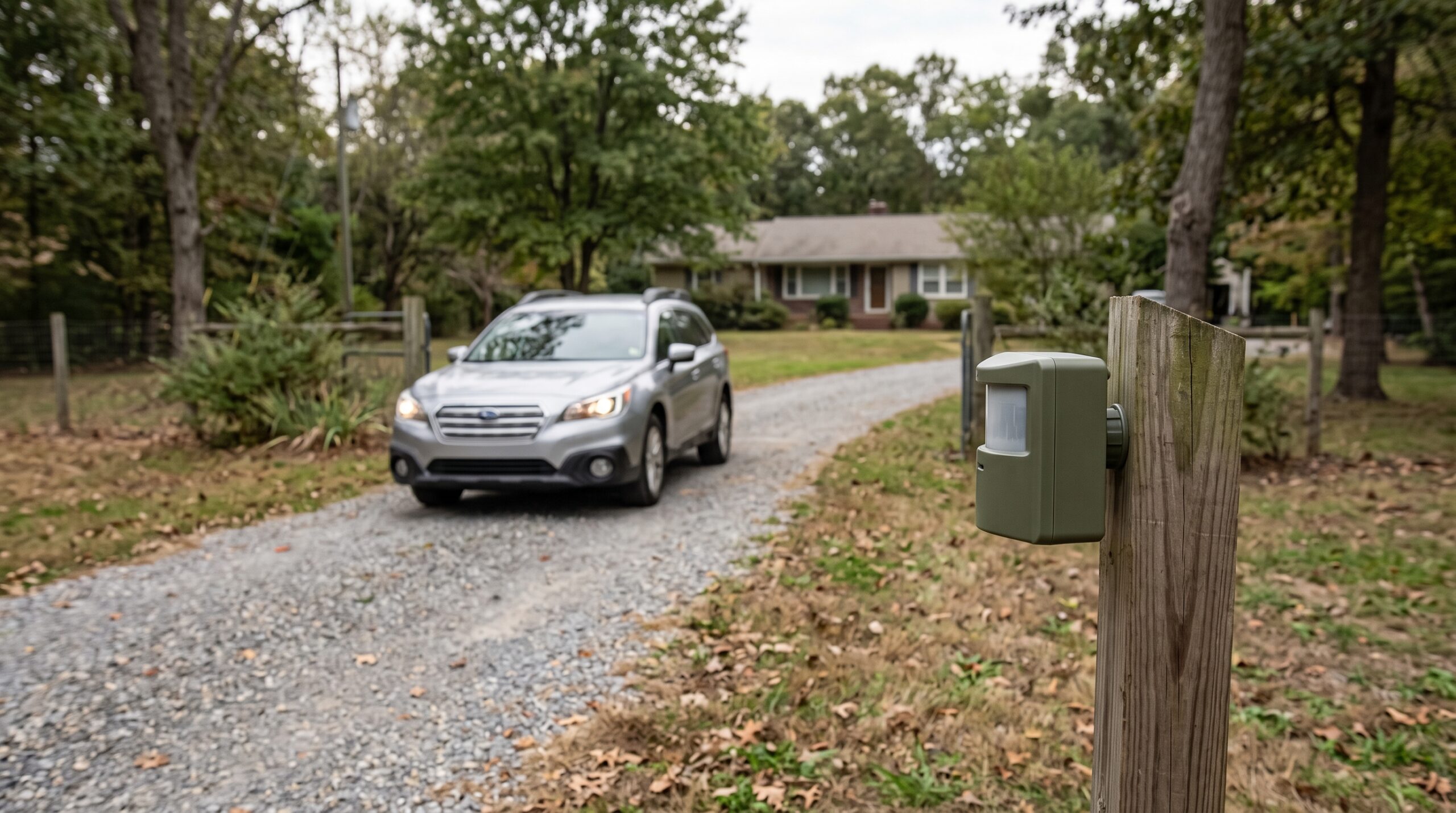
By the time someone reaches your door, your reaction window may already be very short. A driveway alarm can provide something extremely valuable in a home security or preparedness plan: early warning.
For rural properties, long driveways, detached buildings, farms, and larger lots, a sensor positioned well away from the house can alert you before a vehicle or person reaches the immediate area around your home. That extra warning time can be used to check cameras, turn on exterior lighting, secure doors, or assess what is approaching.
PIR vs. Magnetic Driveway Alarms
The most important decision is not the brand. It is the sensor technology.
Many inexpensive driveway alarms use PIR (Passive Infrared) sensors. PIR detects changes in infrared radiation associated with warm moving objects. This makes it useful when you want to detect people as well as vehicles, but animals and environmental conditions can sometimes produce unwanted alerts depending on sensor placement and sensitivity.
Magnetic vehicle probes solve a different problem. Instead of looking for heat or general motion, they detect disturbances associated with large metallic objects such as cars and trucks. This makes them particularly useful at gates and driveways where the objective is specifically to know when a vehicle enters the property.
A magnetic sensor will generally ignore pedestrians and animals, which can substantially reduce nuisance alerts compared with a motion sensor. The trade-off is equally important: if someone enters the property on foot, a vehicle-only magnetic sensor may not detect them.
Long-Range Option: Dakota Alert MURS
Dakota Alert is well known for long-range driveway and property-alert systems. Its MURS-based equipment is designed for applications where the sensor may be located much farther from the receiver than would be practical with many basic consumer driveway alarms.
For a rural entrance or long driveway, a magnetic probe can be positioned near the vehicle approach while the receiver remains inside the house or another occupied building. Actual wireless range will depend on terrain, vegetation, buildings, antenna placement, interference, and installation conditions.
Which Driveway Alarm Should You Choose?
Choose according to what you actually need to detect. A magnetic sensor is usually the better fit when vehicle detection and fewer animal-triggered alerts are the priority. A PIR system makes more sense when you also want warning of people approaching on foot.
Affiliate disclosure: This page contains affiliate links. If you purchase through these links, we may earn a commission at no additional cost to you.
A Layered Early-Warning Setup
For stronger perimeter awareness, do not rely on a single type of sensor.
Zone 1 — Driveway or Gate: Use a magnetic vehicle sensor to alert you when a car or truck enters the property.
Zone 2 — House Perimeter: Use PIR sensors, cameras, or other appropriate detection systems to identify movement closer to the house, including people approaching on foot.
Where supported by the system, different sensors or zones can use different receiver tones. This makes it easier to identify which part of the property generated the alert without immediately checking every sensor.
The alarm should also be treated as an early-warning layer rather than a complete security system. Combining perimeter detection with cameras, exterior lighting, reinforced entry points, and visible home deterrents and security signs creates multiple layers between the property boundary and the house.
Driveway Alarm FAQ
Are magnetic driveway alarms better than PIR alarms?
Neither technology is universally better. Magnetic sensors are preferable when you specifically want to detect vehicles while reducing alerts from animals and pedestrians. PIR sensors are preferable when you also need to detect people moving through the monitored area.
Will a driveway alarm work without WiFi?
Many dedicated driveway alarms do not require WiFi. The outdoor sensor communicates directly with a compatible receiver using its own radio system. This can make them useful for rural properties and preparedness applications where dependence on a home network is undesirable.
Can animals trigger a driveway alarm?
They can trigger PIR driveway alarms because PIR sensors respond to moving heat sources. A properly installed magnetic vehicle sensor is much less likely to be triggered by animals because it is designed to detect large metallic objects such as vehicles.
Where should a driveway alarm sensor be installed?
Placement depends on the sensor type and manufacturer instructions. Vehicle sensors are typically positioned beside or near the driveway where vehicles must pass, while PIR sensors need a clear detection area and should be positioned to reduce unwanted triggers from animals, vegetation, roads, or other sources of movement.