
Portuguese Prepper
Tactical Flashlights: Streamlight vs. SureFire
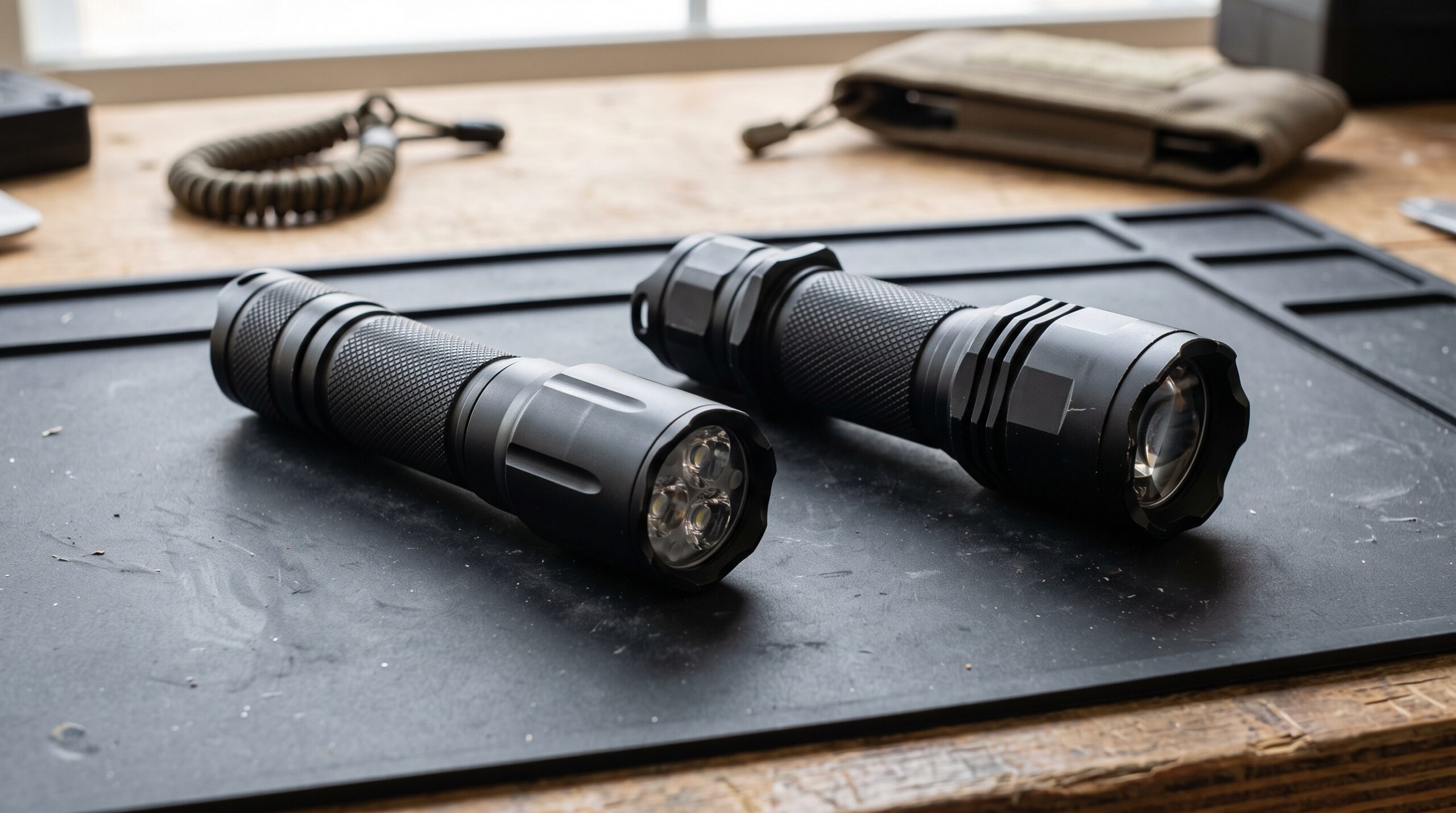
You cannot assess what you cannot see. During a power outage, security incident, or unexpected movement around your property at night, a reliable tactical flashlight gives you immediate illumination without depending on household power.
For defensive and preparedness use, brightness is only part of the equation. Beam intensity, runtime, battery compatibility, controls, durability, and reliability can matter just as much as the headline lumen figure.
Affiliate disclosure: This page contains affiliate links. If you purchase through these links, we may earn a commission at no additional cost to you.
Two of the best-known American flashlight manufacturers are Streamlight and SureFire. Both produce lights intended for demanding professional and personal use, but they approach performance, features, and price differently.
Streamlight vs. SureFire: The Main Difference
For most buyers, the comparison comes down to features and value versus simplicity and proven durability.
Streamlight generally offers strong output and useful features at comparatively accessible prices. SureFire has built much of its reputation around rugged, straightforward lights designed for demanding professional environments.
Neither approach is automatically better. The right choice depends on whether you prioritize output and features, simple controls, battery options, price, or maximum confidence in a proven design.
The Value Pick: Streamlight ProTac HL-X
The Streamlight ProTac HL-X is a popular high-output handheld flashlight that combines substantial light output with flexible controls and practical battery options.
Its combination of lumen output and beam intensity makes it suitable for illuminating rooms, yards, driveways, and other areas where both spill and useful distance matter.
Battery flexibility is particularly useful from a preparedness perspective. Depending on the specific HL-X configuration and compatible battery setup, having both rechargeable and disposable battery options can reduce dependence on a single charging method.
For long-term emergency storage, compatible primary lithium batteries can provide an additional power option. One example is this SureFire CR123A lithium battery 12-pack — Find it Here →.
Verdict: The ProTac HL-X is the stronger choice for buyers who want substantial output, flexible operation, and a good balance between performance and price.
The Simplicity Pick: SureFire G2X Tactical
SureFire has a long-standing reputation for producing rugged illumination equipment for demanding applications. The G2X Tactical takes a deliberately simple approach compared with feature-heavy rechargeable lights.
Its polymer body keeps weight down and is less thermally conductive than an all-metal flashlight body, which can be useful in very cold or hot conditions.
The straightforward interface is also part of the appeal. Instead of prioritizing numerous modes and electronic features, the G2X Tactical is designed around simple operation.
Verdict: Choose the G2X Tactical if simplicity, established design, and straightforward controls matter more to you than having the highest output or the largest feature set.
Which Tactical Flashlight Should You Choose?
Lumens vs. Candela: What Matters More?
A common mistake when choosing a tactical flashlight is comparing products using lumens alone.
Lumens describe total light output. Candela describe how intensely that light is concentrated in the brightest part of the beam. Two flashlights with similar lumen ratings can therefore perform very differently at distance.
For indoor use, a broad beam with useful spill can illuminate a room quickly. Outdoors, higher beam intensity can make it easier to identify objects farther down a driveway, across a yard, or around outbuildings.
For a general-purpose preparedness flashlight, the objective is usually a practical balance between usable output, beam intensity, runtime, and control rather than simply buying the light with the largest lumen number.
What Is a Photonic Barrier?
The term photonic barrier is sometimes used in flashlight training and marketing to describe the visual effect created when an intense beam is directed toward an observer in darkness.
A sufficiently bright and concentrated light can make it more difficult for someone looking toward the source to see detail behind or immediately around the beam. The effect depends on ambient light, distance, beam intensity, reflective surfaces, and the observer’s adaptation to darkness.
It should not be treated as a guaranteed method of incapacitating or controlling another person. From a preparedness perspective, the more important function of a powerful flashlight is simpler: identify what is happening before making a decision.
Tactical Flashlight FAQ
How many lumens should a tactical flashlight have?
There is no universal minimum. Several hundred lumens can provide substantial illumination, while higher-output lights can illuminate larger areas. Beam intensity, runtime, beam pattern, and intended use should be considered alongside lumens.
Is candela more important than lumens?
It depends on the application. Lumens describe total output, while candela indicate beam intensity. Higher candela becomes particularly useful when you need to illuminate objects at greater distances.
Are rechargeable tactical flashlights good for emergencies?
Yes, provided you have a reliable way to recharge them. For preparedness, battery flexibility can be valuable because it reduces dependence on one charging system or one battery type.
Streamlight or SureFire: which is better?
Streamlight is often attractive when price, output, and features are priorities. SureFire is commonly chosen by users who prioritize simple operation and rugged designs with a long professional track record. The better choice depends on the specific model and intended use.
Should a flashlight be part of a home emergency kit?
Yes. A dependable handheld flashlight is useful during blackouts, evacuations, severe weather, equipment failures, and nighttime security incidents. A headlamp is also worth keeping because it provides hands-free illumination for repairs and other tasks.