
Home Deterrence & Psychology
Do Fake Security Signs and Deterrents Actually Work?
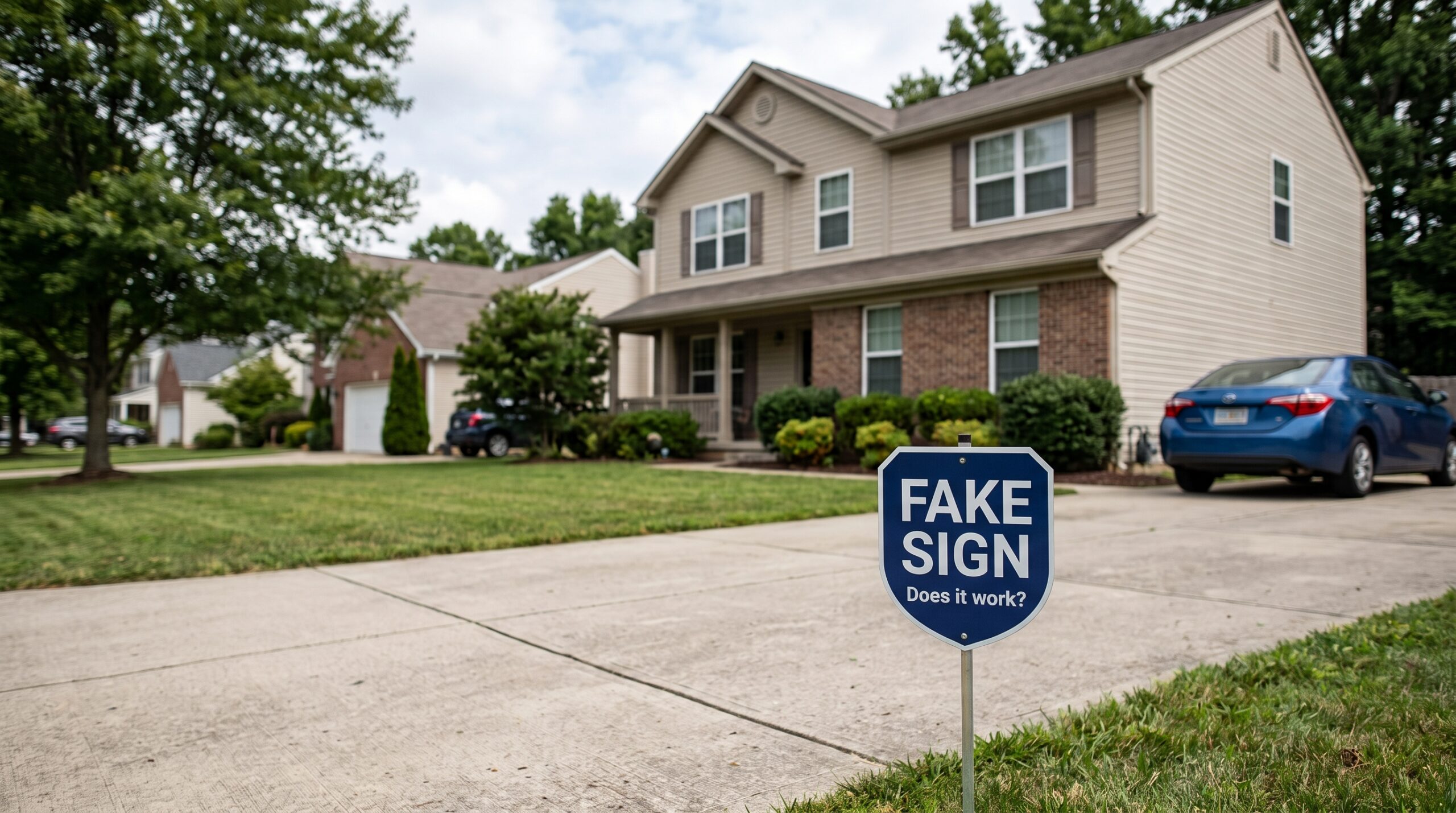
Home security begins before someone touches a door or window. Potential intruders may evaluate a property according to its apparent reward, effort, visibility, occupancy, and risk of detection. Visible security cues can therefore influence whether an opportunistic offender decides that a particular home is worth approaching.
Yard signs, window decals, simulated occupancy devices, lighting, cameras, and other visible measures are commonly used as inexpensive deterrents. But there is an important distinction between creating uncertainty and actually having a functioning security system.
What Research Says About Alarm Deterrence
One frequently cited study of burglar decision-making is Understanding Decisions to Burglarize from the Offender’s Perspective, a 2013 research project led by Dr. Joseph B. Kuhns at the University of North Carolina at Charlotte.
The study surveyed 422 incarcerated burglars in North Carolina, Kentucky, and Ohio and examined factors offenders reported considering when selecting targets.
- Alarm Evaluation: Approximately 83% of respondents indicated that they would attempt to determine whether an alarm was present before attempting a burglary.
- Alternative Targets: Approximately 60% indicated that they would seek another target if they discovered an alarm system.
- Discovery During Entry: Among respondents who encountered an alarm after beginning a burglary attempt, approximately half reported that they would discontinue the attempt.
The important limitation: These findings support the deterrent value of perceived alarm protection, but they do not demonstrate that an inexpensive fake yard sign by itself produces the same effect as a credible, functioning security system.
A sign is therefore better understood as a risk signal rather than a substitute for actual security.
Can Burglars Recognize Fake Security Signs?
A generic security sign may introduce uncertainty for someone quickly evaluating a property. However, its credibility depends partly on whether the rest of the property supports the message.
A warning sign surrounded by obvious security measures is more plausible than the same sign on a dark property with visibly weak doors and no other indication of monitoring or occupancy.
- Generic Signage: Generic signs avoid claiming that a particular commercial monitoring service is installed when it is not.
- Condition Matters: A badly faded, damaged, or obviously neglected security sign may communicate that the security setup itself is outdated or unattended.
- Supporting Measures: Exterior lighting, real cameras, maintained doors and windows, visible alarm hardware where applicable, and other security measures can make the overall deterrence message more credible.
- Obvious Dummy Cameras: Highly unrealistic fake cameras may provide little deterrent value if they are easily recognized as non-functional devices.
Should You Use Fake ADT, Vivint, or Other Branded Signs?
Using unauthorized signs displaying the branding of a security company is different from using generic warning signage.
1. Trademark and Misrepresentation
Company names and logos can be protected trademarks. Purchasing or displaying counterfeit branded security signage may therefore create intellectual-property or misrepresentation issues depending on the circumstances and jurisdiction.
A simpler approach is to use generic security signage that communicates surveillance, alarms, restricted access, or another appropriate warning without copying a company’s branding.
2. Avoid Advertising Unnecessary Details
Even when a genuine security system is installed, there is usually little reason to advertise unnecessary technical information about its configuration.
Generic wording can communicate that a property is monitored or protected without identifying equipment models, communication methods, sensor locations, or other system details.
Low-Cost Home Deterrents Worth Considering
If the budget is limited, focus on measures that increase the apparent risk of detection or suggest that a property may be occupied.
1. Simulated Occupancy
Occupancy cues can make it harder for someone outside the home to determine whether the property is empty.
A TV simulator uses changing light patterns to imitate some of the visual characteristics of a television operating inside a room. When used behind suitable curtains or blinds, the changing illumination may create an occupancy cue without leaving an actual television running.
Timers or smart controls for ordinary interior lighting can provide another option. Varying lighting patterns are generally more convincing than leaving the same lamp continuously illuminated for several days.
2. Dog Warning Signs
A dog can introduce uncertainty because an intruder may not know the animal’s size, location, behavior, or whether barking will alert occupants or neighbors.
A Beware of Dog sign may therefore function as another low-cost deterrence cue, but it should not be treated as evidence that a property is actually protected by a dog or as a substitute for physical security.
3. Real Cameras Instead of Dummy Cameras
If your budget permits, a functioning camera provides substantially more utility than a plastic dummy because it can potentially provide real detection, notifications, recordings, and evidence in addition to its visible deterrence value.
For properties where power or wiring is difficult, battery-powered or solar-assisted cameras may provide practical alternatives depending on connectivity, climate, placement, and charging conditions.
Deterrence Is Not Physical Security
The most important distinction is simple: a deterrent is an informational or psychological layer, not a physical barrier.
A yard sign cannot reinforce a weak door frame. A decal cannot prevent a window from breaking. Simulated occupancy does not notify you when someone actually enters the property.
The danger is not using inexpensive deterrents. The danger is allowing them to create a false sense of security while more important vulnerabilities remain unaddressed.
Build Home Security in Layers
A more resilient approach combines several different functions rather than expecting one product to solve the entire problem.
- Deter: Maintained property boundaries, appropriate warning signs, exterior lighting, visible cameras, and believable occupancy cues.
- Detect: Driveway alarms, door and window sensors, motion detection, cameras, and other early-warning systems.
- Delay: Reinforced door frames, quality locks, appropriate window-security measures, and other physical barriers.
- Respond: A household plan for moving away from the threatened area, contacting emergency services, and communicating with other occupants.
- Evacuate: Alternative escape routes when remaining inside becomes more dangerous than leaving.
The objective is not to make a home theoretically impenetrable. It is to increase uncertainty and risk for an intruder, detect activity earlier, slow unauthorized entry, and provide occupants with more time to respond appropriately.
Home Deterrent Equipment & Options
Affiliate disclosure: This page contains affiliate links. If you purchase through these links, we may earn a commission at no additional cost to you.
Fake Security Signs FAQ
Do fake security signs actually deter burglars?
They may influence some opportunistic offenders by introducing uncertainty about alarms, cameras, or monitoring. However, research supporting alarm deterrence should not be interpreted as proof that a fake sign alone provides the same deterrent effect as a functioning security system.
Do burglars avoid homes with alarm signs?
Research involving convicted burglars indicates that the presence of an alarm can influence target selection. Visible signs may communicate that possibility, but their credibility and effect will vary according to the property and offender.
Should I use a fake ADT or other branded security sign?
Generic signage is generally the cleaner option if you do not actually use the advertised company. It avoids counterfeit branding and communicates a security warning without unnecessarily identifying a particular commercial system.
Are fake security cameras worth using?
A convincing dummy camera may provide some visual deterrence, but a functioning camera can provide actual detection, notifications, recordings, and evidence. Where the cost difference is manageable, a real camera generally provides greater practical value.
Does a “Beware of Dog” sign work if I do not have a dog?
The sign may introduce uncertainty, but there is no guarantee that an intruder will believe it. It should be considered a supplementary deterrence cue rather than a substitute for an alarm, camera, reinforced entry point, or other real security measure.
What is the best low-cost home security deterrent?
There is no single best deterrent. A combination of maintained exterior lighting, credible occupancy cues, visible real cameras or sensors where practical, appropriate warning signage, and basic physical reinforcement generally provides a more credible security posture than any one inexpensive device.
Sources and Criminological Research
- Joseph B. Kuhns et al., University of North Carolina at Charlotte: Understanding Decisions to Burglarize from the Offender’s Perspective (2013).
- Crime Prevention Through Environmental Design (CPTED): Environmental design principles relevant to visibility, territorial reinforcement, access control, and perceived risk.