
Portuguese Prepper
Food-Grade Buckets & Gamma Lids: How to Use Them Safely
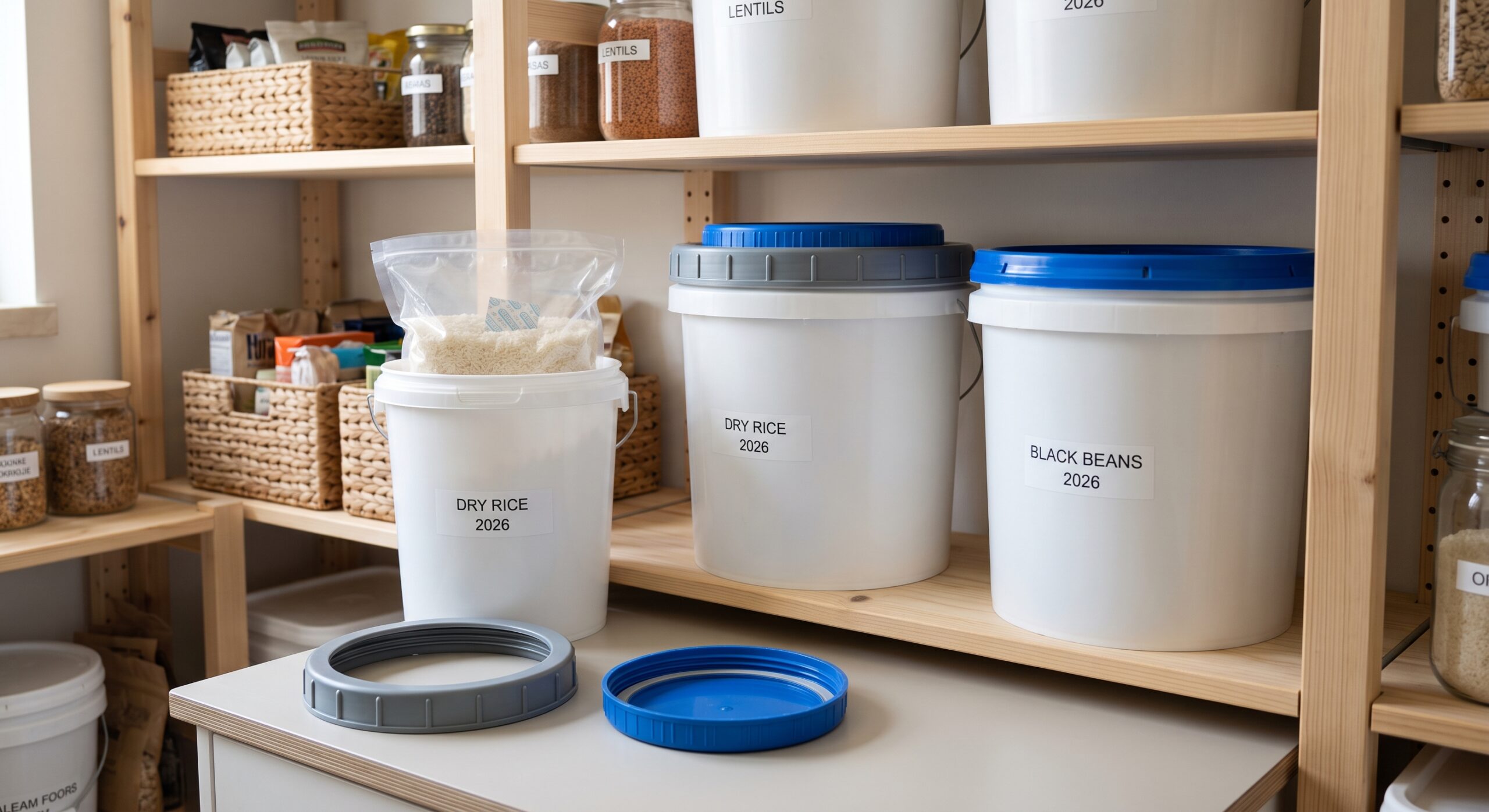
Short answer: use a food-grade bucket as a durable outer container for bulk dry food or sealed inner pouches. A standard gasketed lid is appropriate for food you rarely open; a gamma-style screw lid is more convenient for supplies you access and rotate. For very long dry-food storage, the bucket is usually the protective shell rather than the best oxygen barrier by itself.
Affiliate disclosure: This page contains affiliate links. If you purchase through these links, we may earn a commission at no additional cost to you.
Food-grade bucket vs. long-term barrier package
Utah State University Extension distinguishes between the outer container and the package that protects the food from oxygen and moisture. Food-grade buckets are durable and practical, but plastic is not completely impervious to gases. For long-term dry storage, foil-type pouches are a stronger barrier and can be placed inside the bucket for physical protection.
For a rotating pantry—rice, flour, oats or other foods you open regularly—the bucket itself may be used more directly, provided the food and storage method are appropriate and the container is kept clean and dry.
Standard lid vs. gamma-style lid
| Lid type | Best use | Tradeoff |
|---|---|---|
| Conventional snap lid with gasket | Infrequently opened storage | Can be harder to remove repeatedly |
| Gamma-style screw lid | Rotating pantry and frequent access | More parts and usually higher cost |
A gamma-style lid uses an outer ring attached to the bucket and a threaded removable center. That can make repeated access easier without prying off the entire lid each time.
Current storage components
5-Gallon Food-Grade Buckets
A practical rigid outer container for bulk dry food or sealed inner pouches. Verify the current product is explicitly intended for food contact.
View on AmazonGamma-Style Seal Lids
Useful when you expect to open a bucket regularly. Check diameter and bucket compatibility before ordering.
View on AmazonBucket Wrench
A simple tool for removing conventional snap-on lids with less prying and damage. Keep it where the buckets are stored.
View on AmazonA practical two-layer system
- Choose a suitable dry food and decide whether it will be rotated regularly or stored for a longer period.
- For long storage, seal appropriate dry food in a foil-laminate pouch using the correct oxygen-control method.
- Place the sealed pouch in a clean food-grade bucket for physical protection.
- Use a lid appropriate to access frequency.
- Label the outside with contents, packing date and package sizes inside.
- Store off the floor in a cool, dry location away from chemicals and pests.
Common mistakes
Do not assume every white plastic bucket is food grade. Do not place moist foods into oxygen-reduced long-term storage. Do not store food where the container can absorb or be exposed to fuel, pesticides or other chemicals. And do not build a multi-year food plan around sealed buckets you never inspect or know how to use.
Sources reviewed: Utah State University Extension food-storage packaging guidance. Reviewed: September 2026.