
Portuguese Prepper
Apartment Food Storage: How to Store 3 Months of Food in a Small Space
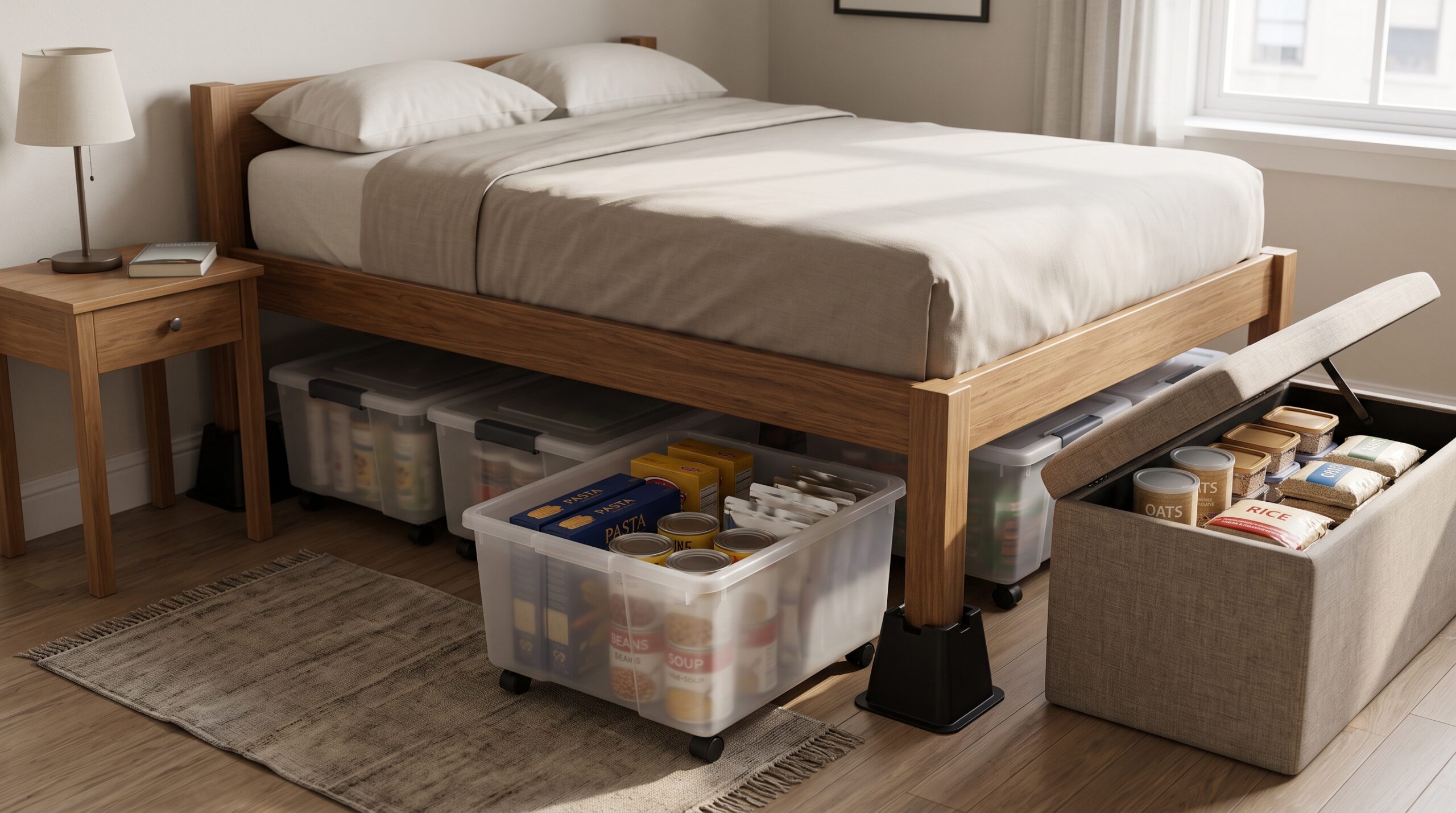
Short answer: you do not need a basement, garage, or dedicated pantry to build a meaningful emergency food supply. In a small apartment, the most effective strategy is to distribute shelf-stable food across unused spaces such as under the bed, inside closets, and in storage furniture.
Affiliate disclosure: This page contains affiliate links. If you purchase through these links, we may earn a commission at no additional cost to you.
Instead of trying to find one large storage area, think in terms of decentralized food storage: several smaller caches that together form your emergency pantry. The exact amount you can store will depend on your available space, household size, food choices, calorie requirements, and how much of your normal pantry you rotate through.
Can You Store 3 Months of Emergency Food in an Apartment?
Potentially, yes—but there is no universal amount of space required for a three-month food supply. A compact supply built around calorie-dense staples, canned foods, and freeze-dried products can occupy considerably less space than three months of normal grocery shopping.
Before buying storage equipment, determine how much food your household actually needs. Then measure the spaces available under beds, on closet floors and shelves, above cabinets, and inside furniture. This prevents you from buying containers that do not fit your apartment.
1. Build an Under-Bed Emergency Pantry
The area beneath a bed is often one of the largest unused storage spaces in a small home. If your bed frame has insufficient clearance, bed risers can create additional usable height without taking up more floor space.
Before using risers, verify that they are compatible with your bed or furniture legs and stay within the manufacturer’s stated load limits. Raising a bed changes its height and potentially its stability, so the highest riser is not automatically the best choice.
Low-profile containers can then hold canned food, sealed dry goods, Mylar-packed staples, or commercially packaged emergency food. Containers with lids help protect packaged food from dust and make rotation easier.
2. Use Shelf-Stable and Space-Efficient Foods
The best apartment emergency foods are not necessarily specialized survival foods. Rice, beans, pasta, canned proteins, canned vegetables, nut butters, shelf-stable staples, and other foods your household normally consumes can form the core of the supply.
Freeze-dried food can complement that pantry because it is relatively lightweight and shelf-stable. Larger cans can make sense for a home-based emergency supply, although they may be less convenient once opened than individually portioned packages.
Whatever foods you choose, follow the manufacturer’s storage instructions and monitor package condition and expiration or best-by dates. A rotating pantry is generally more practical than buying food and forgetting about it for years.
3. Use Closets Vertically
Apartment storage is as much a vertical-space problem as a floor-space problem. Closet floors, upper shelves, and unused gaps between existing items can often accommodate food without affecting everyday living areas.
Keep heavier items low rather than placing them on high shelves. Avoid overloading shelving, and do not block electrical panels, ventilation, emergency exits, fire-safety equipment, or other areas that must remain accessible.
4. Hide Food Storage Inside Furniture
When dedicated storage space is exhausted, furniture with built-in storage can serve two purposes. Storage ottomans, benches, and similar furniture can hold lightweight packaged foods while remaining part of the normal living space.
Always respect the furniture manufacturer’s stated storage and seating limits. Heavy bulk staples can add substantial weight quickly, so do not assume an ottoman or bench can safely hold any quantity of rice, beans, or canned food.
Useful Apartment Food Storage Gear
ANNKUT Heavy-Duty Bed Risers
A practical option for creating additional storage clearance beneath compatible beds and furniture. Measure your existing clearance and check the manufacturer’s dimensions and load specifications before ordering.
View on AmazonTsinglax Rolling Under-Bed Storage Bins
Rolling containers make an under-bed pantry easier to access and rotate than loose cans or packages stored directly beneath furniture.
View on AmazonSONGMICS Folding Storage Ottoman
Dual-purpose furniture can provide additional concealed storage when closet and under-bed space is limited. Check its dimensions and stated capacity before loading it with food.
View on AmazonMountain House Freeze-Dried Ground Beef #10 Can
A large-format freeze-dried food option for a home emergency pantry. Compare serving information, preparation requirements, package size, and current shelf-life guidance with your household’s actual needs.
View on AmazonTemperature, Humidity, and Light Matter
One advantage of storing emergency food inside your living space is that indoor temperatures are often more stable than those in garages, sheds, or vehicles. Heat, moisture, direct sunlight, pests, and damaged packaging can all reduce storage quality.
Choose cool, dry locations away from direct sunlight, plumbing leaks, heaters, ovens, and other heat sources. Follow the storage instructions for each food rather than assuming every shelf-stable product has the same storage life.
Do Not Forget Water
A three-month food supply is only useful if you also have a realistic water plan. Dry staples and freeze-dried foods may require substantial water for preparation, which becomes particularly important during a utility outage.
In an apartment, permanent water storage is usually more space- and weight-constrained than food storage. Plan the two together rather than calculating your food supply in isolation.
A Simple Apartment Food Storage Strategy
- Calculate your needs: determine how many people you are preparing for and how long you want the supply to last.
- Inventory existing food: count your normal pantry before buying dedicated emergency food.
- Measure unused spaces: check under beds, closets, shelving, cabinets, and storage furniture.
- Prioritize foods you already eat: this makes rotation easier and reduces waste.
- Add compact long-term foods selectively: use freeze-dried or specially packaged foods where their storage efficiency provides a real advantage.
- Label and rotate: keep older food accessible so it gets consumed first.
- Plan water simultaneously: include the water required to prepare stored dry foods.