
Portuguese Prepper
Mountain House vs. Augason Farms: Which Is Better for Emergency Food Storage?
Quick answer: Mountain House is usually the better fit for convenient, ready-to-prepare meals; Augason Farms is often better for a flexible pantry with a wider range of ingredients and staples. Compare the exact products by calories, preparation, water and fuel needs, ingredients, price, and product-specific shelf life before choosing.
Affiliate disclosure: This page contains affiliate links. If you purchase through these links, we may earn a commission at no additional cost to you.
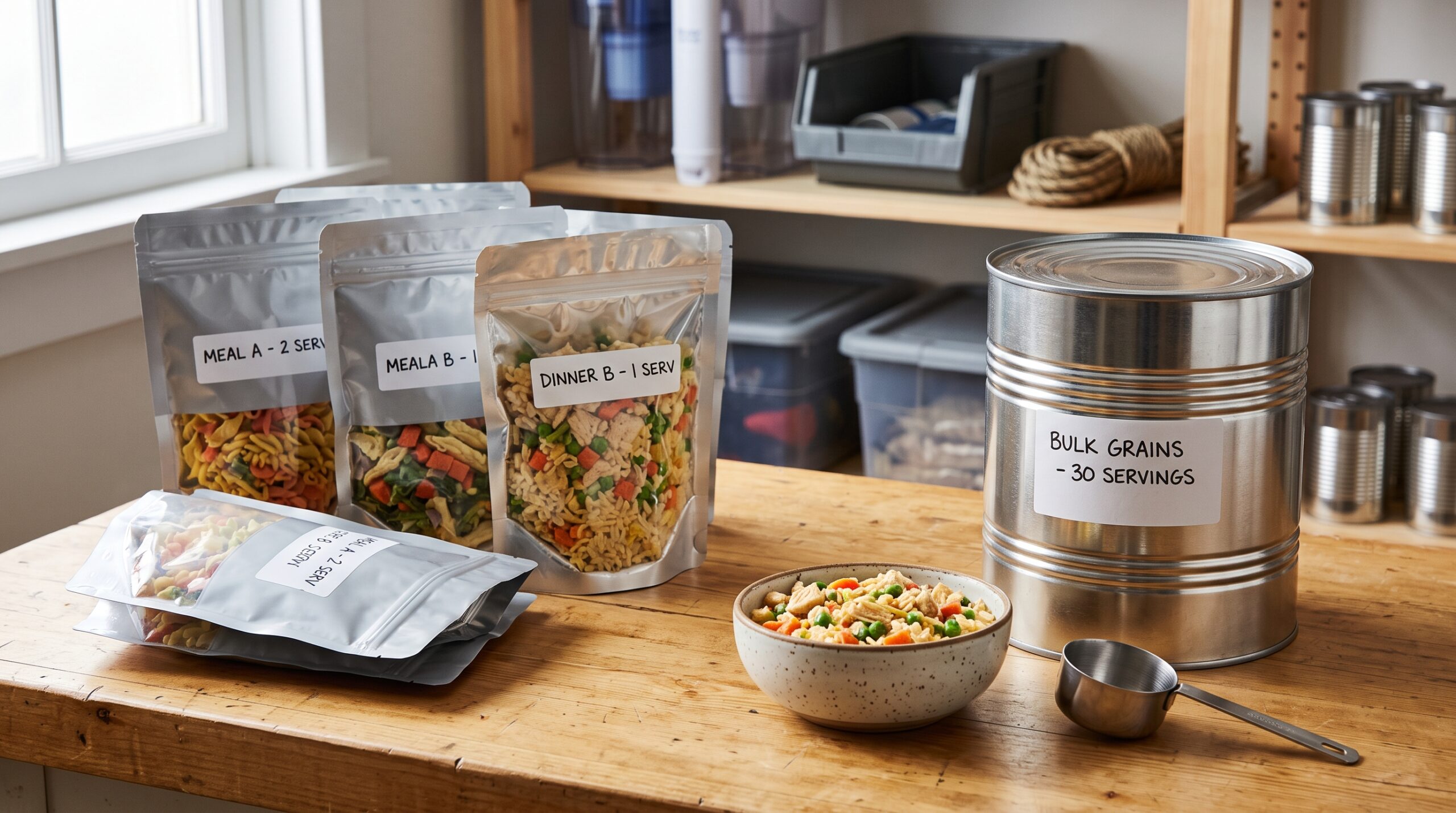
Mountain House and Augason Farms can both play useful roles in an emergency food supply, but they are not direct substitutes for each other. Mountain House focuses heavily on complete freeze-dried meals designed for simple preparation, while Augason Farms offers a broader mix of emergency meals, ingredients, staples, fruits, vegetables, dairy products, and other pantry foods.
For many households, the better strategy is not choosing one brand exclusively. Mountain House can make sense when convenience and simple meal preparation matter most, while Augason Farms can be useful for building a larger and more flexible long-term pantry.
Mountain House vs. Augason Farms: The Short Answer
If your priority is simple emergency meals with minimal preparation, Mountain House has a strong advantage. Its emergency meals are designed around rehydrating prepared dishes rather than assembling meals from separate pantry ingredients.
If your priority is building a broader long-term pantry, Augason Farms offers more flexibility. Its catalog includes complete emergency foods as well as individual ingredients and staples that can be incorporated into everyday recipes or longer-term meal planning.
Neither approach is automatically better. The right choice depends on the emergency you are preparing for, how much cooking capability you expect to have, how many calories you need, and whether you want ready-made meals or ingredients for a deeper pantry.
Which Brand Belongs in Your Pantry?
Mountain House: Best for Convenience
Mountain House specializes in freeze-dried prepared meals. Instead of storing separate ingredients and planning a recipe during an outage, you rehydrate a meal and wait for it to become ready to eat.
This makes Mountain House particularly useful for short-term emergencies, evacuation kits, camping, and situations where reducing preparation and cleanup is valuable. Hot water provides the fastest preparation, although some Mountain House meals can also be rehydrated using cold or room-temperature water with a longer waiting time.
The tradeoff is flexibility. You are buying a prepared meal rather than individual pantry components, so you have less control over ingredients, portion composition, and how the food is incorporated into other recipes.
Augason Farms: Best for a Flexible Deep Pantry
Augason Farms offers a much broader range of long-term food-storage products. Depending on the product, this can include emergency meals, powdered dairy and eggs, grains, fruits, vegetables, proteins, baking ingredients, and other pantry staples.
That flexibility is useful when preparing for longer disruptions because individual ingredients can be combined into different meals instead of relying entirely on preconfigured entrées.
Preparation requirements vary substantially, however. Some Augason Farms foods require cooking or additional ingredients, while others can be rehydrated or eaten with relatively little preparation. Check the instructions for the specific product rather than assuming every Augason Farms item requires the same amount of water, fuel, or cooking.
Shelf Life: Don’t Assume Every Product Lasts 30 Years
Shelf-life claims need to be compared at the product level.
Mountain House states that most of its freeze-dried meals in pouches, emergency kits, buckets, and #10 cans have a 30-year shelf life and taste guarantee from the date of manufacture when stored according to its guidelines. Some products are exceptions.
Augason Farms states that many of its emergency food products can last approximately 20 to 30 years under ideal storage conditions, but there are important exceptions. Products containing ingredients such as eggs or oils may have shorter shelf lives, and some products are rated for considerably less.
For either brand, use the shelf-life information printed for the exact product you are buying rather than assuming that every pouch, can, or bucket has the same lifespan.
Calories Matter More Than “Servings”
Emergency food is often marketed by the number of servings in a package, but a serving is not necessarily a complete meal or a full meal’s worth of calories.
When comparing Mountain House, Augason Farms, or any other emergency food brand, look at the nutrition label and calculate how many total calories the package actually provides.
For longer-term planning, total calories, protein, nutritional variety, water requirements, and preparation requirements are more useful than a large serving count printed on the front of a bucket.
A simple way to compare value is to divide the purchase price by the total calories in the package. This gives you a more meaningful comparison than price per advertised serving.
Preparation, Water, and Fuel
Long-term food storage is only useful if you can actually prepare the food during the emergency you are planning for.
Mountain House is designed around simple rehydration, making it attractive when you want to minimize cooking. Augason Farms preparation varies by product: some foods are simple to rehydrate, while pantry ingredients may require additional cooking, water, fuel, or other ingredients.
Before buying a large emergency food supply, calculate not only how much food you need but also how much water and cooking capability your chosen foods require.
If you expect to rely on freeze-dried food during a blackout, make sure your preparedness plan includes a safe way to heat water. See our Indoor Emergency Cooking guide below for more on backup cooking options and carbon monoxide safety.
Which Is Better for a 72-Hour Emergency Kit?
For a short emergency, Mountain House is generally the more convenient fit because complete meals reduce the amount of meal planning and preparation required.
However, a 72-hour food supply should not consist exclusively of foods that require rehydration. Include some foods that can be eaten without cooking in case water, fuel, or backup power becomes limited.
Which Is Better for Long-Term Food Storage?
For a deep pantry intended to support a household for weeks or months, Augason Farms can offer greater flexibility because you can combine individual ingredients, staples, and emergency foods into a broader meal plan.
That does not mean Mountain House has no place in long-term storage. Ready-to-prepare meals can be valuable on days when fuel, time, or the ability to cook from scratch is limited.
For many households, a mixed strategy is more resilient: keep convenient complete meals alongside ingredients and foods you already know how to use.
A Note on “#10 Cans”
Both brands use #10 cans for selected products, but the contents and post-opening storage guidance are not the same.
Mountain House #10 cans typically contain prepared freeze-dried meals in loose form. Mountain House recommends using the dry contents soon after opening and indicates that properly resealed contents can remain acceptable for up to approximately one week.
Augason Farms uses #10 cans for many different foods and ingredients. Its general guidance is to keep opened dry food tightly sealed in a cool, dry location and use it within approximately one year, while following any product-specific instructions.
The decades-long shelf life advertised for long-term emergency food applies to unopened products stored under the appropriate conditions. Once the container is opened, air and moisture change the storage environment significantly.
The Bottom Line
For most preppers, Mountain House vs. Augason Farms does not need to be an either-or decision.
Choose Mountain House when convenient, complete meals and minimal preparation are the priority. Consider Augason Farms when you want a broader pantry built from a mixture of emergency foods, ingredients, and staples.
Whichever brand you choose, compare the exact products by total calories, nutrition, shelf life, water requirements, preparation requirements, and cost — not simply by the number of servings printed on the package.