
Portuguese Prepper
MREs vs. freeze-dried food: which belongs in your emergency kit?
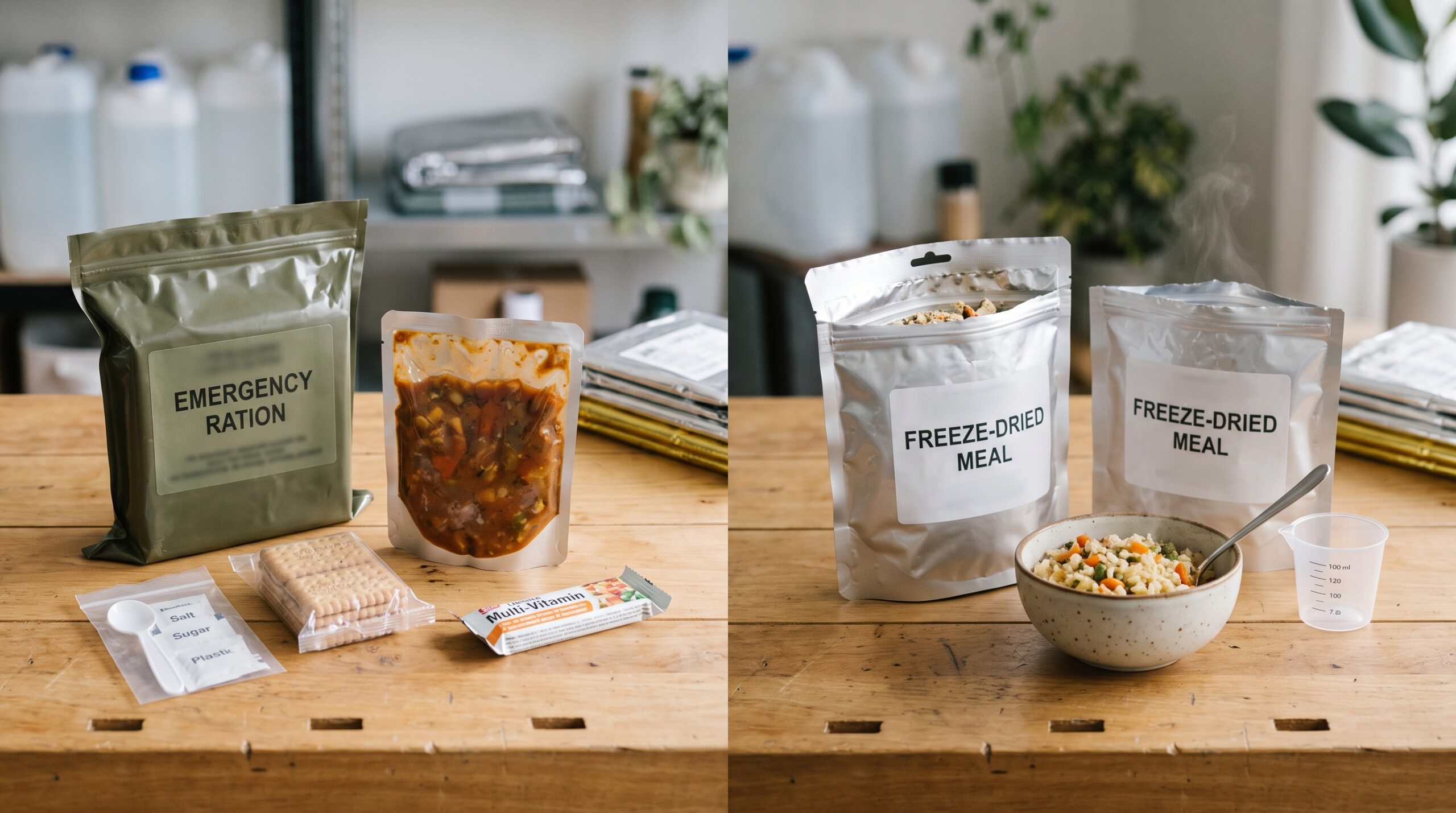
Short answer: MRE-style meals are strongest when you need food that is already hydrated and can be eaten without cooking. Freeze-dried meals are much lighter and can offer far longer manufacturer-rated shelf life, but you must budget additional drinking-quality water for rehydration. A resilient emergency food plan often uses both rather than treating either format as universally superior.
Affiliate disclosure: This page contains affiliate links. If you purchase through these links, we may earn a commission at no additional cost to you.
MRE vs. freeze-dried: the decision table
| Factor | MRE-style meal | Freeze-dried meal |
|---|---|---|
| Water carried inside food | Yes; heavier to transport | Very little; lighter, but rehydration water must come from your supply |
| Can be eaten without heating? | Yes | Product-dependent. Many pre-cooked freeze-dried meals can rehydrate with cold water, but take longer |
| Best role | Vehicle, evacuation, short-duration no-cook use | Home storage, backpacking, longer-duration food reserve |
| Shelf-life planning | Highly temperature-dependent; genuine military MRE specifications use a 3-year benchmark at 80°F/27°C | Brand-dependent; Mountain House currently guarantees 30 years for most meals when properly stored |
| Main hidden resource | Storage space and carrying weight | Potable water; fuel/heat if you want a hot meal |
The case for MREs: food when cooking is inconvenient
A Meal, Ready-to-Eat is designed to be eaten without a kitchen. That makes the format useful during evacuation, travel, power cuts and other situations where stopping to cook is impractical. A heater may be included with some complete ration packs, but the food itself does not depend on that heater to be edible.
The tradeoff is mass and bulk. Because the food is already hydrated, you carry that water inside the ration. This is useful when your water supply is uncertain, but inefficient when every kilogram in a backpack matters.
Do not use a universal 5–7 year rule for military MREs. U.S. Defense Logistics Agency documentation uses a minimum shelf-life benchmark of three years at 80°F (27°C), with much shorter performance at high temperatures. Storage history matters enormously, which is one reason surplus MREs of unknown age and storage conditions deserve caution.
The case for freeze-dried food: low weight and long storage
Freeze-drying removes most of the water from cooked food. Mountain House states that its process removes about 98% of the water and currently gives most of its meals a 30-year shelf-life/taste guarantee when stored under its specified conditions.
That makes freeze-dried food attractive for a pantry reserve or a pack where weight matters. But the missing water has not disappeared from your preparedness calculation: you need to supply it later. For example, Mountain House states that its current 14-day emergency kit requires 56 cups, about 14 litres or 3.5 gallons, of water to rehydrate all 84 listed servings.
Hot water is convenient, not always mandatory. Mountain House says its pre-cooked meals can be rehydrated with cold water in a pinch, generally allowing about twice as much time. Always follow the directions on the specific meal.
The water-budget problem
The most important preparedness difference is not taste. It is where the water is stored. With an MRE, much of the meal’s water travels inside the package. With freeze-dried food, you carry a lighter meal but must obtain and treat the rehydration water separately.
Therefore, never build a freeze-dried food plan independently from your emergency-water plan. Add the manufacturer’s rehydration requirement to the water you already store for drinking, hygiene and any other cooking.
Vehicle storage changes the calculation
Vehicles can become extremely hot. That is particularly relevant to MRE-style rations because military shelf-life specifications are temperature-dependent. A ration that performs for years in controlled indoor storage should not automatically be expected to do the same after repeated summers in a hot car.
For a vehicle kit, rotate food more aggressively, inspect packaging and follow the actual manufacturer’s storage guidance. Do not treat a printed date as independent of storage conditions.
What should a preparedness pantry actually contain?
For a 72-hour evacuation kit: prioritize foods that require little or no preparation. MRE-style meals, ration bars and ordinary shelf-stable foods can reduce dependence on a stove and extra cooking water.
For home preparedness: freeze-dried food becomes more attractive because weight matters less and you can plan water and cooking systems together. It should still complement, not replace, ordinary foods your household already eats and rotates.
For a longer evacuation on foot: freeze-dried food saves substantial carried weight only if reliable safe water is available along the route. Where water is scarce, the weight advantage becomes less meaningful because the water must still come from somewhere.
Nutrition: compare labels, not categories
The old version of this guide characterized all MREs as extremely high-sodium, low-fibre 1,200+ calorie meals and freeze-dried food as inherently easier on the stomach. That is too broad. Nutrition varies substantially by ration, menu, serving size and brand.
For emergency planning, compare calories per package, protein, fibre, sodium, allergens and serving assumptions on the products you actually intend to store. Also test a small quantity before buying a long-term supply; an emergency is a poor time to discover that a household member dislikes or cannot tolerate a staple meal.
Our recommendation
Use MRE-style meals for immediacy and freeze-dried meals for weight-efficient longer storage. For most households, a mixed system is more robust: no-cook food covers the first hours or days of disruption, while freeze-dried and conventional pantry foods provide depth once water and cooking arrangements are stable.
Sources and methodology
This comparison separates military-ration specifications from commercial manufacturer claims. Shelf life is not treated as a universal property of a food category; packaging, product formulation and storage temperature matter.
- U.S. Defense Standardization Program / DLA — MRE design and shelf-life background
- Mountain House — preparation, storage and shelf-life FAQ
- Mountain House — 30-year shelf-life/taste guarantee and storage conditions
- Mountain House — 14-day kit water requirement
Reviewed: September 2026. Product formulations and manufacturer guarantees can change; verify the current package before relying on a stored food supply.