Portuguese Prepper
SAS Survival Handbook Review: Is It Still Worth Owning?
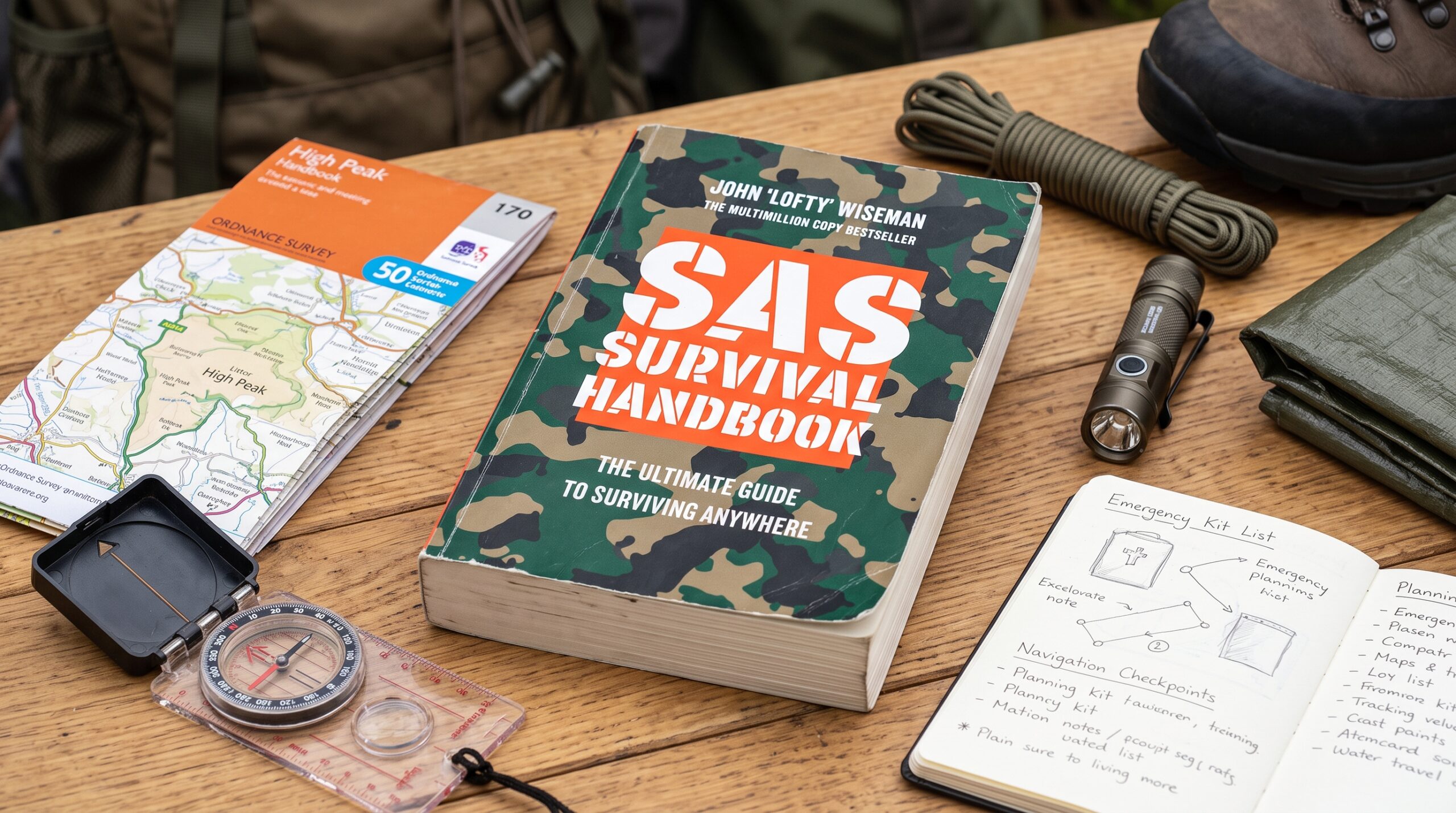
Short answer: John “Lofty” Wiseman’s SAS Survival Handbook remains a useful broad-reference survival manual, especially as an offline preparedness resource. We recommend it as a reference and training companion, not as “the only survival book you need” and not as a substitute for current medical, emergency-management or local civil-protection guidance.
Its main strength is breadth: shelter, fire, water, food, navigation, signaling, first aid and survival across different environments are collected in one volume. Its main weakness is the same breadth: a general survival manual cannot provide the depth, local rules or continually updated guidance available from specialist sources.
Who Is John “Lofty” Wiseman?
John “Lofty” Wiseman is a former member of Britain’s Special Air Service (SAS). Publisher information describes the SAS Survival Handbook as drawing on his military survival experience and bringing a wide range of survival techniques together in a single reference.
That background helps explain the handbook’s practical approach and unusually broad scope. It does not mean every technique should automatically take precedence over modern medical guidance, current emergency procedures, local laws or advice specific to the environment in which you expect to use it.
What Does the SAS Survival Handbook Cover?
The handbook is designed as a general survival reference rather than a specialist manual devoted to one subject. Its value comes from having many fundamental survival topics available in one physical book.
- Survival planning: preparation, priorities and survival mindset.
- Water: finding and managing water in survival situations.
- Food: obtaining and preparing food in different environments.
- Shelter: protection from environmental exposure.
- Fire: fire-making principles and techniques.
- Navigation: orientation and movement without depending entirely on electronic navigation.
- Signaling: methods for attracting rescuers and communicating your position.
- First aid: emergency medical concepts within a broader survival context.
- Environmental survival: techniques for different climates and terrain.
This breadth makes the book particularly useful as a starting point. It can show you which survival skills you understand and, more importantly, which ones require further training.
What the Book Does Well
1. It puts many core survival skills in one offline reference
A printed survival manual does not require electricity, mobile coverage, a charged phone or an internet connection. That gives it a role that even excellent digital resources cannot completely replace.
For preparedness, this makes the SAS Survival Handbook particularly useful on a home reference shelf, in a training environment or wherever you want important information available independently of electronic infrastructure.
2. Illustrations make practical information easier to revisit
The handbook uses diagrams and illustrations throughout. For subjects such as knots, shelter concepts, signaling and navigation, visual references can make procedures easier to understand and revisit than prose alone.
3. It works well as a survival-skills syllabus
You do not have to treat the handbook as something to read from beginning to end. Its breadth makes it useful as a training roadmap.
A section on navigation, water, shelter or first aid can expose a weakness in your preparedness and identify the next skill that deserves practice, specialist reading or formal training.
4. A physical copy remains useful during infrastructure failures
Offline information has particular value in emergency preparedness. Phones can run out of power, networks can become unavailable and cloud-based resources may be inaccessible precisely when you need them.
A physical reference book therefore provides redundancy rather than merely nostalgia for printed information.
Where the SAS Survival Handbook Has Limitations
Medical information can age
First-aid practice and medical recommendations change. Use the handbook to understand preparedness concepts, but learn safety-critical medical procedures through current recognized first-aid training and current health-authority guidance.
Local laws and environments differ
Advice involving trapping, wild plants, fire, weapons or land use may be inappropriate, unsafe or illegal in a particular jurisdiction. Always apply local regulations and current official guidance.
Reading is not competence
Knowing where a technique appears in a book is not the same as being able to perform it outdoors, in darkness, in poor weather or under stress.
A diagram of a fire lay, knot, shelter or navigation technique should therefore be treated as a reference for training—not evidence that the skill has been mastered.
Breadth inevitably limits depth
No single general survival handbook can cover wilderness medicine, land navigation, communications, food preservation, water treatment and every other preparedness discipline at specialist depth.
The better approach is to use the SAS Survival Handbook as a broad foundation and add specialist references for subjects that matter most to your preparedness plan.
SAS Survival Handbook: Best Uses
| Use | Our assessment |
|---|---|
| Home preparedness library | Excellent fit. Breadth and offline availability are major advantages. |
| Offline emergency reference | Strong fit. Requires no battery, network or internet connection. |
| Learning survival skills from zero | Good starting point. Use it as a syllabus and add hands-on practice. |
| Wilderness skills training | Useful companion. Practice the techniques before depending on them. |
| Medical reference | Secondary only. Use current first-aid training and medical guidance for safety-critical procedures. |
| Country-specific emergency planning | Supplement only. Follow current local authorities for hazards, evacuation and emergency procedures. |
| Ultralight bug-out bag | Situational. Consider the weight and size of the edition versus the skills you have already learned. |
Which SAS Survival Handbook Edition Should You Buy?
There have been multiple editions, formats and regional listings of Wiseman’s handbook. Check the exact title, ISBN, publication date, dimensions and contents of the copy you are considering rather than assuming every listing is identical.
For a home preparedness library, we generally prefer a complete physical edition with readable illustrations over the smallest possible format. Compact editions can make sense when portability is more important than comfortable reference use.
If buying used, verify that the listing is actually John “Lofty” Wiseman’s handbook and check the edition and condition. For emergency-reference purposes, completeness and legibility matter more than collectability.
Affiliate disclosure: This page contains affiliate links. If you purchase through these links, we may earn a commission at no additional cost to you.
SAS Survival Handbook
John “Lofty” Wiseman’s broad survival reference covering core subjects including shelter, water, food, navigation, signaling, first aid and survival techniques for different environments.
Our verdict: recommended as a physical, offline survival reference and training companion. It should form part of a preparedness library rather than being treated as a complete preparedness system by itself.
How to Get More Value From the SAS Survival Handbook
- Choose one skill at a time. Do not try to memorize the entire handbook.
- Study the relevant section. Understand the principles before attempting the technique.
- Practise under safe conditions. Learn when failure has no serious consequences.
- Repeat the skill without the book. Your objective is competence, not simply knowing where the instructions are.
- Compare safety-critical procedures with current authoritative guidance. This is particularly important for medicine, water safety and disaster response.
- Add local information. Keep emergency numbers, evacuation information, maps and jurisdiction-specific guidance with your preparedness library.
- Revisit skills periodically. Practical skills deteriorate when they are not used.
Is the SAS Survival Handbook Good for Preppers?
Yes—with the correct expectations. The handbook is particularly well suited to preparedness because it provides a large amount of practical information in a format that remains accessible without power or communications infrastructure.
Its strongest role is as one layer of a broader preparedness knowledge system: general handbook, specialist references, current official guidance and practical training.
For a new prepper building a physical reference library, the SAS Survival Handbook is therefore an easy book to justify. For an experienced outdoorsperson who already owns specialist manuals and has practised the underlying skills, its value is more as a consolidated backup reference.
Frequently Asked Questions
Is the SAS Survival Handbook still worth buying?
Yes. Its breadth and ability to function as a completely offline reference still make it useful. Some safety-critical information should be checked against current authoritative guidance, so it should not be your only preparedness reference.
Is the SAS Survival Handbook good for beginners?
Yes. Beginners can use its broad coverage to understand the major survival disciplines and identify skills that require additional study and practice. It is better used as a starting framework than as something to memorize.
Can the SAS Survival Handbook replace survival training?
No. Reading about navigation, shelter construction, fire making, water treatment or first aid does not establish practical competence. Skills should be practised safely before an emergency.
Should you buy a physical or digital copy?
For preparedness, we prefer a physical copy because it remains accessible without electricity, batteries, a functioning device or internet access. A digital edition can still be useful for everyday portability and searching.
Is the SAS Survival Handbook enough for emergency preparedness?
No. It is a broad survival manual, not a complete emergency-preparedness system. Supplement it with current official emergency guidance, first-aid training, local maps and specialist references relevant to the hazards you are preparing for.
Portugal-Specific Companion Sources
For readers in Portugal, pair any general survival manual with current information from Autoridade Nacional de Emergência e Proteção Civil and other relevant Portuguese authorities.
Official local sources are more appropriate for current wildfire warnings, civil-protection procedures, evacuation instructions and other location-specific public-safety information.
Sources and Review Methodology
Our assessment separates the handbook’s value as a broad offline survival reference from claims requiring current specialist guidance. We do not treat a survival manual as authoritative for every medical, legal or disaster-response procedure solely because of the author’s background or the book’s reputation.
- HarperCollins — SAS Survival Handbook publisher information
- Autoridade Nacional de Emergência e Proteção Civil (ANEPC)
Reviewed: September 2026. Check the publication details of the specific edition you are considering and use current authoritative sources for safety-critical guidance.